Trump Calls Zelensky ‘Courageous’ as Rutte Pushes to Keep Ukraine Armed
AI Analysis
Discussions between Trump, Rutte, and Zelensky highlight continued, though potentially shifting, Western support for Ukraine. A key mechanism for this support, the Prioritized Ukraine Requirements List (PURL), is facilitating arms procurement. Russia is closely monitoring these developments and views continued Western arms supply as a direct threat.
Key Takeaways
- Trump acknowledged Zelensky’s leadership and Ukraine’s battlefield performance, praising their 'courageous' fight.
- NATO Secretary General Rutte emphasized the need to replenish allied stockpiles due to the scale of support for Ukraine.
- The PURL mechanism allows European allies and Canada to fund US-made weapons for Ukraine, addressing both Ukrainian needs and US burden-sharing concerns.
- Russia is analyzing potential shifts in Trump’s posture towards the conflict following the G7 summit and views continued arms sales as escalatory.
- Ukraine’s battlefield success is a key argument for continued Western support, demonstrating Russia can be countered.
Why It Matters
Continued Western military aid, particularly air defense and long-range capabilities, is critical for Ukraine’s ability to resist Russian advances and potentially shift the momentum of the conflict. Russia’s reaction indicates they perceive PURL as a significant obstacle to their attrition strategy. The upcoming NATO summit will be pivotal in solidifying future support commitments.
US President Donald Trump offered a rare public acknowledgment of Ukraine’s battlefield prowess, saying President Volodymyr Zelensky is “doing pretty well” and “holding his own” against Russia.
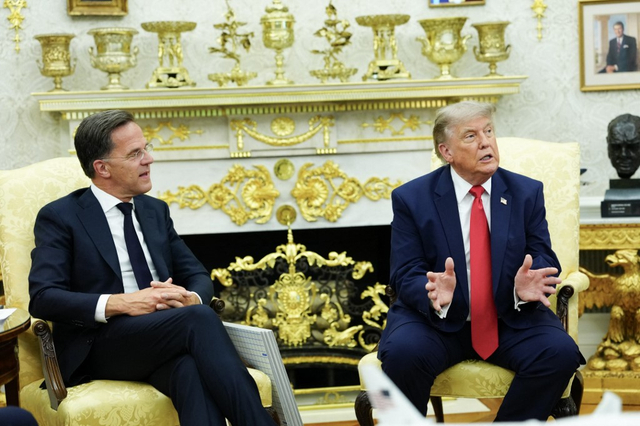
Speaking in the Oval Office alongside NATO Secretary General Mark Rutte on Wednesday, Trump stopped short of saying Kyiv is winning but praised Zelensky’s leadership and Ukrainian fighters.
Follow our coverage of the war on the @Kyivpost_official.
“You have to say he’s courageous,” Trump said of Zelensky. “He’s got great equipment. He’s got great men. He’s got fighters.”
Trump and Zelensky most recently met during the G7 summit in France, where leaders agreed to intensify pressure on Russia to end more than four years of war with Ukraine.
Trump came out of the meeting voicing a renewed interest in reimposing sanctions on Russian oil.
Rutte’s high-stakes visit to Washington came at a critical moment for Ukraine, as Kyiv urgently presses allies for more air defense, interceptors and long-range capabilities while Russia intensifies attacks on its cities and infrastructure.
The NATO chief argued that allied stockpiles must be urgently replenished due to the scale of Western support required to keep Kyiv in the fight.
This is where the Prioritized Ukraine Requirements List, or PURL, has become central. Through the mechanism, European allies and Canada fund American-made weapons and equipment for Ukraine, allowing Kyiv to receive critical systems while satisfying Washington’s demand that Europe pay more for its own security.
The Oval Office meeting also served as a prelude to NATO’s upcoming summit in Ankara, where Ukraine support, defense spending and weapons production are expected to dominate the agenda.
Rutte used the meeting to show Trump that European allies are increasing defense spending and carrying more of the burden for Ukraine’s defense. That helped ease tensions over Trump’s demand for loyalty and burden-sharing.
The Kremlin is watching the Trump-Rutte dynamic with intense scrutiny.
Foreign Minister Sergey Lavrov said Moscow is analyzing whether Trump’s posture has shifted following the G7 summit. His comments came after French President Emmanuel Macron said Trump now recognizes that Russia does not want peace.
Lavrov also criticized continued US arms sales to Europe destined for Ukraine, signaling that Moscow views the PURL procurement model as a direct threat.
If Europe keeps funding and Washington keeps supplying, Russia’s attrition strategy begins to fail. The Kremlin can no longer assume that Western fatigue and division will deliver what Russian forces failed to seize on the battlefield.
Ukraine’s strongest argument in Washington remains its battlefield performance. The more Ukraine proves that Russia can be stopped, hit and weakened, the harder it becomes for anyone to sell a weak peace as a diplomatic success.
Sevinj Osmanqizi is a journalist covering US foreign policy, security, and geopolitics, with a focus on the broader post-Soviet space. She reports on Washington’s decision-making and its implications for Ukraine and regional stability.