Zelensky Says NATO, PURL Guarantee, Key in Defeating Russia’s ‘Final Argument’ – Ballistic Missiles
AI Analysis
Zelensky emphasizes the critical need for increased air defense capabilities, particularly against Russian ballistic missiles, and sustained Western support to compel Russia towards negotiations. He highlights the importance of the PURL program, joint weapons production, and long-term financial guarantees. Delays in US aid, particularly Patriot missile systems, are a major concern, with Ukraine seeking alternative sources.
Key Takeaways
- Russia is increasingly relying on ballistic missiles as its primary offensive weapon, capable of producing ~120 per month.
- The PURL program is receiving contributions from six countries to bolster Ukraine's air defense.
- Ukraine is expanding domestic missile and drone production through joint ventures with foreign partners.
- US aid is significantly delayed due to prioritization of support for Israel, impacting deliveries of critical systems like the Patriot and PAC-3 missiles.
- Zelensky remains open to direct talks with Putin but stresses the need for NATO unanimity regarding Ukraine's potential membership.
Why It Matters
The shift to ballistic missiles represents an escalation in Russia’s targeting strategy, demanding more sophisticated and expensive counter-air defenses. The dependence on Western aid, particularly from the US, creates a vulnerability for Ukraine, and the delays highlight the geopolitical competition for limited defense resources. Ukraine’s increasing self-reliance through domestic production is a positive trend, but insufficient to fully offset external supply constraints.
Ukrainian cities, critical infrastructure and the country’s defense industry are among Russia’s primary targets in an escalating campaign of missile and drone strikes that President Volodymyr Zelensky now calls the Kremlin’s “final argument” in its war on Ukraine.
In an earlier Telegram post on Wednesday, Zelensky argued that sustained Western backing could help force Moscow towards diplomacy.
Follow our coverage of the war on the @Kyivpost_official.
“Ballistics are Russia’s final argument in this war, and we need to find sufficient countermeasures. I thank our partners and [NATO Secretary General] Mark Rutte that the PURL program exists and is working. There were contributions in May. There will be contributions in June as well. Today, we discussed how we can speed up and increase supplies within this key program.”
He also thanked Ukraine’s partners already in joint production projects, which he said are helping finance the expansion of Ukraine’s arms manufacturing.
“We discussed with the NATO Secretary General some additional measures that can give Ukraine more long-term financial security guarantees. We will continue this work at the G7 summit and at the NATO summit in Ankara.”
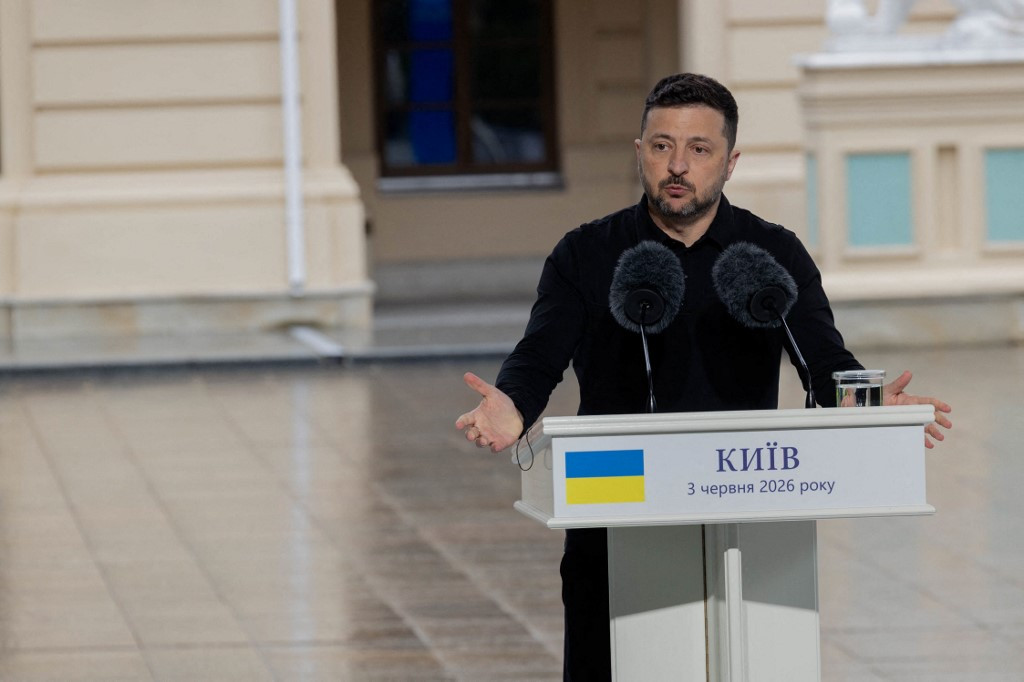
Hosting the first-ever meeting of the NATO-Ukraine Council in Kyiv, Zelensky characterized the high-level presence of ambassadors and defense officials as a deliberate signal of unity from Europe, the US, Canada, and other partners.
The breadth of representation, he said, shows that allies remain committed not only to Ukraine’s security but also to compelling Russia to end what he called its “senseless aggression.”
“Today, six countries have decided that they will make contributions to PURL,” Zelensky said. “I am grateful to them.”
Pressure is mounting, shaped by ongoing Russian overnight strikes on Ukraine’s capital and other regions, as well as a recent Russian drone causing damage to a residential apartment building in Romania.
Zelensky said ballistic missiles, with their speed and destructive payloads, now pose the greatest threat to Ukraine’s security, even compared to the massive drone waves that systematically target cities and energy infrastructure.
“Just yesterday, in a single massive attack, Russia killed 23 people in our country, including children. The Russians used a large number of drones – more than 650 during the night, and about 100 more during the day. But the most dangerous threat, of course, is missiles.”
According to the president, Russia has the capacity to produce about 120 ballistic missiles per month, in addition to other types of missiles. This, he said, allows Moscow to carry out several large-scale attacks on Ukraine every month. At the same time, Zelensky pointed to Ukraine’s own battlefield performance and long-range strike capabilities as key levers in changing the course of the war.
Ukrainian forces are holding strong positions on the front line, gradually reclaiming occupied territory.
“In May, Russia achieved almost no significant results on the battlefield. And this matters,” Zelensky said.
Russian losses, he added, now amount to 30,000-35,000 troops per month, with roughly two-thirds killed and more than one-third severely wounded – a pattern he described as “huge, irrecoverable losses” that are steadily shrinking the strength of Russia’s occupation force.
This pressure, he argued, is forcing Russia into a strategic dilemma: move towards diplomacy or accept military and economic losses.
“Russia is facing a clear fuel shortage in the temporarily occupied territories and in parts of central Russia, as well as serious disruption in its logistics.”
Zelensky’s message to NATO partners is that, ultimately, their decision can shape that choice. Besides PURL, he said, joint weapons production projects between Ukraine and its foreign partners are helping expand domestic missile and drone output despite sustained Russian strikes.
Taken together with multi-year financial aid, tighter sanctions, reinforced air defenses and deeper industrial cooperation, these efforts aim to make further escalation more costly for Russia, leaving Moscow with a stark choice between meaningful diplomacy or mounting losses.
The war in the Middle East has severely affected the quantities of PAC-3 missiles that Ukraine receives.
“This was not because of a lack of money, but because of the war,” Zelensky said, adding that “wherever we could, we replaced them [missiles] with our own domestic production, but we still cannot replace PAC-3.”
Ukraine reached an agreement with US defense manufactuerers in 2025 on new Patriot systems and additional missiles, but the backlog mean delivery wouldn’t begin until 2030, Zelensky said, adding that Ukraine has already begun seeking alternatives with other countries.
Although Ukraine is in constant contact with the American side, the war has been put aside.
“Iran is issue number one for the United States of America,” Zelensky said. “Unfortunately, we are in the queue for these wars.”
Zelensky argued that the US has the weight to truly press Russian President Vladimir Putin to end the war, but insisted Europe’s voice must also be heard, especially as Ukraine moves toward possible EU membership.
“For us, the number one priority is to end the war, and there is no alternative to that,” Zelensky said. “I am ready for direct talks with Putin.”
“As for the EU, we have unanimity. As for NATO, we do not have that yet. And that is absolutely true. No one said they do not want to see us there, but some remain silent on this issue. As they say about both the EU and NATO – unanimity is needed,” he said.
Nina Savić is a Cultural Studies graduate with a strong focus on critical analysis of discourse and media. She is particularly drawn to stories and perspectives often overlooked or erased by mainstream narratives, and is passionate about giving a voice to those pushed to the margins.