One Dead in Chernihiv Region Following Massive Russian Drone Assault
AI Analysis
Russia launched a massive drone assault on Ukraine utilizing 229 UAVs, including Shahed, Gerbera, Italmas, and 'Parodiya' decoys. Ukrainian air defenses intercepted 212 drones, but 14 struck their targets, resulting in one fatality and infrastructure damage in the Chernihiv region. This attack follows a pattern of targeting civilian and industrial infrastructure, including 'double-tap' strikes on emergency responders.
Key Takeaways
- Russia employed a large-scale, multi-directional drone swarm originating from Oryol, Kursk, Crimea, and other locations.
- The drone package included a mix of strike and decoy UAVs, indicating a sophisticated attempt to overwhelm Ukrainian air defenses.
- Ukrainian air defenses utilized a layered approach – fighter aviation, missiles, mobile fire groups, and electronic warfare – achieving a high interception rate (92%).
- Despite successful interceptions, 14 drones reached their targets, highlighting vulnerabilities in Ukraine’s air defense network.
- Russia continues to employ 'double-tap' tactics, deliberately targeting first responders, demonstrating a disregard for civilian life and international law.
Why It Matters
The scale of this attack demonstrates Russia’s continued reliance on drone warfare as a key component of its military strategy. The use of decoys and swarms presents an evolving challenge for air defense systems, requiring ongoing adaptation and investment in counter-UAS technologies. The deliberate targeting of civilian infrastructure and emergency services underscores the brutal nature of the conflict and the need for enhanced air defense capabilities.
Russia launched one of its most expansive overnight Saturday/Sunday drone operations against Ukraine, deploying a massive swarm of combat and decoy unmanned aerial vehicles (UAVs). While Ukrainian air defense networks neutralized the vast majority of the incoming threats, a deadly strike in the Chernihiv region claimed the life of a civilian and caused severe infrastructure damage.
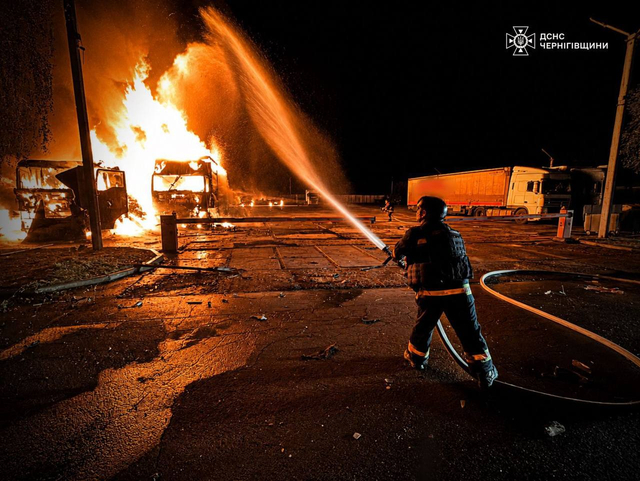
In northern Ukraine, a Russian strike asset successfully penetrated local air defenses to hit a commercial enterprise located in the Koriukivka district of the Chernihiv region. According to the State Emergency Service of Ukraine (DSNS), the impact triggered a large-scale fire across an adjacent corporate parking lot.
Follow our coverage of the war on the @Kyivpost_official.
The resulting blaze completely destroyed seven large cargo trucks parked at the facility. While managing the aftermath of the attack and extinguishing the structural fire, emergency rescue crews discovered the body of a 58-year-old man who was killed in the initial blast.
The Air Force of the Armed Forces of Ukraine reported that the Kremlin deployed a total of 229 unmanned assets during the overnight operation. The strike package was launched from multiple strategic sectors inside Russia – including Oryol, Kursk, Bryansk, Millerovo, and Shatalovo – as well as from Gvardiyske in temporarily occupied Crimea.
To confuse and saturate Ukraine’s integrated air defense umbrella, the Russian military utilized Shahed loitering munitions, Gerbera and Italmas UAVs and”Parodiya“ decoy drones.
A coordinated defense effort involving Ukrainian fighter aviation, anti-aircraft missile troops, mobile fire groups, and electronic warfare (EW) units successfully shot down or suppressed 212 hostile drones across the northern and eastern regions of the country. However, military officials confirmed that 14 strike drones successfully hit targets across 11 distinct locations, while falling debris from intercepted targets caused damage in 5 additional areas.
The deadly bombardment in Chernihiv marks a continuation of high-intensity Russian drone strikes targeting civilian and industrial infrastructure over the weekend. Just 24 hours prior, Russian forces executed a highly destructive, multi-wave “double-tap” drone assault against an industrial zone in Zaporizhzhia.
In that incident, a secondary wave of loitering munitions was deliberately timed to strike emergency crews as they managed the aftermath of an earlier bombardment, resulting in the death of one worker, wounding three others, and heavily damaging adjacent residential buildings.
Concurrently, parallel drone strikes over the weekend targeted residential quarters in Kherson’s Korabelnyi district and civilian medical infrastructure in the Poltava region, underlining a sustained, nationwide campaign of aerial attrition against non-military targets.