Ukraine Downs 269 Russian Drones During Another Massive Air Attack
AI Analysis
Russia launched a massive drone attack on Ukraine involving 294 UAVs, including Shahed variants, decoys, and new platforms like 'Gerbera' and 'Italmas'. Ukrainian air defenses intercepted 269 drones, but 20 struck targets across multiple regions, causing damage to infrastructure and civilian areas. The attack highlights Russia's growing drone production capacity and continued access to Western components.
Key Takeaways
- Russia employed a mixed drone strike package including attack, decoy ('Parodiya'), and newly identified platforms ('Gerbera', 'Italmas').
- Ukraine’s air defenses demonstrated a high interception rate (91.5%), utilizing mobile fire groups, EW units, and anti-aircraft missile teams.
- Despite successful interceptions, 20 drones caused direct hits, targeting critical infrastructure like Kharkiv’s subway and civilian areas in multiple regions.
- Analysis of recovered drone fragments indicates Russia is utilizing microchips sourced from US and European tech brands, circumventing sanctions.
- The scale of the attack suggests Russia is prioritizing drone production to sustain a high-volume bombardment strategy.
Why It Matters
This attack demonstrates Russia’s evolving drone warfare tactics, including the use of decoys to overwhelm defenses and a focus on targeting civilian infrastructure. The continued access to Western components raises concerns about the effectiveness of current sanctions and necessitates a review of export controls. Ukraine’s ability to maintain a high interception rate is crucial, but the persistent damage indicates a need for enhanced and layered air defense systems.
Ukrainian air defense units engaged in an intensive battle against a large-scale Russian aerial assault, downing the vast majority of nearly 300 drones launched from several sectors inside the Russian Federation and occupied Crimea.
According to the Ukrainian Air Force, Russian forces deployed 294 unmanned aerial vehicles (UAVs) starting Friday evening. The strike package included jet-powered Shahed variants, “Gerbera” and “Italmas” platforms, and “Parodiya” decoy drones designed to oversaturate defense radars.
Follow our coverage of the war on the @Kyivpost_official.
Mobile fire groups, electronic warfare (EW) units, and anti-aircraft missile teams successfully neutralized 269 targets across northern, southern, central, and eastern Ukraine. However, 20 drones recorded direct hits across 15 separate locations.
In addition to a morning strike on Kharkiv’s central Shevchenkivskyi district that crippled the municipal subway and transit network, Russian forces targeted the city’s Kyivskyi district, aacording.
A specialized, high-speed “Molniya“ drone directly struck a garage cooperative. Three men sustained injuries during the blast and are receiving urgent medical care.
The attack tore through the roofing of the garage structure, expanding a morning of heavy damage that had already hit three subway exits, an educational facility, and an apartment building.
In the south, Russian strikes directly targeted regional population centers. In the city of Zaporizhzhia, an enemy strike hit a civilian area, wounding two men aged 30 and 40 who are currently hospitalized with shrapnel injuries.
Meanwhile, at approximately 7:00 a.m. local time in the Central district of Kherson, a Russian drone deliberately dropped ammunition onto a transit minibus. The 60-year-old driver sustained a concussion, blast-induced traumatic brain injury, and shrapnel wounds to his legs, leaving him in moderate condition.
The Dnipropetrovsk region came under heavy, continuous fire as Russian troops utilized a mix of artillery and kamikaze drones to strike three separate districts. Regional Administration Chief Oleksandr Hanzha reported that the Nikopol district – including the communities of Myrivska, Marhanets, Chervonohryhorivka, Pokrovska, and Nikopol itself – bore the brunt of the tactical strikes.
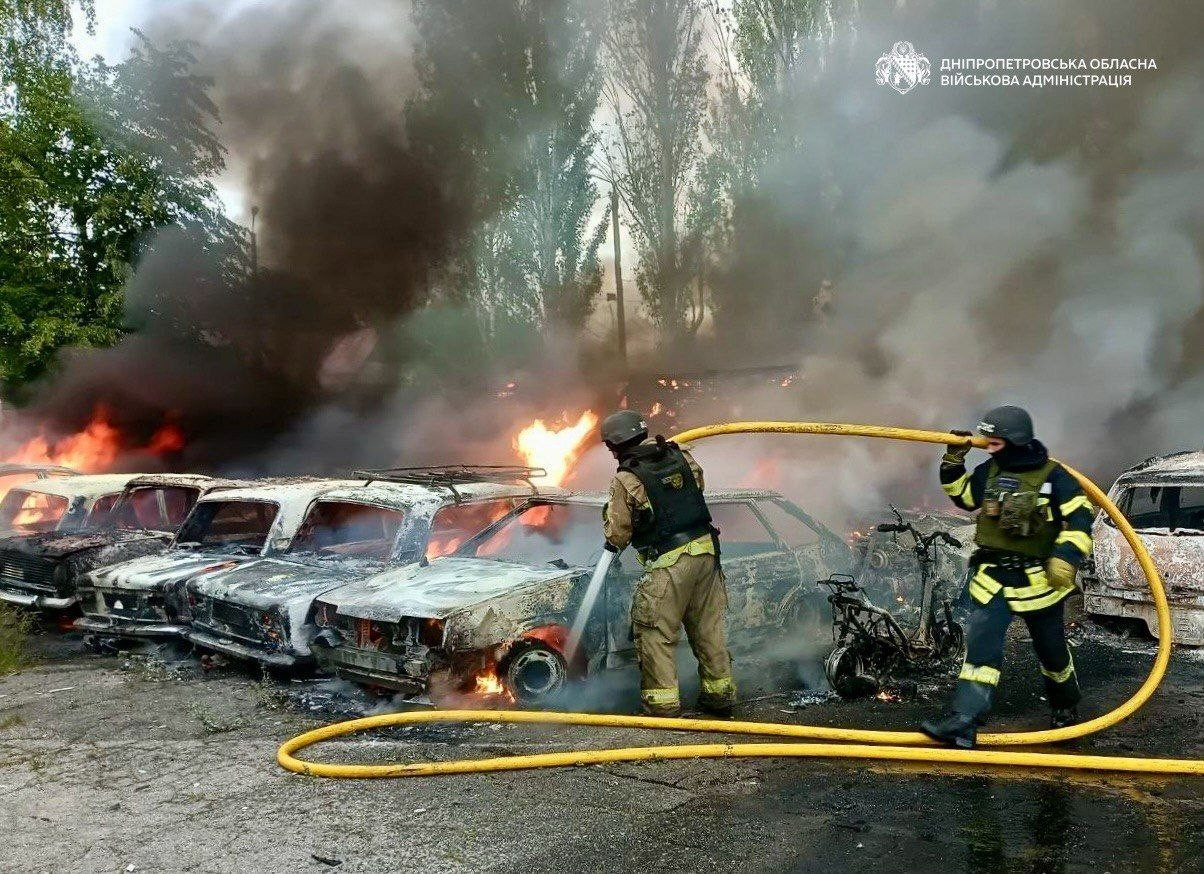
The strikes destroyed 17 automobiles and 15 mopeds in Nikopol, alongside an additional 10 vehicles that burned out in the Sinelnykove area.
A 22-year-old man was injured during the attacks and is currently undergoing outpatient treatment.
Infrastructure assets and private residences were also damaged in Kryvyi Rih and the Sofiivska community.
The capital region was subjected to multiple air raid alerts as defensive forces suppressed incoming targets over the Vyshhorod district. Kyiv Regional Military Administration Chief Mykola Kalashnyk confirmed that while no civilian casualties occurred, an exploded drone and its corresponding blast wave significantly damaged a private residential home and the property of a municipal utility enterprise.
Seven utility and transport vehicles, including trucks and a tractor, were heavily damaged by falling metal fragments.
The systemic, nationwide drone blitz mirrors a growing industrial capability inside Russia’s borders.
Military analysts warn that despite Western sanction controls, components continue to reach factory assembly lines, allowing the Kremlin to maintain a high-volume, multi-vector bombardment strategy against civilian populations and transport hubs.
These morning updates expand upon a highly destructive overnight bombardment. Southern Odesa remains a primary crisis zone after wave-strategy drone attacks severely damaged critical maritime shipping infrastructure, hitting an administrative office complex and a port warehouse.
A five-story apartment block in Odesa was also struck, igniting ground-floor retail shops and forcing the evacuation of residents.
The extensive deployment of fresh Russian drone configurations matches recent warnings from sanctions commissioner Vladyslav Vlasiuk. Investigations into fragments recovered from high-volume strikes show that Moscow is deploying military assets built with microchips sourced from US and European tech brands late last year and into early 2026.
Ukrainian defense officials emphasize that the continuous stream of weapons “straight off the factory line” underscores why Russia utilizes diplomatic maneuvers primarily to buy time to expand its industrial output.