All Articles
Latest articles and analysis on counter-UAS technology and drone warfare
Poland Becomes First Nation to Receive SAFE Loan Funding for Defense Procurement
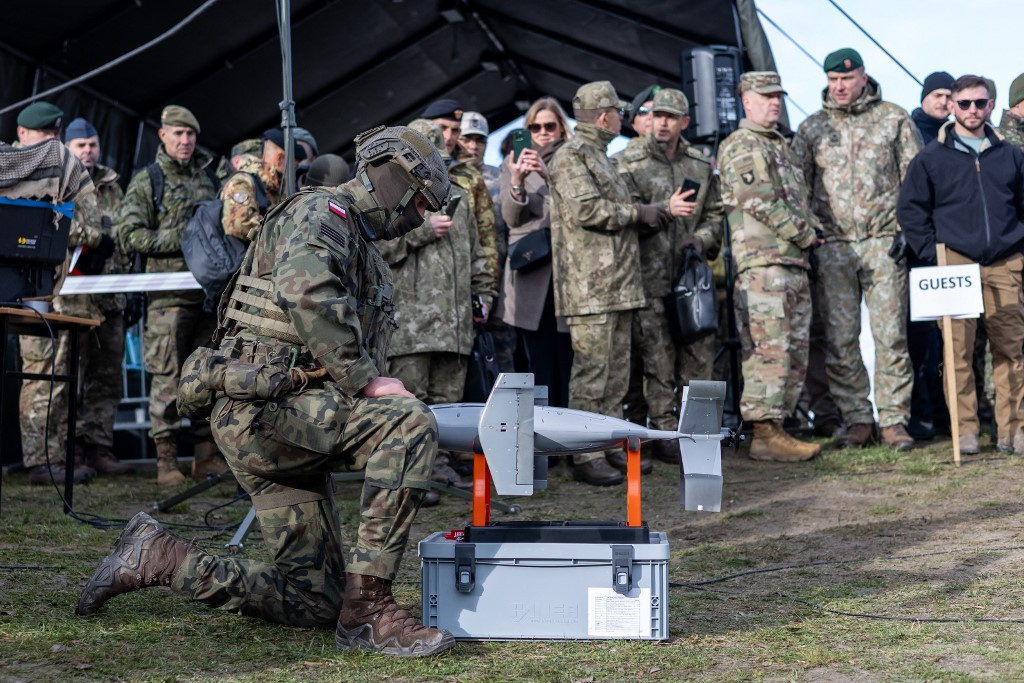
Poland has received the first disbursement (€6.6 billion) from the EU’s €150 billion SAFE loan program, intended for defense procurement. This funding supports a large-scale military modernization effort, encompassing 40 active contracts worth €23.6 billion. A portion of this procurement includes loitering munitions, indicating a growing focus on asymmetric warfare capabilities.
U.S. Army Evaluates New Command-Networked Drone Interceptor
The U.S. Army is evaluating a new, low-cost drone interceptor designed to operate without reliance on radar. This system is intended to integrate with existing command-and-control networks and is being tested as part of a broader NATO effort to bolster air defense capabilities in Europe. The focus is on a networked solution, suggesting a move towards coordinated counter-UAS operations.

Germany Defence Technology Startup STARK in Talks to Raise $350 Million (€300 Million) at $2.9 Billion (€2.5 Billion) Valuation, Raised Funding at $1.2 Billion Valuation in 2026 February & Raised $62 Million at $500 Million Valuation in 2025 August, STARK Founded in 2024 by Florian Seibel & Johannes Schaback | Caproasia
German defense technology startup STARK is seeking to raise $350 million at a $2.9 billion valuation, indicating strong investor confidence. The company has already secured significant funding in recent rounds, raising $62 million in August 2025 and $1.2 billion in February 2026. Founded in 2024, STARK is rapidly attracting capital in the burgeoning defense tech sector.
TYTAN Technologies €30M Series A for AI-powered drone interceptors, NATO Innovation Fund co-led, 3,000/month production target | robotics.press
TYTAN Technologies secured a €30M Series A funding round co-led by the NATO Innovation Fund and Armira, aiming to scale production of its AI-powered METIS drone interceptor to 3,000 units per month by the end of 2026. The company already has confirmed contracts with Ukraine and Germany. This investment signals a strong procurement intent from NATO member states to address the growing drone threat.
NATO Allied Air Command leads counter-drone training over Baltics under enhanced Vigilance Activity Eastern Sentry
NATO Allied Air Command recently conducted counter-drone training ('Eastern Sentry') over Lithuania and Latvia, integrating air and ground-based defense systems from Romania, Portugal, and Spain. The exercise focused on enhancing NATO’s Integrated Air and Missile Defence capabilities against UAS threats. This training highlights a proactive approach to bolstering air defense along NATO's eastern flank.
Indra stands out in anti-drone performance at NATO | Demócrata
Indra's C-UAS systems demonstrated leading performance during NATO's TIE 2026 exercise, achieving a high level of interoperability with systems from multiple nations. The tested systems include the C4ARMS command and control system, SmartEar RF sensor, and Brontes RF jammer. This success positions Indra as a key provider for NATO's evolving defense architecture against drone threats.
Deep Signal: Destinus profile: €200M pre-IPO at >€5B valuation, Rheinmetall 51-49 JV for missiles, Shield AI Hivemind integration, €500M revenue | robotics.press
Destinus, a European defense startup, secured a €200M pre-IPO investment at a >€5B valuation and formed a 51-49 joint venture with Rheinmetall for cruise missile production. They are integrating Shield AI's Hivemind autonomy software onto their Hornet interceptor drone and partnering with Quantum Systems for reconnaissance-strike capabilities. This positions Destinus as a key platform integrator in the European autonomous systems market.
Tabor Electronics unveils Anti-Drone Test and Evaluation solution.
Tabor Electronics has launched a new Anti-Drone Test and Evaluation solution based on its Proteus Software-Defined Radio (SDR) platform. This solution allows for realistic simulation and stress-testing of counter-UAS systems, focusing on communication link validation and resilience. The system utilizes COTS technology for rapid deployment and scalability.

How Сan NATO Respond to Romania Drone Crash?
A Russian drone crashed in Romania, prompting NATO to consider responses short of invoking Article 5. Options include strengthening eastern flank defenses, integrating the US-made Merops counter-drone system under NATO command, and potential Article 4 consultations. NATO is also assessing improvements to air-domain awareness and sensor/shooter networks.

Russian Strikes Hit Industrial Facility in Zaporizhzhia and Civilian Sectors in Kherson
Russian forces conducted strikes in Zaporizhzhia and Kherson, targeting industrial infrastructure and civilian areas with loitering munitions and drones. Ukrainian officials report a potential escalation in Russian air attacks, with preparations for a large-scale offensive detected by intelligence networks. The Kherson strike specifically highlights a penetration of Ukrainian electronic warfare (EW) defenses by a Russian drone.