From Radushne to Lublin: How Russia’s North Korean Missiles Expose the West’s Air Defense Gap
AI Analysis
Russia has resumed using North Korean ballistic missiles against Ukraine, killing a family in Radushne, while a Russian cruise missile breached Polish airspace near Lublin. These incidents highlight Ukraine's critical air defense shortage and the direct threat to NATO's eastern flank from the Russia-North Korea military alliance.
Key Takeaways
- Russia used a North Korean KN-23 or KN-24 ballistic missile to destroy a home in Radushne, killing three generations of one family.
- A Russian Kh-101 cruise missile crossed into Polish territory near Lublin, landing 2 km from residential buildings, though no casualties occurred.
- Ukraine had recorded no North Korean missile launches since August 2025, indicating fresh supplies or reserve stocks from Pyongyang.
- North Korea has provided artillery shells, 14,000 troops, and is reportedly preparing to send 30,000 more soldiers and additional missile launchers.
- Zelensky emphasized the urgent need for Patriot, NASAMS, IRIS-T, and HAWK air defense systems to counter Russian and North Korean missiles.
- The incidents expose the weakness of treating Ukrainian and NATO airspace as separate defensive environments, as Ukraine defends Europe's eastern frontier.
Why It Matters
The Russia-North Korea alliance is directly threatening European security by integrating advanced ballistic missiles and troops into Russia's war machine. Ukraine's air defense gap is no longer a local problem—it is a NATO vulnerability, as missiles can cross into alliance territory. The West must accelerate air defense deliveries to prevent further escalation and protect both Ukraine and NATO members.
For the first time in nearly a year, Russia has apparently used a North Korean ballistic missile against Ukraine – destroying an ordinary family home near Kryvyi Rih and killing three generations of one family. During the same attack, an apparent Russian cruise missile crossed into Poland, proving that Ukraine is constantly defending Europe’s eastern frontier.
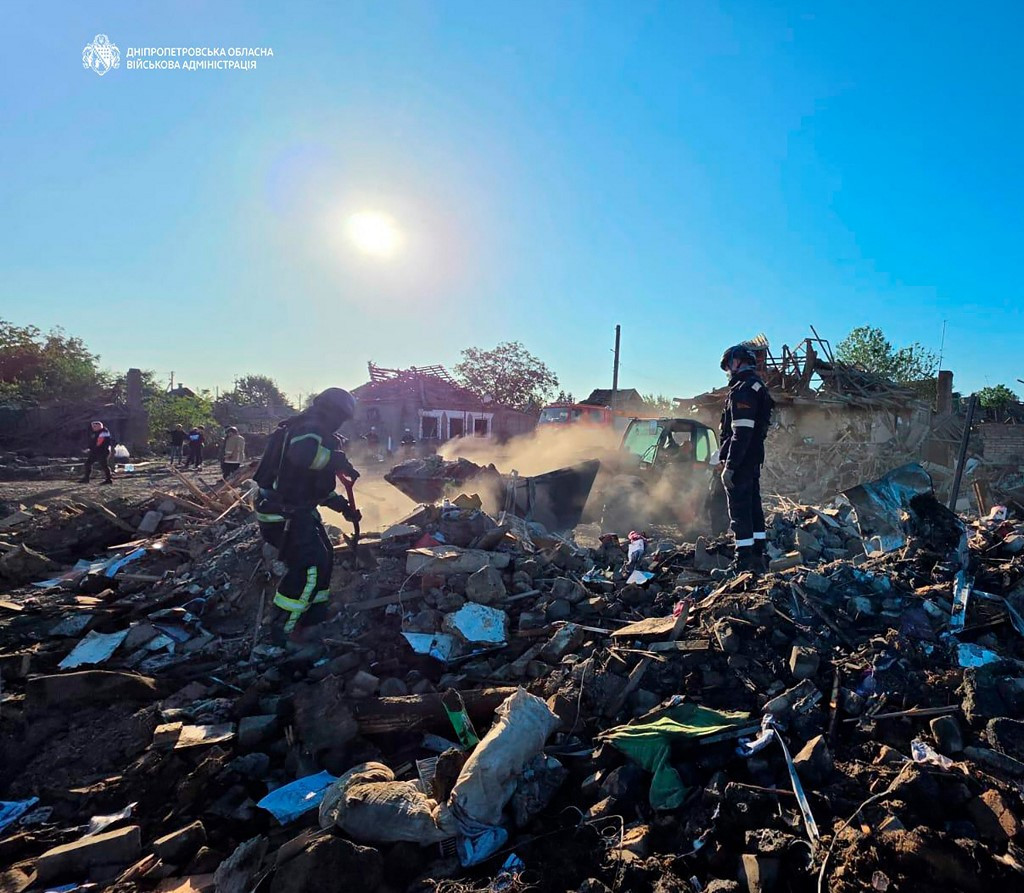
According to preliminary Ukrainian findings, Russia used a North Korean missile to strike Radushne, near Kryvyi Rih, where a family home was completely destroyed. Six people had been confirmed killed, while another four were presumed dead as forensic examinations continued.
Follow our coverage of the war on the @Kyivpost_official.
The presumed victims were Olena and Artem Voronov, their seven children and their 18-month-old grandson.
“In Radushne, near Kryvyi Rih, a ballistic missile struck a house directly,” President Volodymyr Zelensky said in his evening address. “An ordinary house. Ordinary children were killed, their parents – an entire peaceful family.”
Zelensky said the available evidence indicated that Russia had used a North Korean missile for the first time in a long time.
“Of course, there will still be examinations, and everything will be verified. But as of now, it was North Korean ballistic weaponry,” he said.
Ukrainian radar detected two flight tracks characteristic of North Korean KN-23 or KN-24 short-range ballistic missiles heading toward Kryvyi Rih during the Russian barrage, a Ukrainian military source told Reuters.
Two tracks would typically indicate that four missiles had been launched, according to the source, although the locations of the other possible impact sites were not immediately known.
Investigators were still examining recovered fragments to confirm the weapon’s origin conclusively, but the source said he was confident that Russia had used a North Korean missile.
The apparent return of Pyongyang’s ballistic hardware after Ukraine had recorded no such launches since August 2025 means Moscow has either secured a fresh supply or begun drawing from missiles held in reserve.
Either possibility confirms that North Korean weapons remain fully integrated into Russia’s war machine.
The KN-23 and KN-24 reportedly carry larger warheads and have longer ranges than Russia’s Iskander short-range ballistic missiles, while being less accurate. That combination – greater destructive power paired with lower precision – makes them especially lethal when Russia fires them toward populated Ukrainian regions.
Radushne showed exactly what that means: an ordinary home reduced to rubble and three generations of one family wiped out.
Zelensky described the military partnership between Moscow and Pyongyang in uncompromising terms.
“The alliance between the Moscow scumbags and the deranged regime in North Korea exists for the sake of missiles, for the sake of a North Korean military contingent here in Europe, on our borders, and for the sake of killing our Ukrainian children,” he said.
North Korea’s role in Russia’s invasion already extends far beyond a limited supply of ballistic missiles.
Pyongyang has delivered millions of artillery shells to sustain Moscow’s war. In 2024, it also deployed approximately 14,000 troops to help Russian forces repel Ukraine’s operation in the Kursk region.
Zelensky has since warned that Russia wants North Korea to send another 30,000 soldiers, with preparations reportedly underway to receive them in Russia’s Voronezh region.
He has also said Pyongyang is preparing to provide Russia with additional ballistic missile launchers.
North Korea is no longer merely selling equipment to Russia. It is gaining real-world battlefield information on how its missiles perform against Western-designed defenses, while its troops acquire combat experience and exposure to modern electronic warfare.
Russia, meanwhile, receives weapons and personnel from a dictatorship willing to sustain its invasion without the political restrictions, delays and lengthy approval processes imposed on Ukraine’s democratic partners.
This is an active authoritarian wartime alliance directed against Ukraine and the European security order.
Moscow and Pyongyang move missiles, shells, and troops according to battlefield demand. In stark contrast, Ukraine’s allies still too often move vital air-defense interceptors according to political calendars.
During the same wider Russian assault, an object believed to be a Russian Kh-101 cruise missile crossed into Polish territory and came down near Tarnawa-Kolonia in the Lublin region.
The impact left a crater approximately 10 meters (32 feet) wide in a field just over 100 kilometers (62 miles) from the Ukrainian border and around 2 kilometers (1 mile) from residential buildings.
Polish Prime Minister Donald Tusk said the available evidence indicated that the object was a Russian Kh-101, although investigators were still working to establish its type and origin conclusively.
An apparent Russian missile entered NATO territory and crashed near civilian homes. Nobody was killed because of where it happened to land, not because Europe’s eastern frontier was adequately protected.
The missile that destroyed the Voronov family home and the apparent Kh-101 that entered Poland were different weapons following different trajectories. Strategically, however, they were two consequences of the same Russian attack.
Radushne showed how Moscow’s alliance with Pyongyang is increasing the destructive force available for attacks on Ukraine.
Lublin showed that the consequences of Russia’s war cannot be contained within Ukraine’s borders.
Radushne suffered the human cost. Poland received the warning.
The Lublin incident exposes the weakness of treating Ukrainian and NATO airspace as separate defensive environments.
Ukraine is already fighting the weapons threatening Poland, Romania, and the rest of NATO’s eastern flank. Every Russian or North Korean missile destroyed over Ukraine is one less weapon capable of crossing into alliance territory.
Nevertheless, Zelensky said Ukraine must continue moving forward and confront Russia with the only language it understands – sufficient force.
“This is an evil that can be stopped only by enough strength,” he said.
“Air-defense missiles – above all missiles for Patriot, but also for NASAMS, IRIS-T, HAWK and our other systems – are the key priority,” Zelensky said.
Russia’s aggression will not be stopped by appeals to Putin’s reason. It will be stopped only when Ukraine possesses enough military strength to deny Moscow the ability to continue its terror.
He added that Ukrainian officials had approved specific steps and decisions the country urgently needed.
“There will be more of our deep strikes, so that this Russian war returns to where it came from,” Zelensky said, stressing that the political and military responsibility for prolonging the war lies entirely with Moscow.
Sevinj Osmanqizi is an experienced journalist who writes extensively for Kyiv Post on foreign policy, international security and geopolitics. Based in Washington, D.C., her work focuses on Ukraine, Russia’s war and the broader post-Soviet space.