Video purportedly shows Ukrainian unit running down Russian Shahed. The US is paying attention.
AI Analysis
Recent footage suggests the American-made Merops interceptor is effectively engaging Russian Shahed drones in Ukraine, prompting the US Army to pursue a domestically-owned, low-cost interceptor program. This initiative aims to reduce reliance on Perennial Autonomy, the current Merops manufacturer, and ensure scalable production. Several NATO countries are also deploying Merops to bolster air defenses along their eastern flanks.
Key Takeaways
- Ukrainian forces reportedly used a Merops interceptor to successfully engage a Shahed drone, marking the first publicly available video evidence.
- The US Army is launching the Low-Cost Interceptor program to develop a government-owned design for drone interceptors, aiming for systems under $1 million.
- The Army seeks to avoid sole-source dependency on Perennial Autonomy, despite awarding them a $500 million contract.
- Merops interceptors have reportedly downed over 4,000 Russian drones in Ukraine, accounting for approximately 40% of Shahed drone destruction.
- Romania and Poland have integrated Merops into their national air defense systems, with Lithuania also procuring them for deployment along the Danube corridor.
Why It Matters
The success of low-cost interceptors like Merops demonstrates a shift in counter-drone strategy, favoring expendable systems over expensive missile defenses. The US Army's pursuit of a domestic design signals a long-term commitment to countering drone threats and reducing reliance on external suppliers. This development has significant implications for future air defense strategies and procurement decisions across NATO.
KYIV, Ukraine — A Ukrainian drone unit has posted a video reportedly showing American-made Merops interceptors running down an Iranian-designed Shahed drone, fresh proof the cheap weapon works as the U.S. Army moves to build a version it can field at scale.
Ukraine’s 427th Separate Unmanned Systems Regiment, known as Rarog, posted the unverified night-vision clip to its Telegram channel last month showing an interceptor closing on a one-way attack drone and a flash at the moment of contact. The unit flies Ukrainian-built interceptors alongside foreign systems, and did not specify which it used.
Foreign Policy Research Institute senior fellow Rob Lee shared the clip and called it the first public video he believed of Perennial Autonomy’s Merops, the American interceptor, “targeting Shahed/Geran one-way attack drones.”
The footage lands as the Army is moving to build a version of that drone it can call its own.
On June 23, the Army opened a Low-Cost Interceptor program at an industry day in Arlington, Virginia, seeking complete systems for under $1 million and government-owned designs it can hand to any manufacturer, with a first live-fire demonstration set for the fall.
The program would let the Army break the interceptor into pieces, buy or lease the design, and use contract manufacturers to build it — so it owns the weapon rather than depending on a single prime, Army Secretary Dan Driscoll said in May.
The Army does not own the Merops design and cannot produce them at will. The new program would change that, letting it hand a government-owned blueprint to any manufacturer rather than buy from only a single contracting company.
The vendor that the U.S government appears to be seeking independence from in this case is Perennial Autonomy, the maker of Merops.
Former Google chief executive Eric Schmidt launched the defense startup in 2023 and signed a three-year, $500 million contract with the Pentagon in May — the largest single counter-drone deal it’s ever awarded — making the company uniquely influential to military supply chains.
The Pentagon turned to Merops after burning through hundreds of Patriot missiles defending against Iranian Shaheds, each Patriot costing more than $3 million and drawing down stockpiles Ukraine has long depended on for its own air defense.
The Army bought 13,000 Merops in eight days after the Iran war began in late February, at roughly $15,000 each, Driscoll told Congress in April.
“They protected U.S. troops,” the Army secretary told lawmakers, defending the cost as a fraction of what a Shahed costs to produce. “We will make that trade all day long.”
A Merops costs roughly $15,000 against a Shahed that runs $30,000 to $50,000.
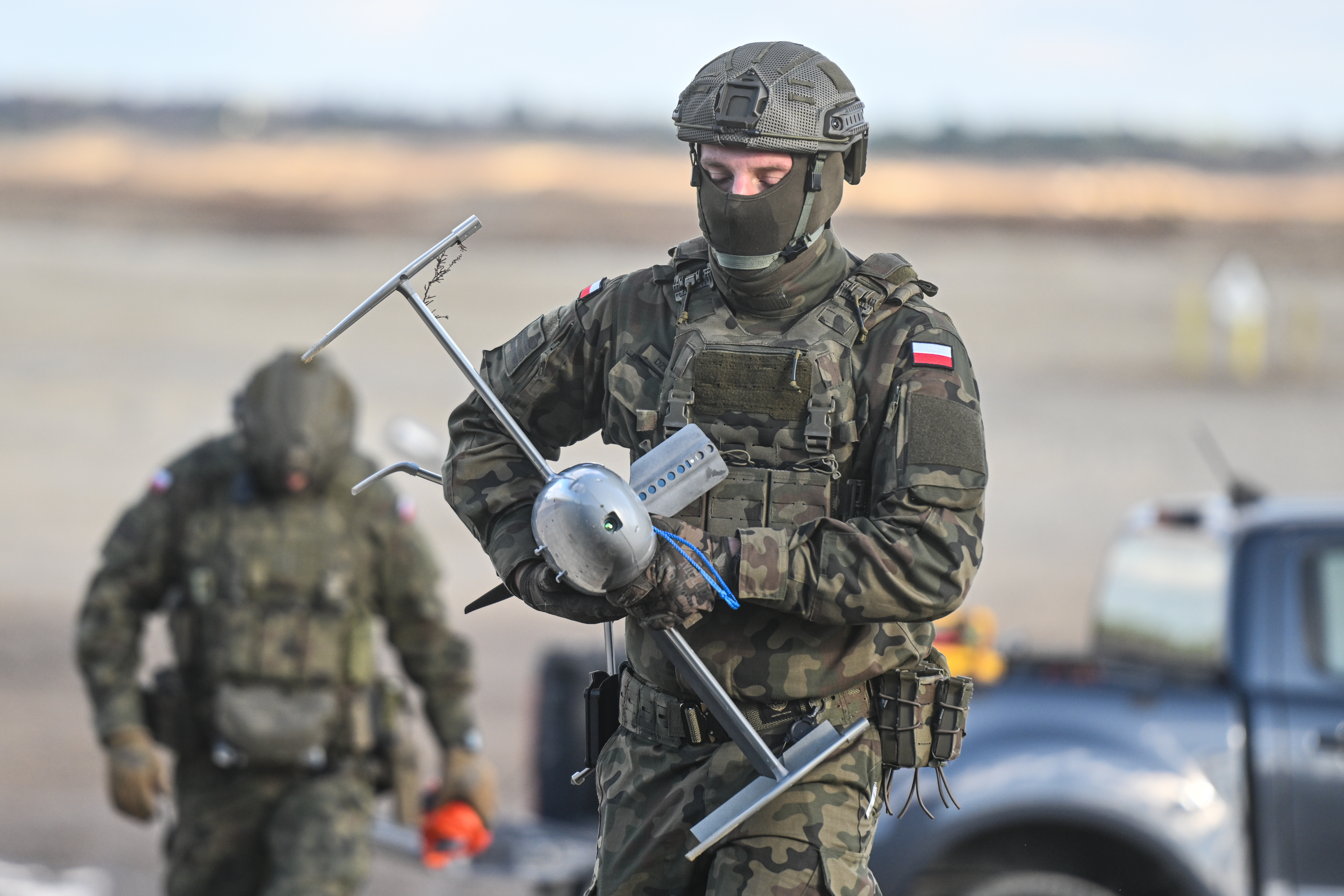
The interceptor is a roughly three-foot, fixed-wing drone that flies up to 174 mph (280 km/h) and homes in on its target using thermal radar or radio-frequency sensors when its links are jammed.
It has downed more than 4,000 Russian drones in Ukraine, German production partner Twentyfour Industries said.
The system has conservatively accounted for 40% of all Shahed destruction in Ukraine, Brig. Gen. Curtis King, commanding general of the 10th Army Air and Missile Defense Command, told reporters at a Polish base in November.
NATO has already built Merops interceptors into the forces protecting its eastern flank.
Romania folded Merops into its national air defenses on June 29, joining Poland in fielding it, and Lithuania bought 48 interceptors earlier this year. Officials said they are planning a deployment along the Danube corridor, where Russian drones have repeatedly crossed from the war next door, according to Reuters.
In mid-June, footage circulated of Merops interceptors failing to down a Russian drone, and a Romanian field test in April logged a failure the military attributed to “target maneuvering,” according to Greek publication Pronews. The outlet still called Merops one of the most effective low-cost tools in the drone war.
Ukraine’s military also flies an array of homegrown drones that run $1,000 to $3,000 a unit and have downed thousands of Russian drones since 2024, on a cost exchange that runs as steep as 85-to-1 in Kyiv’s favor.