US Army turns to Ukraine-tested drones to counter Iranian UAV threat
AI Analysis
The U.S. Army is deploying Merops interceptor drones, initially tested in Ukraine, to counter Iranian Shahed drones. These cost-effective interceptors are designed to shift the economics of air defense in favor of the U.S. by offering a cheaper alternative to traditional systems.
Key Takeaways
- The U.S. Army has purchased 13,000 Merops interceptor drones to counter Iranian Shahed drones.
- Merops drones are developed by Perennial Autonomy and cost significantly less than Shahed drones.
- The system features a two-kilogram fragmentation warhead and advanced target tracking capabilities.
- Merops has been used by Ukrainian forces and NATO allies to defend against drone threats.
- The system can be launched from vehicles and operates effectively in contested environments.
Why It Matters
The deployment of Merops drones represents a strategic shift in air defense, leveraging cost-effective technology to counter massed drone attacks. This approach enhances U.S. and allied capabilities to defend against increasingly prevalent and inexpensive UAV threats, particularly from state actors like Iran.
The U.S. Army is turning to low-cost interceptor drones first tested in Ukraine to counter Iranian-made Shahed drones, aiming to flip the economics of air defense that have long favored combatants using quick, disposable technology.
Army Secretary Dan Driscoll told lawmakers last week during a budget hearing that the service has already begun deploying the system — known as the Merops — and is rapidly scaling production as part of a broader push to defend against cheap, massed drone attacks.
“When the conflict kicked off, within about eight days, we were able to purchase … 13,000 Merops, which are incredible,” Driscoll said during a budget hearing, describing a streamlined acquisition process that cut through what had previously been a years-long, multi-agency effort.
The cost advantage is central to the strategy. Officials say the Merops interceptor currently runs about $15,000 per unit and could drop below $10,000 at scale and well below the estimated $30,000 to $50,000 price tag of a Shahed drone.
“That puts us on the right end of the cost curve, and we will make that trade all day long,” Driscoll said.
Developed by U.S. defense firm Perennial Autonomy, formerly known as Project Eagle, the Merops is a mobile, fixed-wing interceptor designed to destroy hostile drones in flight. According to industry data, it has a range of roughly five to 20 kilometers and can reach speeds of up to 280 kilometers per hour.
The system carries a two-kilogram fragmentation warhead and uses onboard sensors for target tracking and terminal homing, allowing it to lock onto targets using radio frequency signals, radar guidance or thermal signatures. It is also designed to operate in contested environments and resist GPS and radio-frequency jamming.
The drone was first used by Ukrainian forces in June 2024 against Russian-operated systems, including Shaheds, and has since been deployed by NATO allies such as Poland and Romania to help defend the alliance’s eastern flank.
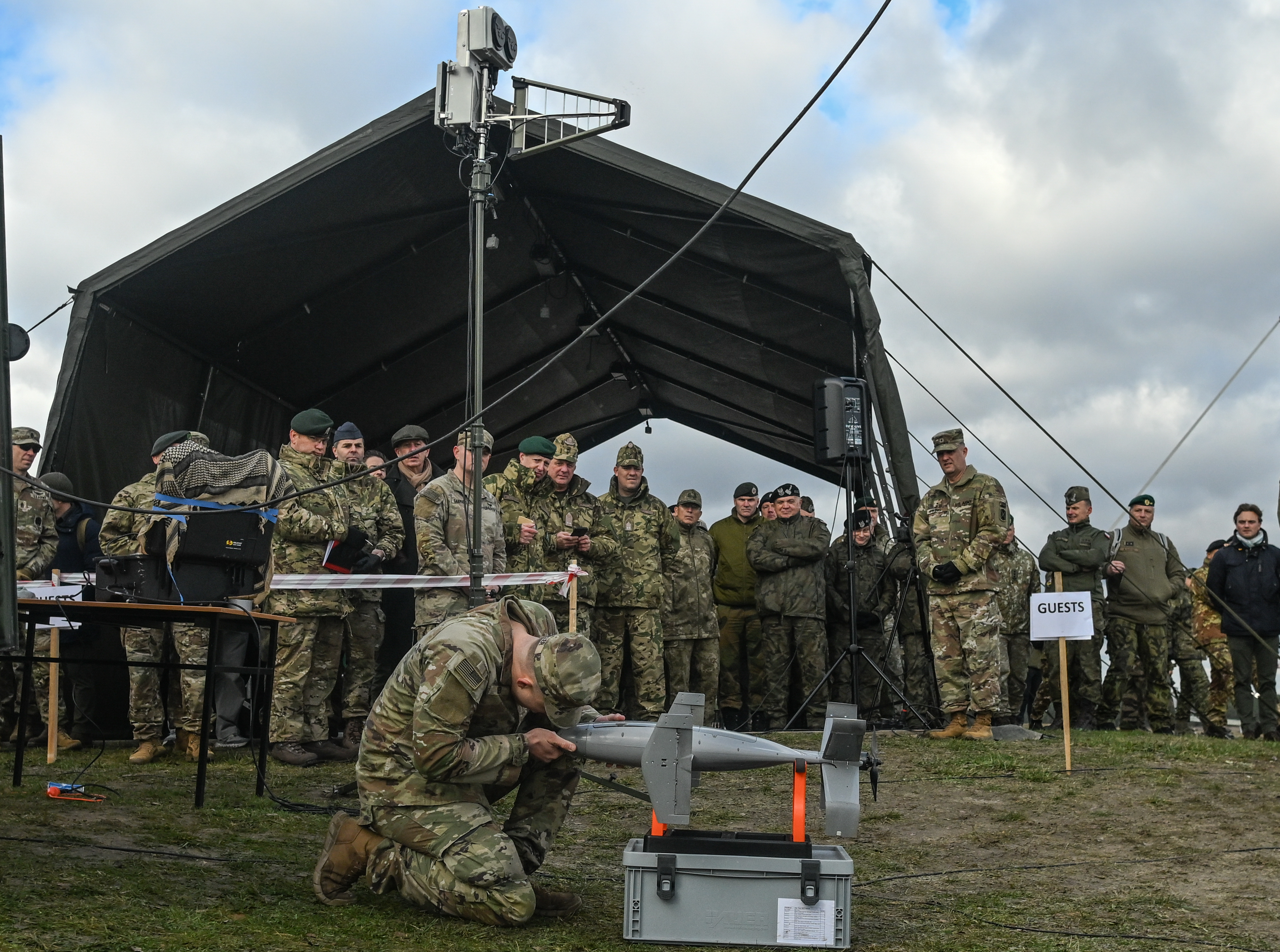
In a November demonstration by U.S. and NATO forces, soldiers launched the interceptor from the back of a pickup truck, showcasing its ability to autonomously locate and engage targets.
Brig. Gen. Curtis King, commanding general of the 10th Army Air and Missile Defense Command, described the system as “very lethal” and said it “enables us to kill [enemies] very effectively and at a much lower cost.”