‘How Are We Supposed to Live Now?’: Russians React to Massive Moscow Drone Attack
AI Analysis
A large-scale drone attack targeted Moscow and the surrounding region, disrupting civilian life and raising questions about the effectiveness of Russian air defenses. Public reaction ranged from frustration and fear to calls for retaliation and minimization of the event by pro-war commentators. The attack appears to be a direct response to recent Russian strikes on Kyiv, including cultural heritage sites.
Key Takeaways
- The drone attack targeted Moscow infrastructure, including the Moscow Oil Refinery and multiple airports, causing disruptions to travel and daily life.
- Russian air defenses appear to have been overwhelmed or ineffective in intercepting a significant number of drones.
- Public reaction within Russia highlights growing anxiety and dissatisfaction with the war's impact on the homeland.
- Pro-war voices attempted to downplay the attack's significance or called for escalation, including the use of ballistic missiles.
- Ukrainian President Zelenskyy explicitly linked the attack to Russian strikes on Kyiv, signaling a tit-for-tat escalation strategy.
Why It Matters
This attack demonstrates Ukraine's increasing capability to strike deep within Russian territory, challenging Russia’s narrative of control and potentially impacting domestic morale. The perceived failure of Russian air defenses raises questions about their overall effectiveness and could encourage further attacks. This escalation cycle highlights the widening scope of the conflict and the potential for further attacks on civilian infrastructure.
“Why should I suffer because of this? Why aren’t they shooting them down?”
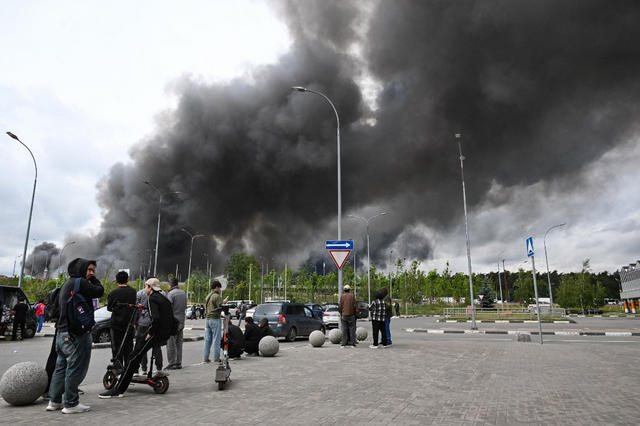
That was among the reactions posted by Russian social media users after one of the largest Ukrainian drone attacks on Moscow and the surrounding region this year.
Follow our coverage of the war on the @Kyivpost_official.
The strike, which Russian authorities said involved hundreds of drones, targeted Moscow and the Moscow region. Fires were reported near the Moscow Oil Refinery in Kapotnya, a facility supplying a significant share of the capital’s fuel market. Airports across Moscow temporarily suspended operations, while thick black smoke was visible from several parts of the city.
For many Russians, the disruption itself appeared to be the main concern.
“My Vnukovo! Why should I suffer because of this? Why aren’t they shooting them down? Where was the warning? Why are my vacation plans being ruined?” one user wrote on Threads, referring to Moscow’s Vnukovo Airport.
Others expressed disbelief that the war was now visibly affecting life in the Russian capital.
“Oh my God, why was Moscow attacked? This is a capital city, not some village! What is happening? They are reaching central Moscow and the suburbs. Take the air defenses and equipment out of Crimea! How are we supposed to live now?” another user wrote.
Ukrainian President Volodymyr Zelensky earlier on Thursday linked the strike to Russia’s recent attack on Kyiv, including damage to the UNESCO-listed Kyiv-Pechersk Lavra.
“They struck the Lavra,” Zelensky said. “I said openly that we would prepare a response and that you would see it. I think you are seeing it now.”
Some complained that airport shutdowns had effectively stranded travelers.
“Where are you planning to spend your vacation this summer? First, I spent four days in Sheremetyevo [Moscow’s Airport], now three days in Sochi airport,” one post read, drawing thousands of likes.
Some pro-war commentators called for retaliation, including renewed references to Russia’s Oreshnik ballistic missile.
“Maybe it’s time to launch Oreshnik? People are asking for it quite strongly. Our people shouldn’t have to suffer,” one user wrote in a pro-war Telegram chat.
Others appeared unable to connect the attacks to Russia’s full-scale invasion of Ukraine.
“There is a smell of smoke in the air and black smoke in the sky. Questions keep spinning in my head: Why these drone raids? Who was bothered by this refinery that provides fuel to Muscovites?” one user wrote, adding that the strikes looked like an attempt to “drag Moscow into a war between Ukraine and Russia.”
Some Russians, however, pushed back against criticism directed at Ukraine.
“We are ordinary people just like you. We cannot influence politics and we cannot stop this. Do you really think we wanted this?” one woman wrote, responding to comments from Ukrainians online.
Pro-war military bloggers and state media figures largely sought to calm the public and minimize the significance of the attack.
Dmitry Steshin, a war correspondent for Komsomolskaya Pravda, argued that residents should only start worrying when self-propelled mortars begin firing outside their windows.
“Pull the blanket over your ear and go to sleep,” he wrote. “If you’re unlucky, God decided it that way. If you’re lucky, they’ll dig you out.”
Ilya Tumanov, a prominent pro-war aviation blogger known as Fighterbomber, initially expressed concern that even Moscow’s heavily protected air-defense network was allowing repeated strikes on the same targets. He later deleted the post and insisted Russia still possessed “an air-defense system unlike any other in the world.”
Andrei Medvedev, deputy head of Russia’s state broadcaster radio division, said that successful strikes were “unpleasant” but argued they demonstrated the effectiveness of Russian air defenses because “it could have been much worse.”
Elsewhere, frustration is increasingly mixed with calls for de-escalation.
“How much longer can this continue? People are dying. Maybe it’s time to negotiate?” one commenter wrote.
Others demanded retaliation, while some mocked official explanations that restrictions on internet access and airport operations were necessary for security.
Some Russians responded with dark humor. One widely shared post joked that Ukrainian President Volodymyr Zelensky had effectively “allowed” Russia’s Victory Day parade on May 9 to proceed safely, only for Moscow to face one of its largest drone attacks weeks later.
“After today’s attack on Moscow, it became clear that Zelensky did allow the May 9 parade to take place,” one user wrote.
Kateryna investigates today's most important topics, from geopolitical challenges and defense strategies to stories that change the course of events. She explores the secrets of Ukraine's intelligence services and shows the hidden side of global events. Her passion is uncovering secrets that change history. Born and lives in Kyiv.