Fire Erupts at Major Russian Oil Refinery as Drones Strike Krasnodar, Crimea
AI Analysis
A coordinated drone attack targeted a major Russian oil refinery in Krasnodar Krai and multiple sites in occupied Crimea, causing fires, damage, and civilian injuries. Russian air defenses reportedly intercepted a large number of drones, but were evidently overwhelmed. The attacks exacerbate existing fuel shortages in Russia and occupied territories.
Key Takeaways
- The Afipsky Oil Refinery, a significant Russian energy facility, was struck by drones, causing a fire and temporarily halting operations.
- Multiple locations in occupied Crimea reported explosions and strikes, potentially targeting military infrastructure near Sevastopol and Armyansk.
- Ukrainian drone attacks are demonstrably impacting Russian oil refining capacity, with utilization down 14% YTD and 20% below pre-war levels, leading to fuel shortages and price increases.
- Russian air defenses claimed to have intercepted 330 drones, suggesting a large-scale, coordinated attack, but clearly demonstrating limitations in comprehensive coverage.
- Airport operations were disrupted in several Russian regions due to the drone threat, highlighting the expanding reach and impact of UAS operations.
Why It Matters
These attacks demonstrate Ukraine’s ability to strike deep within Russia and target critical infrastructure, impacting Russia’s war economy and logistical capabilities. The success of these strikes, despite Russian air defenses, underscores the growing effectiveness of drone warfare and the need for improved counter-UAS capabilities. Continued disruption of Russian fuel supplies could significantly hinder military operations and civilian life.
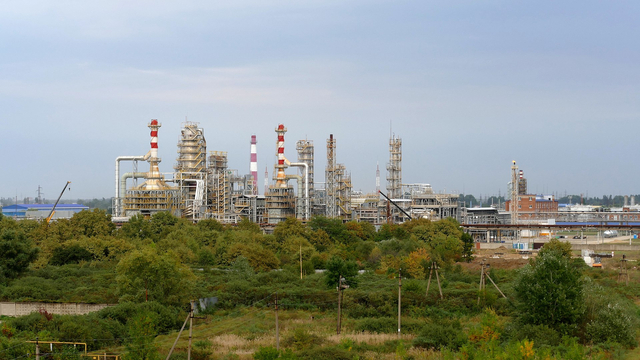
A fire broke out at one of Russia’s largest oil refineries overnight after what local authorities said was a Ukrainian drone attack, while explosions and strikes were also reported across occupied Crimea.
According to the Krasnodar Krai operational headquarters, drone debris fell in the village of Afipsky, causing a fire at the local oil refinery.
Follow our coverage of the war on the @Kyivpost_official.
“Debris from the drones fell in the village of Afipsky. This resulted in a fire at the refinery,” the statement said.
Russian authorities also claimed drone debris fell at three locations in a residential area, setting a outbuilding on fire, shattering windows in a house, and damaging a gas pipeline.
The Afipsky Oil Refinery, located about 20 kilometers (12 miles) southwest of Krasnodar, is one of Russia’s largest refining facilities.
Owned by the Safmar Group of businessman Mikhail Gutseriev, it processes approximately 6.25 million tons of crude oil annually and produces gasoline, diesel fuel, fuel oil, and other petroleum products.
The facility completed a 217-billion-ruble ($2.6 billion) modernization project in 2025 and has been repeatedly targeted since the start of Russia’s full-scale invasion of Ukraine due to its role in supporting the Russian economy and military logistics.
At 7:00 a.m., the task force announced that the fire had been extinguished.
The refinery had previously been attacked by drones twice this year, on January 21 and March 14. Previous strikes were reported in February, August and September 2025.
Krasnodar Krai Governor Veniamin Kondratyev said three people were injured during the attack. He reported that drone debris struck an apartment building in Krasnodar, causing a fire and injuring two residents.
A third person was reportedly injured in the Seversky district, where several private homes were damaged.
Russian outlet Astra, citing open-source intelligence analysis, reported that a residential building damaged in central Krasnodar is located less than two kilometers from the Kaskad Instrument Plant and JSC Saturn, both linked to Russia’s defense sector, and roughly three kilometers from the Krasnodar-Tsentralny military airfield.
Explosions were also reported across occupied Crimea overnight.
Local Telegram channels reported fires in Simferopol and Sevastopol, while air raid alerts remained in effect for several hours before being lifted after 4 a.m.
According to the Crimean Wind Telegram channel, an explosion in Sevastopol appeared to be an incoming strike, with a flash observed near Kozacha Bay.
Additional strikes were reportedly recorded near Komyshova Bay and a military facility in Striletska Bay, although it remains unclear whether drones or missiles were involved.
Russian air defenses were also reported active near Armyansk. Local channels claimed drones crossed a road bridge, damaging the structure and igniting several trucks.
“The bridge at the entrance to Krasnoperekopsk from Armyansk was also damaged. It appears there are no intact bridges left at the land entrances to the peninsula,” local channels reported.
At the time of publication, Ukraine had not commented on the reported attacks.
According to the Russian Ministry of Defense, air defense forces intercepted and destroyed 330 Ukrainian drones over Russian territory overnight. The ministry said drones were detected over the Bryansk, Kursk, Belgorod, Oryol, Smolensk, Kaluga, Tula, Tver, Vladimir, and Moscow regions, as well as over Krasnodar Krai and occupied Crimea.
Due to the drone threat, Rosaviatsiya imposed restrictions on airport operations in Tambov (Donskoye), Krasnodar (Pashkovsky), Sochi, Gelendzhik, and Zhukovsky in the Moscow region starting on the evening of June 10.
According to estimates by the independent Russian outlet 7x7, at least 25 Russian oblasts were experiencing gasoline shortages and supply disruptions as of June 10.
If Russia-occupied territories of Ukraine – Crimea, Sevastopol, and parts of the Luhansk, Donetsk, Kherson, and Zaporizhzhia regions – are included, the number rises to 31.
In Krasnodar Krai, some gas stations have reportedly begun shutting down due to fuel shortages.
In occupied Crimea, fuel prices have surged. As of June 10, a liter of AI-92 gasoline cost around 82 rubles ($1.13), compared with roughly 69 rubles ($0.69) in Moscow, while AI-95 reached nearly 90 rubles per liter versus 75 rubles in the Russian capital. Resellers were reportedly offering fuel for 130-150 rubles per liter ($5.35 to $6.17 per gallon), around 50% above official Crimean prices.
The shortages are largely attributed to Ukrainian strikes on Russia’s oil refining infrastructure.
According to Bloomberg, Russian refineries were attacked 38 times between January and May 2026, including 16 attacks in May alone – the highest monthly figure since the start of the full-scale war. Data from OilX indicates refinery utilization has fallen 14% since the beginning of the year and remains about 20% below pre-war levels.
Julia is a Deputy Head of News and correspondent for Kyiv Post who has previously worked as a parliamentary editor, journalist, and news editor. She has specialized in covering the work of the Ukrainian parliament, government, and law enforcement agencies.