Ukraine Equips S-5 Unguided Rockets on FPV Drones in Escalating Mid-Strike Campaign
AI Analysis
Ukraine is adapting Soviet-era S-5 unguided rockets for deployment from FPV drones, extending their range and enabling strikes against logistical targets up to 500km deep into Russian-held territory. This development allows Ukraine to utilize existing stockpiles of rockets and potentially conserve more expensive drone assets by delivering multiple warheads per sortie. Russia is similarly integrating air-to-air missiles onto its Shahed drones, indicating a broader trend of weaponizing kamikaze drones.
Key Takeaways
- Ukraine’s Fire Point has successfully integrated S-5 rockets (55mm, up to 8 per drone) onto its FP-1 and FP-2 drones.
- The S-5 rockets, originally designed for aircraft, extend the range of drone strikes despite their limited individual range (3-4km).
- Recent attacks near Myrnyi, Crimea demonstrate operational use with a reported operational depth of 500km utilizing a 60kg strike wing warhead.
- Ukraine is targeting Russian logistics routes in Luhansk and Donbas, potentially shifting the balance in those regions.
- Russia is also adapting missiles (R-60) for use on Shahed drones, including variants with depleted uranium warheads, raising concerns about potential hazards.
Why It Matters
This adaptation represents a low-cost, high-impact method for Ukraine to degrade Russian logistics and increase pressure on occupied territories. The trend of weaponizing kamikaze drones signals a shift in drone warfare, moving beyond reconnaissance and direct attacks to a more versatile and potentially destructive role. The use of depleted uranium warheads, even if debated in terms of risk, introduces a new dimension of concern.
Ukraine has suggested ongoing efforts to integrate unguided rockets into its drone fleets as mid-range strikes intensify.
Denys Shtilerman, the co-founder of Ukrainian arms manufacturer Fire Point, said the integration has been completed on the company’s FP-1 and FP-2 long and mid-range drones.
Follow our coverage of the war on the @Kyivpost_official.
In an interview with local outlet New Voice of Ukraine published Wednesday, Shtilerman said each drone can carry up to eight Soviet-era S-5 unguided rockets.
“We have developed a solution for existing rockets. We have a bunch of S-5 rockets left over from Soviet times and they are practically not used at the front. So why shouldn’t we use them,” Shtilerman said.
The S-5 family is a 55mm unguided rocket fired from a 57mm launch tube, according to the Collective Awareness to Unexploded Ordnance (CAT-UXO) database. Shtilerman noted that the rockets were developed from German designs used during WWII and were later adopted by the Soviet Union.
Originally intended for launch from fighter-bombers and helicopters, the S-5 has also been adapted by Russia for ground-based launchers mounted on tanks, according to reports in 2023.
Shtilerman said they’re primarily used against less protected targets, as the S-5 lacks enough penetration against those heavily armored.
Shtilerman added that the new configuration, while not “revolutionary,” could help Ukraine conserve the drone itself, rather than sacrificing it in a single attack.
“If we see a train with a bunch of tanks, we can blow up not one tank or locomotive, as before, but four tanks and a locomotive,” he said.
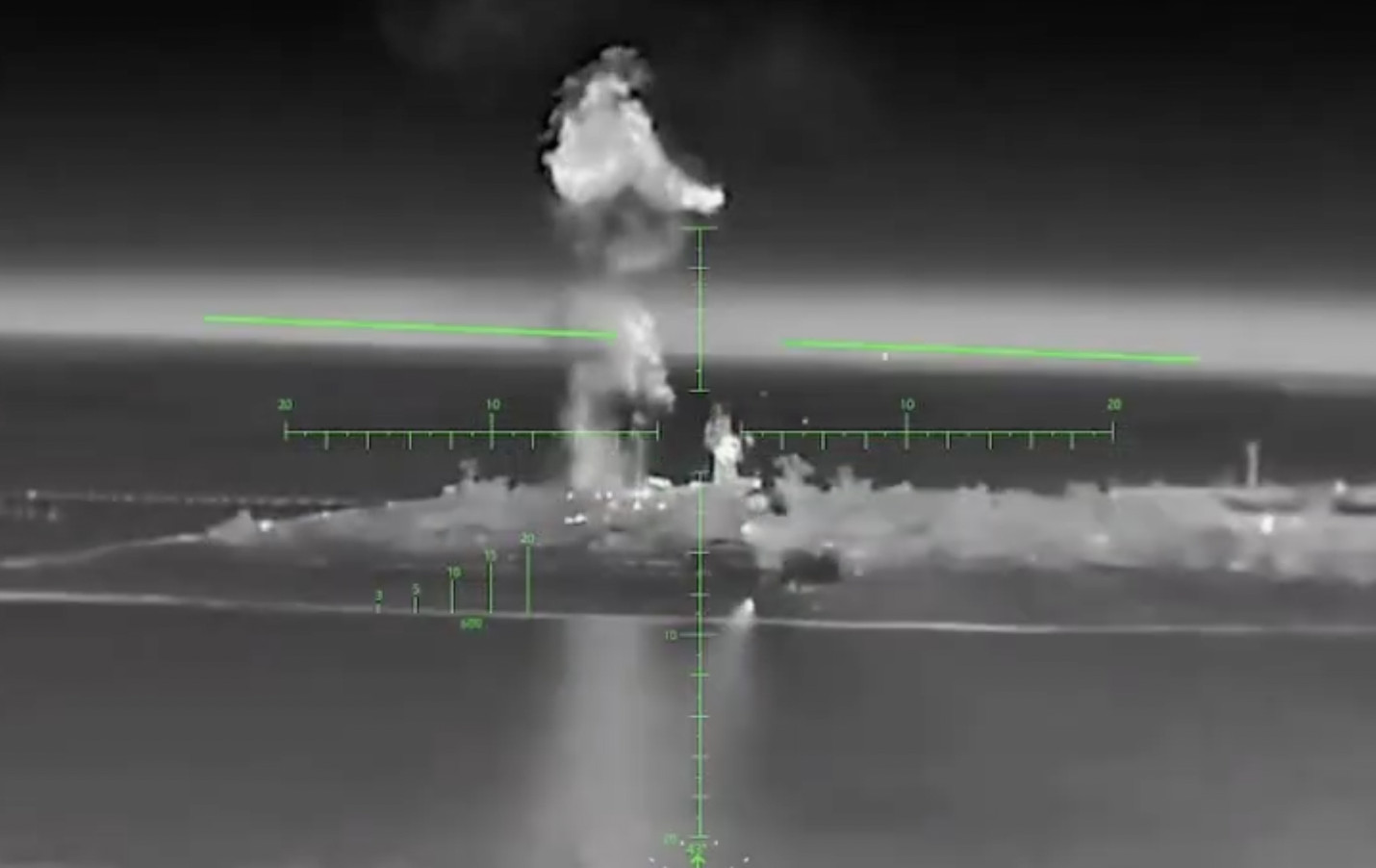
Footage published in mid-May by Ukraine’s Unmanned Systems Forces (USF) showed drones launching unguided rockets in flight.
In first-person view (FPV) footage captured from the drone’s perspective, projectiles can be seen being launched mid-air at targets identified through the drone’s onboard crosshair.
The footage is dated May 17 near the settlement of Myrnyi in western occupied Crimea, where thermal footage shows explosions after the rockets strike their targets.
The update accompanying the video said the attack has “an operational depth of up to 500 km [311 miles]” using “a 60-kg [132-lb] strike wing warhead.”
While the drone model was not identified, the report says each drone was fitted with eight unguided rockets mounted under the wings, consistent with Shtilerman’s remarks, with the USF commander noting that this “opens up completely different possibilities.”
The configuration would open the door to Ukraine’s intensifying mid-range strikes, with top commanders hinting at an ongoing campaign to pressure Russian logistics.
In his interview, Shtilerman said the rockets have a limited range, but noted that mounting them on drones significantly extends their reach.
One variant of the S-5 rocket is reported to have an effective range of 3-4 kilometers (1.9-2.5 miles), while Shtilerman said Fire Point’s drones can fly up to 1,300 kilometers (808 miles) in autonomous mode and around 500 kilometers (311 miles) when controlled via Starlink satellite communications.
The development means Ukraine can now deploy rockets that were previously impractical due to contested airspace, as they no longer need to be launched from expensive manned aircraft.
On Sunday, Ukraine’s 3rd Army Corps said Russian logistics routes towards the occupied Luhansk region – over 200 kilometers (124 miles) behind the contact line – are now under Kyiv’s drone control, with the corps’ commander previously hinting at a potential turning tide in Kyiv’s favor.
Two days prior, Ukraine’s Defense Intelligence (HUR) also claimed to have obtained fire control over the logistics routes linking occupied Donbas and Crimea.
The idea of drones firing missiles or rockets is not new, as seen in the US use of AGM-114 Hellfire missiles on MQ-9 Reaper drones and laser-guided munitions dropped from Turkey’s Bayraktar TB2 platform.
However, the latest reports suggest that both Ukraine and Russia have begun to increasingly integrate rockets and missiles into kamikaze drones, originally designed as low-cost, expendable systems with limited sophistication.
Since late 2025, Ukraine has reported instances of R-60 air-to-air missiles being mounted on Russia’s Shahed-based kamikaze drones. While some were later identified as decoys, others were assessed as operational systems intended to target aircraft deployed to intercept the drones.
In May, Ukraine also said it recovered an R-60 variant fitted with a depleted uranium warhead and warned of a potential radiation hazard, although the actual risk posed by depleted uranium remains debated.
Leo Chiu is a journalist and editor based in Eastern Europe since 2015. He has witnessed two presidential elections in Belarus and traveled widely to conflict zones and contested regions, producing reporting that bridges the gap between major developments and local realities.