Lessons from Ukraine are shaping US Army's drones, training, comms
AI Analysis
The U.S. Army is leveraging lessons from Ukraine to enhance its drone and counter-drone capabilities, focusing on resilient navigation and communication systems. Emphasis is placed on developing training environments that reflect real-world drone warfare scenarios and exploring fiber-optic drones to mitigate electronic interference.
Key Takeaways
- The U.S. Army is seeking to improve training for drone operations based on Ukrainian experiences.
- Navigation systems need alternatives to GPS, such as visual or magnetic navigation.
- Command-and-control links must be resilient to jamming and interference.
- Fiber-optic drones offer a potential solution to electronic interception.
- Ukraine's expertise in counter-UAS operations is highly regarded and influential.
Why It Matters
The strategic significance lies in the U.S. Army's adaptation to modern warfare challenges, emphasizing the need for robust and resilient systems in contested environments. By learning from Ukraine's experiences, the U.S. aims to enhance its counter-UAS capabilities, ensuring operational effectiveness and survivability in future conflicts.
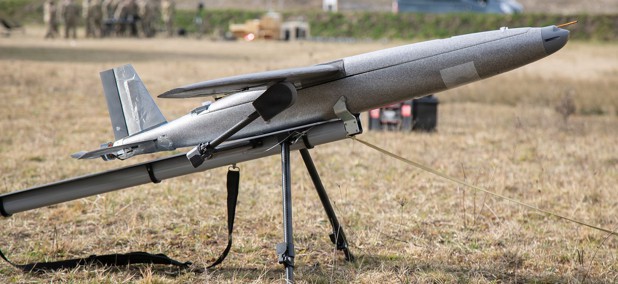
A one-way attack Hornet Drone is set up during a demonstration in the 7th Army Training Command’s Grafenwoehr Training Area, Germany, March 25, 2026.
U.S. Army / Spc. Thomas Dixon
Stay Connected
Meghann Myers
HUNTSVILLE, Alabama—The Army is sprinting to field drones and counter-drone systems throughout its units, but there are a handful of capabilities they’re still seeking to make these new systems viable in combat.
That starts with the training environment, Col. Burr Miller, of Security Assistance Group-Ukraine, said Tuesday at the AUSA Global Force Symposium.
“I saw many U.S. systems in Ukraine that did not survive contact because they were not prepared for the environment,” Miller said, calling on vendors to help the Army develop training that models the way drone warfare is actually playing out in Ukraine.
One of the key factors is navigation, which has primarily been done using GPS. Soldiers need the option to do visual-based navigation, magnetic navigation, even radio or cellular signals, he said, as back-up when GPS isn’t available.
“There are many, many ways of doing it out there, but I encourage you to consider that,” he added.
Similarly, the command-and-control links for drone systems need to be resilient to interference, able to switch from using satellites to radio frequencies to cellular signals to prevent jamming.
“And I saw a lot of systems over there where the C2 links were easily intercepted by the enemy,” Miller said. “The Ukrainians were very good at this. And they would drive off with the enemy's system and bring the party home.”
Units will have to be dispersed to stay undetected, while still being able to communicate with each other, said Col. Ryan Bell, who commands the 101st Airborne Division’s 3rd Mobile Brigade Combat Team at Fort Campbell, Ky.
“Wherever we go, we're going to be seen, and so we have to spread out,” he said. “Our communications are going to be contested in the electromagnetic spectrum…If we talk, we can be seen. If we put a signal out, they can be targeting us.”
One way to prevent that kind of interference would be to use more fiber-optic drones, Miller said, which are tethered to a control station. Though they can’t travel as far, they’re much harder to intercept than drones that rely on signals.
“I think there's a lot of value to the fact that you can take a drone, put a fiber optic core behind it, and negate the entire electronic protection that you needed to have,” he said, adding that basically the only way to defeat them is to find and physically cut the cord.
Miller’s final point was one that Army senior leaders have been making often—especially after last summer's creation of Joint Interagency Task Force-401, which is tasked with creating doctrine for counter-drone operations while putting together an online marketplace accessible to the entire U.S. government.
“There are incredible counter-UAS systems on the battlefield today that are less than $5,000 that can knock down a Group 2, 3 and 4,” he said, referring to classes of drones. “So I really think that's something important we should look at, and we need to take that experience from Ukraine's, because they are by far the best counter-UAS people on the planet.”
Help us report on the future of national security. Contact Meghann Myers: mmyers@defenseone.com, meghannmyers.55 on Signal.
NEXT STORY:
Bradley replacement is still on track, says Army acquisitions boss