Poland Signs Deal to Build €3.5 bln ‘Breakthrough’ Anti-Drone Defense System
AI Analysis
Poland has signed a €3.5 billion deal to develop the San anti-drone defense system, which is described as a groundbreaking addition to NATO's eastern air defense. The system, built by a consortium including PGZ, APS, and Norway's Kongsberg, will consist of 18 anti-drone batteries and over 700 vehicles, enhancing Poland's layered air defense network.
Key Takeaways
- Poland signed a €3.5 billion contract for the San anti-drone system to strengthen NATO's eastern flank.
- The system will include 18 anti-drone batteries and over 700 vehicles, complementing existing air defense layers like Patriot and Narew systems.
- San is described as a unique, integrated system focused on countering drones more effectively and cost-efficiently than traditional methods.
- The program will be developed by a consortium led by Poland's PGZ, private firm APS, and Norway's Kongsberg over two years.
- The initiative is part of Poland's broader Eastern Shield strategy to protect its border with Russia and Belarus, emphasizing NATO and EU security.
Why It Matters
This development highlights Poland's proactive approach to countering modern drone threats, particularly from Russia and Belarus, which have tested NATO's air defenses. The San system's integration into Poland's air defense network strengthens NATO's eastern flank and sets a precedent for European nations to adopt specialized counter-UAS systems tailored to emerging threats.
Poland signed a contract on Friday for what Prime Minister Donald Tusk called an “unprecedented” anti-drone air defense system, boasting it as a game-changer for protecting NATO’s eastern flank.
“We are dealing with an absolute breakthrough when it comes to effective defense of the Polish, European and NATO eastern border,” Tusk said at the signing ceremony. “Especially in the most sensitive area – air defense, and above all defense against modern forms of aggression.”
Follow our coverage of the war on the @Kyivpost_official.
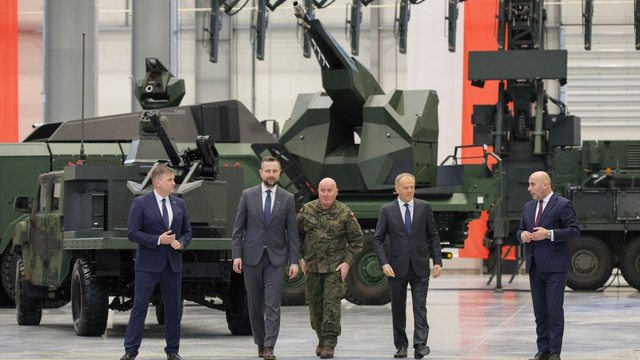
The agreement covers the San anti-drone system and was signed at a state-owned defense facility near Warsaw in the presence of Tusk and Defense Minister Władysław Kosiniak-Kamysz.
The system will be built by a consortium led by Poland’s state defense group PGZ, alongside private firm APS and Norway’s Kongsberg, in a program expected to run for two years.
Unofficial estimates put the cost at nearly 15 billion zlotys (€3.4 bln).
The San system will complement Poland’s layered air defense network, which already includes U.S.-made Patriot systems under the Wisła program, British short-range missiles under Narew, and very short-range Pilica systems.
Kosiniak-Kamysz said the San program would include 18 anti-drone batteries and more than 700 vehicles, and that Poland’s total investment in air defense systems amounted to about 250 billion zlotys.
“This is a system of connected vessels – sensors and effectors – designed above all to counter threats coming from the east,” he said.
Strongest border in Europe
Tusk said the project was central to strengthening Poland’s eastern border with Russia and Belarus, which is also the frontier of the European Union and NATO.
“It is crucial for us that the Eastern Shield also effectively protects Polish airspace,” he said.
Calling San unique in Europe, Tusk said it would allow Poland to respond to aerial threats “more effectively, more cheaply and more intelligently” than using fighter jets or missiles.
“There is no other example in Europe today of such an integrated, intelligent system focused primarily on countering drones,” he said.
He referred to incidents last autumn when Russian drones entered Polish airspace, arguing they exposed the limits of traditional air defense methods.
“These first experiences with drone aggression showed how inadequate tools like fighters or missiles are when it comes to shooting down drones,” Tusk said.
The prime minister said cooperation with Norway’s Kongsberg reflected a new regional security architecture linking Poland with Nordic and Baltic states.
“This is also an element of a new security architecture that Poland initiated less than two years ago,” he said.
Tusk said he would raise the “European dimension” of the San program and Poland’s broader Eastern Shield initiative at talks with European leaders in Zagreb later on Friday.
“I will emphasize again that securing the eastern border is not only Poland’s task, but the responsibility of all of Europe and the whole of NATO,” he said.