Orlan-10
Russia's most widely deployed tactical reconnaissance UAV, used extensively for artillery spotting, surveillance, electronic warfare, and communications relay across the Ukrainian front.
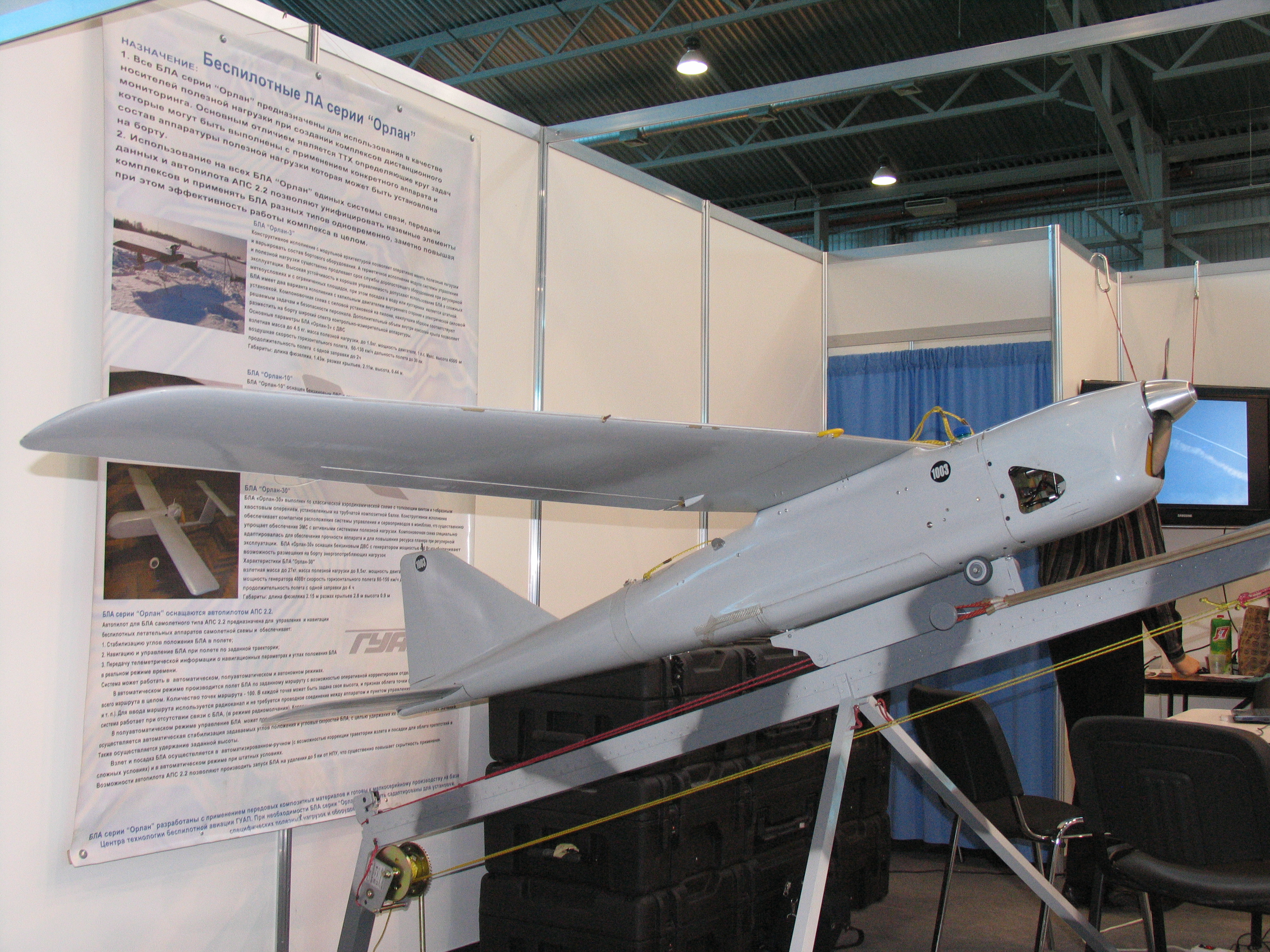
System Overview
What It Is
The Orlan-10 is Russia's workhorse tactical unmanned aerial system, produced by the Special Technology Center in St. Petersburg. It is by far the most numerous UAV in Russian military service, with thousands produced and deployed. It serves primarily as a reconnaissance and artillery fire-correction platform but can also carry electronic warfare payloads.
How It Works
The Orlan-10 is catapult-launched and recovered by parachute. It carries interchangeable payload modules including daylight and infrared cameras for reconnaissance and a suite of electronic warfare payloads for jamming cellular communications and GPS signals. In its primary role, it orbits over the battlefield transmitting real-time video to ground stations, allowing artillery units to observe targets and correct fire. The system typically operates in groups with a ground control station managing up to four aircraft simultaneously.
Primary Capability
Tactical reconnaissance, surveillance, artillery fire correction, electronic warfare, and communications relay.
Combat Record / Operational History
The Orlan-10 has been Russia's primary ISR UAV throughout the war in Ukraine, with thousands of sorties flown. It has been instrumental in directing Russian artillery fire, which has been a primary casualty-producing weapon system. Ukraine has shot down hundreds of Orlan-10s, and captured examples have revealed extensive use of Western commercial components including Canon cameras and various GPS/IMU modules, despite international sanctions. The Orlan-10 was previously used in Syria, supporting Russian operations from 2015 onward. It has also been deployed in EW roles, jamming Ukrainian cellular and GPS communications.
Overview
The Orlan-10 is the backbone of Russian tactical unmanned aviation. Produced by the Special Technology Center in St. Petersburg, it is the most widely used UAV in the Russian military, with an estimated 1,000+ units in service at any given time. Its primary mission is reconnaissance and artillery fire correction, making it a critical enabler of Russia's artillery-centric warfighting doctrine.
Technical Details
The Orlan-10 has a wingspan of 3.1 meters and a maximum takeoff weight of 18 kg. It is powered by a small gasoline piston engine giving it an endurance of 10-16 hours and a maximum speed of about 150 km/h. It operates via a datalink with a range of up to 120 km and can carry approximately 5 kg of interchangeable payloads. Standard payloads include daylight and infrared cameras for surveillance, as well as electronic warfare modules capable of jamming cellular communications and GPS signals. The system is catapult-launched and recovered by parachute. A single ground control station can manage up to four Orlan-10s simultaneously.
Combat History
The Orlan-10 has been used extensively in both Syria (from 2015) and Ukraine (from 2022). In Ukraine, it has been the primary means by which Russian forces direct artillery fire, serving as airborne eyes for howitzer and multiple-launch rocket system batteries. Ukrainian forces have shot down hundreds, and analysis of captured units has revealed extensive reliance on Western commercial components including Canon EOS cameras, Garmin GPS modules, and various European-manufactured inertial measurement units. This dependency on imported components has been a vulnerability exploited by international sanctions, though Russia has found alternative supply channels.
Electronic Warfare Role
Beyond reconnaissance, the Orlan-10 carries electronic warfare payloads in some configurations. These can jam cellular communications over a localized area, disrupt GPS signals to interfere with precision-guided weapons, and perform signals intelligence collection. This multi-role capability makes the Orlan-10 a flexible tactical asset that extends well beyond simple surveillance.
Technical Specifications
- Wingspan: 3.1 m
- Length: 1.8 m
- Maximum takeoff weight: 18 kg
- Payload: ~5 kg
- Endurance: 10-16 hours
- Range: 120 km (datalink)
- Ceiling: 5,000 m
- Speed: 90-150 km/h
- Engine: Gasoline piston (various, including converted commercial engines)
- Launch: Catapult
- Recovery: Parachute
- Sensors: Daylight camera, IR camera, optional EW payload
Range
25-30 km (optical sensors)
120 km datalink range
Compatible Platforms
Deployed By
Key Features
- Modular payload bay for different mission configurations
- Long endurance (10-16 hours)
- Electronic warfare capability
- Real-time video downlink for artillery correction
- One ground station controls up to 4 aircraft
- Simple catapult launch / parachute recovery
Advantages
- Produced in very large numbers (thousands in service)
- Relatively inexpensive
- Long endurance for persistent surveillance
- Versatile mission profiles (ISR, EW, arty correction)
- Simple logistics and operation
- Battle-tested extensively
Limitations
- Uses some Western commercial components (subject to sanctions)
- Vulnerable to modern air defense and EW
- Limited altitude and speed
- Catapult launch limits operational flexibility
- Parachute recovery can damage the aircraft
- Camera quality inferior to Western equivalents