Kinetic Defeat: Interceptor Drones and Missiles
The full spectrum of kinetic C-UAS methods—from net-capture drones and loitering interceptors to missiles, guns, and shotgun rounds—and the cost-per-kill economics that are forcing a rethink of how we spend kinetic munitions on drone threats.
Quick Overview
What It Is
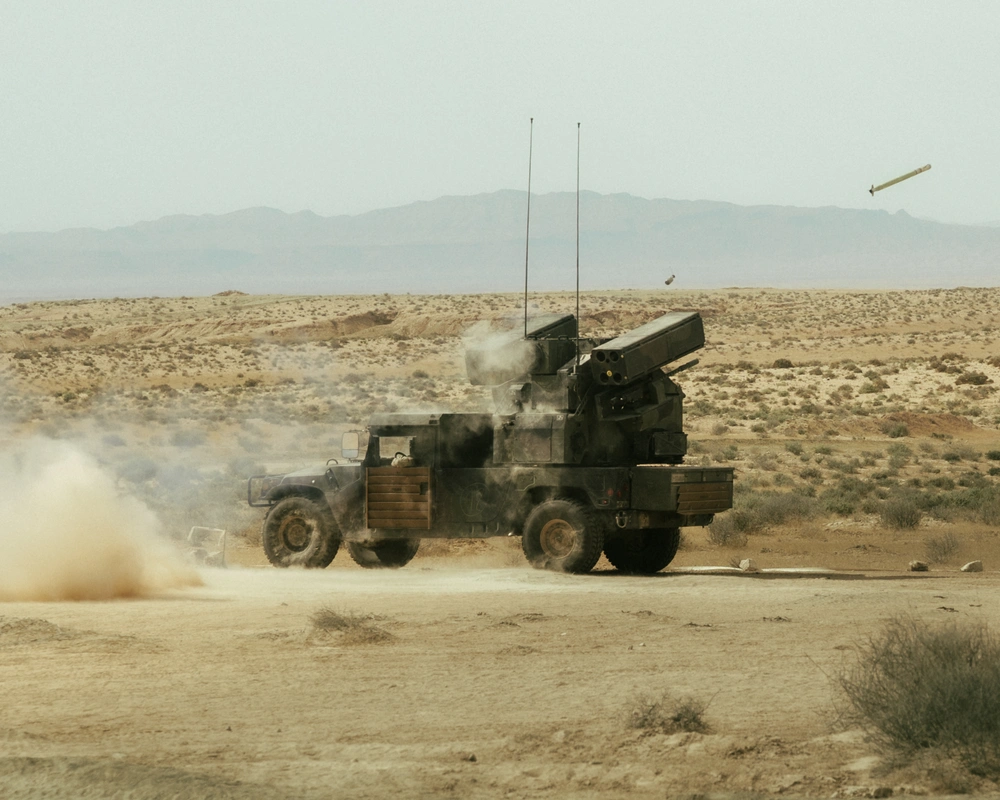
Kinetic defeat encompasses all C-UAS methods that physically destroy or capture a drone through direct force: interceptor drones (both net-capture and ram types), purpose-built air defense missiles, gun systems, and novel approaches like high-velocity projectiles and shotgun munitions. Unlike electronic warfare, kinetic defeat is terminal—it guarantees destruction rather than behavioral disruption.
How It Works
Kinetic defeat requires the C-UAS system to solve a fire control problem: compute an intercept solution, guide a defeat mechanism to the predicted intercept point, and achieve sufficient lethality to disable the target. Different kinetic mechanisms solve different parts of this problem differently. Interceptor drones can pursue maneuvering targets autonomously. Missiles use active or semi-active guidance to home on the target. Guns require accurate fire control to place a projectile in the target's path. Net systems capture without destroying, enabling post-engagement exploitation.
Kinetic Defeat: Interceptor Drones and Missiles
The drone threat economics problem is simple to state and difficult to solve: a $500 commercial quadrotor or a $20,000 Shahed loitering munition can be defeated by a $4 million SM-6 missile. The US Navy demonstrated this exchange rate repeatedly in the Red Sea starting in October 2023, burning through surface-to-air missile inventory at a rate that alarmed defense planners and elevated cost-per-kill from a background logistics concern to a strategic-level problem. Kinetic defeat of drones is technically solved. The challenge is doing it in a way that doesn't bankrupt the defender faster than the attacker can manufacture threats.
The Hierarchy of Kinetic Options
Kinetic C-UAS methods occupy a spectrum from expensive and high-reliability to cheap and probabilistic. Understanding where each method sits on that spectrum—and what threat types it's appropriate for—is the foundation of effective layered kinetic defense.
Tier 1: Purpose-built air defense missiles (Patriot, SM-2/SM-6, NASAMS) were designed for aircraft and ballistic missiles. They work against large UAS and cruise missiles but at cost ratios that are operationally unsustainable against cheap drone swarms. These remain appropriate for defending high-value assets against cruise-missile-class UAS threats.
Tier 2: UAS-specific interceptor missiles (Coyote family, Roadrunner, NINJA) represent the deliberate attempt to create cost-competitive kinetic solutions. They sacrifice some performance envelope to achieve dramatically lower unit costs.
Tier 3: Interceptor drones (DroneHunter F700, Iron Drone) pursue drone-on-drone defeat, either through net capture or physical ram. Single-use interceptors can be substantially cheaper than missiles if the airframe itself is low-cost.
Tier 4: Gun systems (30mm chain gun on M-SHORAD, ZU-23-2, Centurion CIWS) use existing high-volume ammunition against drone targets. The cost per round is orders of magnitude lower than any missile—the challenge is fire control accuracy and fragmentation hazard.
Tier 5: Improvised and emergent methods (modified shotgun rounds, RPGs against slow drones, small arms) are not doctrine but have proven tactically relevant in Ukraine and other theaters where formal C-UAS systems are unavailable or overwhelmed.
Drone-on-Drone Intercept
The intuitive appeal of using drones to kill drones is strong. The interceptor drone can maneuver autonomously, pursue a maneuvering target, and theoretically achieve high single-shot kill probability without the complexity of guided missiles.
Fortem Technologies DroneHunter F700 is the leading purpose-built interceptor drone in the US market. It carries a net gun that fires a tethered mesh to entangle the target drone's rotors. The key operational advantage is capture: the target drone is recovered intact rather than destroyed, enabling forensic exploitation for intelligence—operator identity from telemetry logs, payload assessment, network attribution if the drone connected to known C2 infrastructure. The DroneHunter has been demonstrated against Group 1 and Group 2 targets and can operate autonomously from radar cueing to intercept without human in the loop for the terminal engagement.
Rafael Iron Drone (Israel) takes a kinetic-kill approach—the interceptor physically rams the target. This eliminates the complexity of net deployment (nets can miss; a pursuing drone that physically contacts the target does not) at the cost of recovery and intelligence exploitation. Iron Drone has been tested in the context of Israel's layered air defense architecture as a lower-cost complement to Iron Dome for Group 1–2 threats.
The operational limitation of interceptor drones is loiter time and readiness. A DroneHunter on a pad waiting for an inbound drone is consuming battery. It must launch quickly from cueing, which requires integration with a detection system that provides adequate warning time—typically 30–90 seconds for approaching Group 1 threats at engagement ranges of 500m–2km. In high-threat environments with frequent drone activity, interceptor drones require multiple airframes in rotation or a rapid-recharge/swap infrastructure.
Net capture systems also exist as ground-launched (net guns) and drone-deployed configurations for very short-range or static site defense.
Missile Interceptors: The Coyote Family
Raytheon's Coyote program is the US military's primary purpose-built answer to the cost-exchange problem for Group 1–3 UAS. The family has evolved significantly through multiple block upgrades.
Coyote Block 1 was originally a one-way UAS platform repurposed as a kamikaze interceptor—an early attempt to use an existing airframe rather than design a new missile. Performance against maneuvering targets was limited.
Coyote Block 2+ is a true interceptor missile with active radar seeker for terminal homing. It's launched from a tube launcher (LASSO system) and can engage targets up to several kilometers. The unit cost is approximately $30,000–$75,000 depending on contract quantity—a meaningful improvement over large SAMs but still expensive relative to the cheapest threats. Block 2+ has been operationally deployed and has engagement history against real-world UAS threats.
Coyote Block 3 extends the engagement envelope and adds capability against faster and more maneuvering targets, bridging toward the Group 3 threat class. The CUDA kinetic interceptor variant (compact high-speed kinetic energy interceptor) represents a further evolution toward defeating high-speed threats including possible UAS swarms.
Roadrunner from Anduril Industries takes a different architectural approach: a jet-powered loitering interceptor that can take off, search for threats, and return to land if no engagement occurs—unlike a missile, it's recovered and reused when not expended. Roadrunner-M carries a kinetic warhead for autonomous engagement. The reusability directly addresses the cost-per-engagement problem by amortizing airframe cost across multiple sorties. Roadrunner entered testing with US military customers in 2023 and represents the commercial defense sector's answer to the Coyote architecture.
Gun-Based Kinetic Defeat
Gun systems solve the cost problem more aggressively than any missile: a 30mm APFSDS round costs roughly $20–$80. The challenge is entirely in fire control.
M-SHORAD (Maneuver-SHORAD) on the Stryker platform integrates the XM914 30mm chain gun as its primary kinetic defeat mechanism for UAS, alongside Stinger missiles. Against hovering or slow-moving Group 1–2 UAS, the 30mm is highly effective. Against fast-moving cruise-missile-class UAS, the engagement geometry becomes challenging. Fire control integration with the LMADIS/MADIS detection stack enables automatic target tracking to drive the gun mount, reducing the latency that would result from manual operator slewing.
In Ukraine, the ZU-23-2 twin 23mm autocannon—a Soviet-era system originally designed for aircraft—has become one of the primary anti-drone weapons by volume of engagements, simply because ammunition is available in enormous quantities relative to missile stocks. Ukrainian forces have developed modified aiming techniques and engagement profiles for UAS that the system was never designed for.
The NINJA (Non-Kinetic Integrated Joint Actuation) concept uses high-velocity projectiles designed specifically for the UAS engagement problem—lighter than traditional anti-aircraft rounds, with fusing and fragmentation patterns optimized for small, slow targets rather than aircraft.
For very close-in defense, the XM1100 Shotshell—a 30mm cartridge containing tungsten pellets—provides a pattern-based defeat mechanism that relaxes fire control accuracy requirements. At ranges of 100–300 meters against slow Group 1 UAS, a single round that places several pellets through rotor assemblies is reliably lethal. The fragmentation hazard is the primary operational constraint on this approach in populated or friendly-force-dense environments.
Cost-Per-Kill Economics
The Red Sea experience forced explicit cost-exchange ratio analysis into operational planning in a way it had not been before. During November 2023–January 2024, US Navy destroyers expended approximately 28 SM-2 and SM-6 missiles in defense against Houthi drone and missile attacks. At published unit costs, this represents $40–$80 million in expenditure against an attack force worth a fraction of that figure.
The asymmetry matters operationally for two reasons. First, magazine depth is finite—a destroyer carries roughly 90 VLS cells total, shared across all threat categories. Exhausting SAM inventory to defeat cheap drones creates vulnerability to concurrent or subsequent higher-value threats. Second, US defense industrial capacity to produce SM-2/SM-6 missiles is measured in hundreds per year, not thousands. An adversary capable of manufacturing cheap drones by the tens of thousands annually is imposing an industrial attrition that the defender cannot sustain with legacy missile responses.
This analysis has directly driven investment acceleration in:
- Coyote Block 2+ and Block 3 production scale-up
- Roadrunner development contract
- DE M-SHORAD (directed energy as a zero-marginal-cost alternative)
- Gun-based engagement as the preferred method for Group 1 threats where engagement geometry permits
The doctrine emerging from this analysis is cost-tiered engagement: match the defeat mechanism to the threat cost tier. Group 1 threats (under 20 lbs) should be engaged with guns, interceptor drones, or low-cost missiles. Group 2 threats with EW or mid-cost missiles. Reserve high-cost SAMs for Group 3 and above, or threats with high confidence of WMD/high-explosive payload.
Integration and Fire Control
Kinetic defeat is only as effective as the detection-to-engagement pipeline feeding it. A Coyote launcher or 30mm gun that receives a radar track 15 seconds before a drone reaches the defended asset is operationally different from one receiving 120 seconds of warning. The detection layer—whether KURFS radar, LSTAR, or a passive RF system—must be tightly integrated with the kinetic defeat system through a common operational picture.
FAAD C2 serves this integration function for most US Army kinetic C-UAS systems, fusing tracks from multiple sensors and providing engagement geometry to weapons system operators. The human-machine interface question—how much automation to enable at the weapons release decision point—remains operationally and legally contested, with current US policy requiring a human in the loop for kinetic engagement decisions even where the geometry makes automated engagement technically superior.
As drone swarms become operationally relevant—Iranian and Houthi forces have demonstrated coordinated multi-UAS attacks—the fire control problem scales non-linearly. A single engagement system engaging one target at a time cannot defeat a simultaneous 10- or 20-drone attack. Directed energy (which can re-engage instantly after defeating one target) and gun systems (high rate of fire) have inherent advantages over single-shot missiles in swarm scenarios, driving the current multi-layer architecture toward using kinetic missiles as a backstop rather than the primary layer.
Key Features
- Drone-on-drone intercept via physical ram or net deployment
- Loitering interceptor missiles (Coyote Block 2+, Roadrunner)
- Gun-based defeat (30mm cannon, 7.62mm, specialized shotgun rounds)
- Net and capture systems for non-destructive intercept
- Guided missile intercept (Stinger FIM-92 adapted for UAS)
- Autonomous terminal guidance reducing human reaction time requirements
- Cost-scalable defeat mechanisms matched to target value
Advantages
- Terminal defeat—guaranteed destruction versus behavioral disruption
- Effective against autonomous drones with no RF link to jam
- No electromagnetic fratricide risk to friendly systems
- Can defeat targets that have survived EW engagement attempts
- Net capture enables intelligence exploitation of intact airframe
Limitations
- Expendable munitions create resupply and cost sustainability challenges
- High-cost missiles against low-cost drone targets creates asymmetric economics
- Gun systems require precise fire control and create debris/fragmentation hazards
- Interceptor drones have limited loiter time and require recovery or are single-use
- Weather and visibility conditions affect optical/IR guidance systems
- Blue-on-blue risk in complex airspace with multiple friendly UAS
Real World Application
The cost asymmetry of kinetic C-UAS became a central US military concern during Red Sea operations in 2023–2024, where Navy ships expended SM-2 and SM-6 missiles (unit costs ranging $400K–$4M) against Houthi Shahed drones costing approximately $20,000–$50,000 each. The Coyote interceptor program was specifically designed to address this: Coyote Block 2+ costs approximately $30,000–$75,000 per round, creating a more defensible cost ratio against Group 1–3 UAS. In Ukraine, gun-based defeat using ZU-23-2 twin 23mm systems and modified infantry weapons has been a primary method due to unlimited ammunition availability relative to missile stocks.