The Kill Chain: Detect, Track, Identify, Defeat
How the counter-UAS kill chain maps to real hardware, what breaks it in practice, and why vendor integration is the hardest problem in C-UAS.
Quick Overview
What It Is
The counter-UAS kill chain is the sequence of sensor and shooter actions required to find, fix, track, identify, and neutralize an unmanned aerial threat. Each phase maps to specific hardware and software, and the chain is only as fast as its slowest link — which in practice is usually identification or the human authorization step.
How It Works
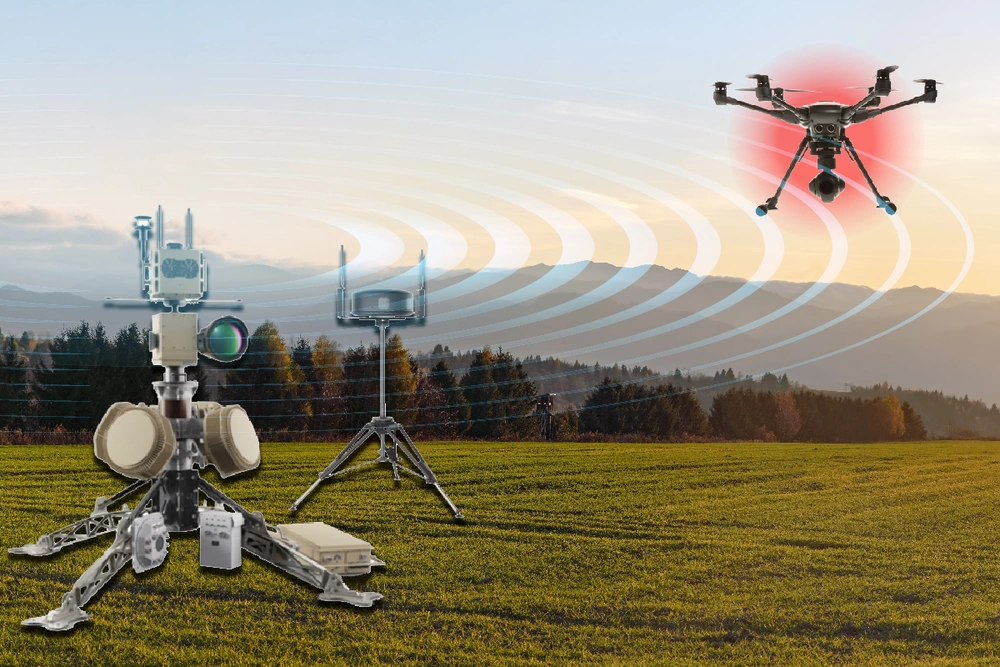
A detection sensor (radar, RF, acoustic, optical) generates a cue. That cue is handed to a tracker — typically radar — that maintains continuous contact. An identifier (EO/IR camera, RF classifier, or AI algorithm) determines whether the contact is hostile. An engagement authority (human operator or automated rule set) authorizes defeat. A defeat system (kinetic, EW, directed energy, net) executes. Confirmation sensors verify the kill.
What a Kill Chain Actually Is
"Kill chain" entered defense vocabulary as a targeting model — Find, Fix, Track, Target, Engage, Assess (F2T2EA) — developed by the U.S. Air Force for precision strike planning. Counter-UAS adapted this into a more compact version: Detect, Track, Identify, Defeat (DTID). Both frameworks describe the same reality: neutralizing a threat requires successfully completing every phase in sequence, and failure at any phase means the threat survives.
In C-UAS, the kill chain runs in seconds to minutes, not hours. A DJI Mavic-class UAS flying at 60 km/h covers 16 meters per second. An engagement window at a defended perimeter may last 30–90 seconds. Against a Shahed-136 kamikaze drone flying at 180 km/h, the window may be under two minutes from first radar contact to impact on a ship or facility. Every second of latency in the kill chain is distance the threat travels toward its objective.
Phase 1: Detect
Detection is the first task and, for small UAS, often the hardest. The detection layer typically includes:
Radar — the primary sensor for all-weather, long-range, multi-target detection. Provides range, azimuth, and (in 3D systems) elevation. Does not require the target to be emitting. Range limited by RCS physics (Group 1 UAS at under 0.1 m² effective RCS) and clutter floor. KURFS provides 360° detection at 3–8 km for Group 1 UAS. LSTAR extends to larger targets at greater range.
RF detection — passive monitoring of the radio frequency links between drone and pilot (typically 2.4 GHz, 5.8 GHz, or 900 MHz ISM bands). Can detect the drone before radar if the pilot is transmitting telemetry. Provides bearing to drone and — by triangulation — range estimate. Cannot detect pre-programmed autonomous drones that are not transmitting. DedroneTracker and DroneShield RfPatrol are deployed at dozens of U.S. military installations specifically for RF cueing.
Electro-optical/infrared (EO/IR) — cameras (visual and thermal) that detect the visual or heat signature of a UAS. Highly effective at short range for confirmation and classification. Limited by weather, light conditions, and effective range (typically under 3 km for Group 1). Almost always used as a secondary sensor cued by radar or RF.
Acoustic — arrays of microphones that detect rotor noise. Range limited to a few hundred meters in ambient noise. Used mainly at fixed facilities as a proximity alarm or cue to slew EO/IR cameras.
A mature C-UAS architecture uses all four in fusion — each sensor's detections feeding a common track manager that combines evidence to build confident detections and reduce false alarms.
Phase 2: Track
Detection produces a point cue — a single range/azimuth/elevation measurement. Tracking produces a state estimate — a continuously updated position, velocity, and predicted trajectory. The difference matters operationally: you cannot fire a Coyote at a detection. You need a track with sufficient accuracy to compute an intercept solution.
Track quality degrades when:
- The radar scan rate is too slow (legacy rotating radars at one revolution per 4–8 seconds lose Group 1 UAS behind clutter between scans)
- The UAS maneuvers aggressively (Kalman filter diverges; multi-hypothesis tracking required)
- The target descends into terrain mask and falls below radar line of sight
- Multiple drones in a swarm create track association ambiguity
FAAD C2 (Forward Area Air Defense Command and Control) is the Army's primary C-UAS track manager. It ingests reports from multiple sensors — KURFS, LSTAR, the AN/TPS-80 G/ATOR — and maintains a composite air picture with assigned track numbers. Operators see a single display rather than separate sensor displays, enabling faster decisions.
IBCS (Integrated Air and Missile Defense Battle Command System) extends this to a nodal network architecture where any sensor can feed any shooter, regardless of physical proximity or vendor. An IBCS-enabled brigade could theoretically cue a Coyote battery 20 km away using KURFS radar data from a different unit — closing kill chains that would be impossible with stovepipe systems.
Phase 3: Identify
Identification is where kill chains fail most often in practice. Radar sees a small slow-moving aerial contact at low altitude. Is it a Group 1 UAS? A large bird? A weather balloon? A friendly ISR drone? An error at this phase kills civilians, destroys friendly assets, or — through inaction — allows hostile UAS to complete their mission.
Identification relies on:
Micro-Doppler classification — rotor blade signatures analyzed by signal processing or neural network classifiers. Trained on libraries of known drone types. Effective for rotary-wing UAS; weaker for fixed-wing.
RF fingerprinting — passive intercept of the drone's control link. Different manufacturers and even individual units have detectable RF signatures. DedroneTracker can identify DJI, Autel, and Parrot drones by their RF protocol characteristics. Autonomous or encrypted links defeat this method.
Visual identification via EO/IR — a slewed camera zooms onto the track and an operator (or AI) identifies the airframe visually. Requires favorable lighting and range. AI-assisted ID systems from Palantir (Lattice), Dedrone, and others reduce operator workload but require continuous retraining as adversaries field new airframes.
Cooperative identification (IFF) — friendly forces broadcast cryptographic identification codes. Any track not squawking a valid code is treated as potentially hostile. Standard in manned aviation; absent on most UAS, creating fratricide risk in dense airspace.
In Iraq and Syria, identification delays of 30–60 seconds were common before engagement authorization — time during which an adversary drone covered 500–1,000 meters toward its target. The Army's ABMS (Advanced Battle Management System) concept aims to push AI-assisted ID to the track level, completing classification in under five seconds.
Phase 4: Defeat
The defeat phase offers the most choices — and the most constraints. Defeat options include:
Kinetic defeat — Coyote interceptor, Stinger FIM-92, XM914 chain gun, laser (HELWS, DE M-SHORAD). High confidence of kill. Risk of debris. Ammunition-limited. Cost per shot matters: at $30,000–$100,000 per Coyote round versus a $500 commercial drone, the math is unfavorable at scale.
Electronic attack (EA) — RF jamming (DroneDefender, Dronebuster, DroneGun Tactical) or GPS spoofing (EnforceAir). No expenditure cost per shot. Effective against radio-controlled or GPS-dependent drones. Fails against autonomous pre-programmed UAS. Creates collateral RF interference that may affect friendly communications and navigation.
Directed energy (DE) — THOR, HELWS, Iron Beam, Leonidas. Near-zero cost per shot. Speed-of-light engagement. Limited by aperture size, atmospheric conditions, and cooling requirements. Effective against small UAS at close range. Range-limited against fast-moving or highly maneuverable targets.
Capture/net — Dronehunter F700, net gun systems. Non-destructive. Useful for capturing evidence or intact threat hardware for exploitation. Limited range. Requires skilled operator. Not scalable for swarm threats.
Defeat system selection is driven by rules of engagement (ROE), collateral damage estimation (CDE), and logistics. At a firebase in Anbar Province, a Coyote engagement produces falling debris over known terrain — acceptable CDE. Over Baghdad or Kabul, the same engagement might be prohibited. RF jamming may be authorized over open terrain but prohibited at an airport where it would disrupt commercial air traffic.
What Breaks the Kill Chain
Latency in sensor-to-C2 handoff: If the radar-to-FAAD data link uses legacy TADIL-J protocols at low update rates, track accuracy degrades by the time it reaches the fire control system. Modern systems use modern data links (Link 16, MQTT-based IP networks) to reduce this to under one second.
Vendor stovepipes: KURFS speaks one protocol. A non-Raytheon fire control system may not ingest KURFS tracks natively. Every proprietary interface requires an adapter — and each adapter introduces latency, potential failure modes, and maintenance burden. The Army's C-UAS Task Force spent significant effort in 2021–2023 forcing vendors to adopt common data formats through the CUAS MOSA (Modular Open Systems Architecture) initiative.
Human bottlenecks: When ROE require a human commander to authorize each engagement, and that commander is simultaneously managing other tasks, engagement authority becomes the rate-limiting step. Automation can compress Detect-to-Track-to-Identify to under five seconds; human authorization adds 10–60 seconds. Against a fast-moving threat, this is the difference between a kill and a miss.
Swarm saturation: A 20-drone swarm launched simultaneously creates 20 simultaneous track requirements, 20 simultaneous ID requirements, and potentially 20 simultaneous engagement decisions. Any finite-capacity kill chain will be overwhelmed. The response is pre-planned automated engagement authorities — pre-delegated ROE that allow the system to engage without human authorization within defined parameters.
Real Execution: Al-Asad and the Ukraine Contrast
At Al-Asad Air Base in Iraq, the integrated C-UAS system — KURFS radar, FAAD C2, Coyote interceptors — has successfully engaged Iran-backed one-way attack UAS multiple times since 2021. The kill chain there is tightly integrated, trained, and practiced. Sensor-to-shooter timelines are under 60 seconds.
In Ukraine in 2022, improvised kill chains using MANPADS, ZSU-23-4 anti-aircraft guns, and operator-portable RF jammers proved surprisingly effective against early Shahed-136 attacks. Ukrainian operators developed informal but rapid kill chains: RF detection gives bearing, operators visually acquire, engage with available weapon. No C2 software, no automated handoffs — but kill chain latency measured in seconds because every element was co-located and the authorization chain was immediate.
As Shahed attacks intensified and Ukrainian air defenses were degraded, longer kill chains with more process — NASAMS, Patriot batteries with formal engagement authority procedures — showed higher latency. The lesson: simplicity of integration competes with depth of capability. The best kill chain is the one that closes before the threat reaches its objective.
Key Features
- Multi-layer sensor architecture: radar, RF, EO/IR, acoustic
- Automated track management and cue routing
- Identity classification via micro-Doppler, RF fingerprinting, or visual AI
- Rules of engagement (ROE) enforcement before engagement
- Multi-effector defeat options: kinetic, EW, DE, capture
- Battle damage assessment and reattack cueing
Advantages
- Structured process reduces missed threats and fratricide risk
- Automated handoffs accelerate sensor-to-shooter timeline
- Multiple defeat options allow ROE-appropriate responses
- Networked architecture enables engagement by the best-positioned shooter
- Recorded kill chain data supports post-engagement analysis and training
Limitations
- Each handoff point introduces latency — seconds matter against fast UAS
- Proprietary vendor interfaces create interoperability gaps
- Human-in-the-loop authorization can become the rate-limiting step
- Swarm attacks can saturate any finite-capacity kill chain
- Classification errors at the identify phase risk fratricide or civilian harm
Real World Application
At Al-Asad Air Base in Iraq, KURFS radar cues Coyote interceptors through FAAD C2 — a complete kill chain demonstrably effective against Iranian-backed drone-rocket combinations used since 2021. In Ukraine, short kill chains enabled by operator-portable RF jammers proved effective against Russian Shahed-136 attacks in 2022–2023, while longer chains with multiple authorization steps missed fleeting engagement windows.