The Drone Proliferation Problem
How commercial drones became the defining weapon of modern warfare, why export controls failed to stop proliferation, and what the democratization of aerial lethality means for every future conflict.
Quick Overview
What It Is
Drone proliferation refers to the rapid spread of unmanned aerial systems—from state militaries to non-state armed groups, from specialized military technology to commodity consumer goods—that has fundamentally changed who can conduct aerial reconnaissance and strike operations and at what cost. The proliferation problem is not primarily about military UAVs; it is about the weaponization of commercial technology that was designed for photography, agriculture, and recreation.
How It Works
Commercial drone manufacturing, led by Chinese firms like DJI, has compressed the cost of a capable multi-rotor aerial platform from hundreds of thousands of dollars to several hundred. These platforms carry sensors, payloads, and autonomy software that would have required purpose-built military systems a decade ago. Non-state actors have learned to modify them for reconnaissance, weapons delivery, and kamikaze strike missions. State actors have integrated them as the cheapest available precision strike option. The result is an aerial dimension to conflict that previously only militaries with significant budgets could access.
The Drone Proliferation Problem
In 2006, the United States military fielded approximately 5,000 unmanned aerial systems of all types, almost all of them expensive purpose-built military platforms. Access to armed aerial reconnaissance required nation-state budgets and nation-state logistics. By 2024, a motivated non-state group could acquire a surveillance drone for $300 at a consumer electronics retailer, modify it for weapons delivery using freely available online tutorials, and integrate it into military operations within weeks of organizational decision.
That compression—from exclusive military capability to commodity consumer product in roughly 15 years—is the drone proliferation problem. It is not primarily about state-on-state competition for advanced military UAS. It is about the collapse of the barrier to entry for aerial operations and what that means for every future armed conflict.
How the Price Floor Collapsed
The technology that made drones expensive in 2006 was not the fundamental physics of aerial platforms. Multi-rotor electric aircraft are mechanically simple—the invention of the helicopter predates microelectronics. What was expensive was the sensing, processing, and control technology required to make small unmanned aircraft stable, controllable at range, and useful for anything other than toy flying.
Three technological shifts compressed the price floor:
Smartphone component economics drove dramatic cost reductions in accelerometers, gyroscopes, GPS receivers, microprocessors, and miniature cameras—exactly the components a useful drone requires. The global smartphone supply chain, producing billions of units annually, drove these components to near-commodity prices. A flight controller that cost thousands of dollars as a purpose-built aerospace component could be assembled from smartphone-derived parts for tens of dollars.
Brushless motor and lithium polymer battery advances provided efficient, lightweight propulsion at consumer prices. The RC (radio-controlled) hobbyist market had long driven motor and battery development; the drone boom accelerated it further and brought the technology to mainstream retail.
Open-source flight controller software (ArduPilot, Betaflight, PX4) made sophisticated autonomous flight behavior available without proprietary development costs. A $200 flight controller running ArduPilot can execute complex autonomous missions, maintain stable hover in wind, and return to home on signal loss—capabilities that would have required expensive purpose-built avionics a decade earlier.
DJI synthesized these components into consumer products in the 2010s, achieving dominant market position by offering integrated, reliable platforms that required no technical expertise to operate. The Phantom series, Mavic series, and FPV platform lines established price points that industrialized aerial photography and, secondarily, created the off-the-shelf base for military weaponization.
From Hobbyist to Combatant: The Weaponization Pathway
The gap between a commercial drone and a military weapon is narrower than most people outside the defense community appreciate. The weaponization pathways that ISIS pioneered in 2015-2017 are now documented extensively in open-source military analysis, journalism, and—most consequentially—in the online communities where drone builders share technical knowledge.
The basic ISIS approach: purchase DJI Phantom or similar quadcopter; 3D-print a cradle attached to the undercarriage; fit a trigger mechanism activated via the drone's RC channel; arm grenades with a mechanism that removes the pin on release. The entire modification requires electronics skills, a 3D printer, and approximately a day of work. ISIS's drone warfare unit, based in Mosul, was conducting dozens of missions daily by late 2016 with equipment purchased on commercial markets.
The evolution from ISIS's artisanal approach to Ukraine's industrial-scale FPV drone program represents a maturation of the same basic technology:
FPV racing drones modified for military use have become the dominant precision anti-armor weapon in the Ukraine conflict. A racing FPV drone costs $300-500 in components. Fitted with a 40mm grenade or anti-tank warhead and flown by a trained operator using FPV goggles, it can disable or destroy vehicles costing millions of dollars. Ukraine has produced and fielded these weapons by the hundreds of thousands.
One-way attack drones (OWA-UAV in U.S. military terminology) represent the non-state/proxy tier of the Iranian proliferation model. The Shahed-136 (designated Geran-2 by Russia) is a delta-wing loitering munition that Iran has supplied to Russia, Houthi forces, and other proxies. It costs an estimated $20,000-50,000 per unit and can strike targets at 2,000+ km range with roughly 50 kg warhead. Russia has produced indigenous versions under Iranian technical licensing. The Houthis have used their inventory against Saudi targets since 2019 and against Red Sea shipping since 2023.
The Export Control Failure
The Missile Technology Control Regime (MTCR), established in 1987, was designed to prevent the proliferation of ballistic missiles and cruise missiles capable of delivering weapons of mass destruction. The original MTCR parameters—range exceeding 300 km and payload exceeding 500 kg—were designed to control the Cold War missile threat. They are largely irrelevant to Group 1-3 UAS, which typically carry less than 25 kg and operate at ranges of kilometers to tens of kilometers.
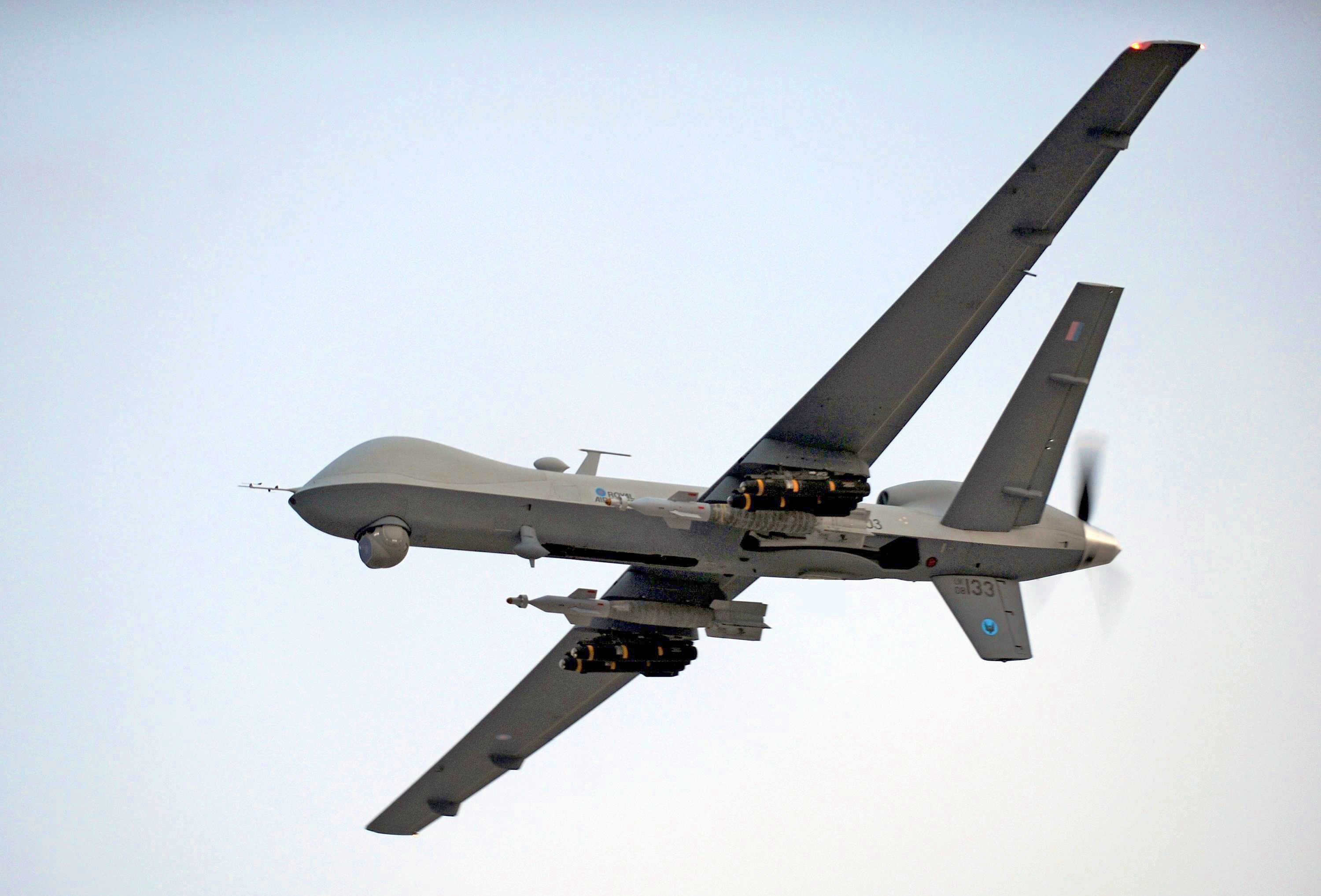
Category I MTCR items (highest-controlled) do include certain larger military UAS above the threshold parameters. This has some effect on state-to-state transfers of systems like Predator or Reaper. It has no effect on commercial quadcopters, FPV racing drones, or even modified commercial UAS that fall below the payload and range thresholds.
The Wassenaar Arrangement on Export Controls for Conventional Arms and Dual-Use Goods and Technologies covers some drone technology under its munitions and dual-use control lists. But Wassenaar is a political agreement among 42 participating states—it lacks enforcement mechanisms, requires consensus to add new items, and does not bind China, which is the dominant manufacturer of the commercial platforms being proliferated.
The commercial UAS market has simply outrun the export control architecture. DJI sells its products globally through retail channels. Secondary market resale, gray-market export, and modification after purchase place commercial drones in the hands of any actor with the motivation to acquire them and the ability to pay consumer prices. Export controls cannot effectively constrain a product line that is distributed through Amazon, Walmart, and equivalent global retail.
State-Sponsored Proliferation
The commercial proliferation problem is compounded by deliberate state proliferation of military drone technology to proxy and partner forces.
Iran's drone proliferation network is the most consequential current example. Iran has supplied Shahed-136 and related OWA-UAV designs to Russia (which is now manufacturing them domestically), Houthi forces in Yemen, Kata'ib Hezbollah and other Iraqi militias, and potentially other actors. The transfer of not just systems but manufacturing knowledge—technical drawings, materials specifications, production processes—creates indigenous production capacity that persists after any direct supply is interdicted.
North Korea has acknowledged and displayed indigenous drone capability including long-range reconnaissance UAS. North Korean drones have overflown South Korean territory and are believed to have been transferred to Russia for use in Ukraine, though official confirmation of the latter is limited.
Turkey has positioned its Bayraktar TB2 as an export product for allied and partner states, with transfers to Ukraine, Azerbaijan, Ethiopia, Morocco, Poland, and others. The TB2's impact in the 2020 Nagorno-Karabakh conflict, where it devastated Armenian armor and air defense with minimal losses, created global demand that Turkey has actively met. Unlike Iranian proliferation, Turkish TB2 transfers go through formal government channels and include training and support—a more sustainable proliferation model from the recipient's perspective.
China's role is structural rather than direct: by dominating commercial drone manufacturing and declining to implement the export controls that Western states apply to comparable military technology, China has effectively enabled global proliferation as a byproduct of its commercial industrial policy.
Strategic Consequences
The proliferation of capable drones has altered the strategic balance in several specific ways that will persist regardless of what happens to export control policy:
Air superiority is no longer sufficient for dominance of the low-altitude airspace. Traditional air superiority operations—defeating enemy air forces in the air and on the ground—do not address the Group 1-3 UAS threat, which operates below the altitude where air superiority fights occur, in numbers that exceed the capacity of traditional air-to-air intercept, and at costs that make kinetic intercept uneconomical. The force that controls the sky at 20,000 feet may be entirely vulnerable to drone attack at 300 feet.
Persistent surveillance is now available to any actor. The ISR advantage that U.S. forces have relied on since the Gulf War—the ability to see the battlefield comprehensively while the adversary is blind—is eroding. Any motivated actor can purchase commercial UAS and conduct persistent surveillance of military positions, supply lines, and leadership. The resulting tactical intelligence degrades the operational security that U.S. and allied forces previously took for granted.
Precision strike is no longer a great power monopoly. A $500 FPV drone guided by a trained operator is a precision strike weapon. It lacks the range, payload, and all-weather capability of a Hellfire missile, but it is orders of magnitude cheaper and is being produced and fielded in numbers that approach the artillery shell counts of World War II. The implications for combined arms warfare are still being worked out in Ukraine, but they point toward a fundamental change in how precision effects are achieved and at what cost.
What This Means for Future Conflicts
Every military that anticipates future conflict must now plan for an environment in which the adversary has persistent aerial surveillance, can deliver precision effects against vehicles and personnel, and can conduct these operations with systems that cost hundreds of dollars per unit and require only basic training to operate.
Counter-UAS is not an optional add-on capability—it is a fundamental requirement for operating in any contested environment above the squad level. The proliferation problem does not have a technology solution; it has a technology management problem. The counter-UAS community is building systems that can detect and defeat individual and small swarms of commercial-class drones. The adversary response is more drones, cheaper drones, and drone tactics designed to exhaust the magazines and cost-per-intercept math of the defender.
The strategic lesson of drone proliferation is not that drones are decisive. It is that the barrier to entry for aerial operations has collapsed permanently, and any future military doctrine that assumes aerial dominance extends to the 50-meter altitude band is planning for the wrong war.
Key Features
- Cost collapse: military-capable aerial platforms now cost $200-$2,000
- Commercial off-the-shelf modification pathways for weaponization
- Chinese manufacturing dominance (DJI holds ~70% global market share)
- MTCR (Missile Technology Control Regime) inadequacy for small UAS
- Group 1-2 UAS threat tier proliferation to non-state actors
- One-way attack drone templates (Shahed-136, Lancet) spreading through proxy networks
Advantages
- Commercial UAS have legitimate beneficial uses in agriculture, search and rescue, infrastructure inspection
- Proliferation has driven innovation in drone technology with dual-use benefits
- Lower barriers to entry have democratized aerial surveillance for journalists and civil society
Limitations
- No effective export control regime exists for Group 1-2 commercial UAS
- Weaponization knowledge is freely available online and through conflict documentation
- Counter-UAS costs remain orders of magnitude higher than drone acquisition costs
- State actors (Iran, Russia, North Korea) are actively proliferating military drone designs to proxies
- The technology gap between offense and defense has widened consistently since 2015
Real World Application
ISIS operated a dedicated drone warfare unit by 2016, having purchased DJI Phantoms commercially and developed in-house bomb-dropping attachments. The Houthi one-way attack drone campaign against Saudi Arabia and UAE, using Iranian-supplied Shahed variants, demonstrated that non-state actors can conduct sustained strategic bombing campaigns with commercial-derived technology. In Ukraine, both sides have fielded millions of commercial and semi-commercial drones, with FPV racers costing $300-500 becoming the primary precision anti-armor weapon at the tactical level.