Civilian Airport Drone Defense — Protecting the Skies Without Jamming ATC
How airports counter unauthorized drones without disrupting air traffic control, navigation, or commercial aviation — the Gatwick wake-up call and the layered civilian C-UAS approach.
Quick Overview
What It Is
Civilian airport C-UAS is the specialized practice of detecting and mitigating unauthorized drone activity at commercial airports — a unique challenge because traditional military countermeasures like RF jamming are prohibited in civilian airspace where they would disrupt air traffic control, navigation aids, and aircraft communications.
How It Works
Airports deploy passive detection only — RF sensors that listen for drone signals, radar optimized for small slow targets, and EO/IR cameras for visual confirmation. When a drone threat is confirmed, the response is procedural rather than technical: alert ATC, suspend operations, deploy law enforcement to locate the operator. No jamming. No kinetic interception. No directed energy.
Civilian Airport Drone Defense — Protecting the Skies Without Jamming ATC
Gatwick Airport. December 19, 2018. Three days before Christmas. Drone sightings near the runway shut down the United Kingdom's second-busiest airport for 33 hours. Over 1,000 flights were cancelled. Roughly 140,000 passengers were stranded. Airlines lost an estimated $60 million. And the drone operator was never caught.
Gatwick was the wake-up call that transformed civilian airport drone defense from a hypothetical concern into an urgent operational requirement. But the core problem remains unsolved: how do you stop a drone at an airport when you cannot use the tools the military uses?
The Civilian Constraint: No Jamming, No Kinetics
Military C-UAS has a full toolkit: jammers that disrupt drone control links, GPS spoofers that confuse navigation, directed energy weapons that burn drones out of the sky, and kinetic interceptors that physically destroy threats. None of these are legal or safe at a civilian airport.
RF jamming is prohibited. The same frequencies drones use — 2.4 GHz, 5.8 GHz, GPS L1 — are used by aircraft navigation, air traffic control communications, and airport operations systems. Blanket jamming around an airport would create a safety-of-flight emergency worse than the drone threat itself.
Kinetic interception is unthinkable. Firing projectiles — bullets, missiles, nets, anything — into the airspace above a commercial airport is not an option. The risk of hitting an aircraft, or debris falling onto aircraft or passengers, is unacceptable.
Directed energy carries collateral risk. A laser powerful enough to destroy a drone is powerful enough to blind a pilot or damage aircraft sensors. Directed energy at civilian airports remains experimental, limited to controlled test environments.
The result: civilian airport C-UAS is almost entirely passive. Detect, identify, locate the operator — but do not touch the drone.
How Civilian Airport C-UAS Actually Works
Detection Layer
Airports deploy passive sensors in a layered architecture:
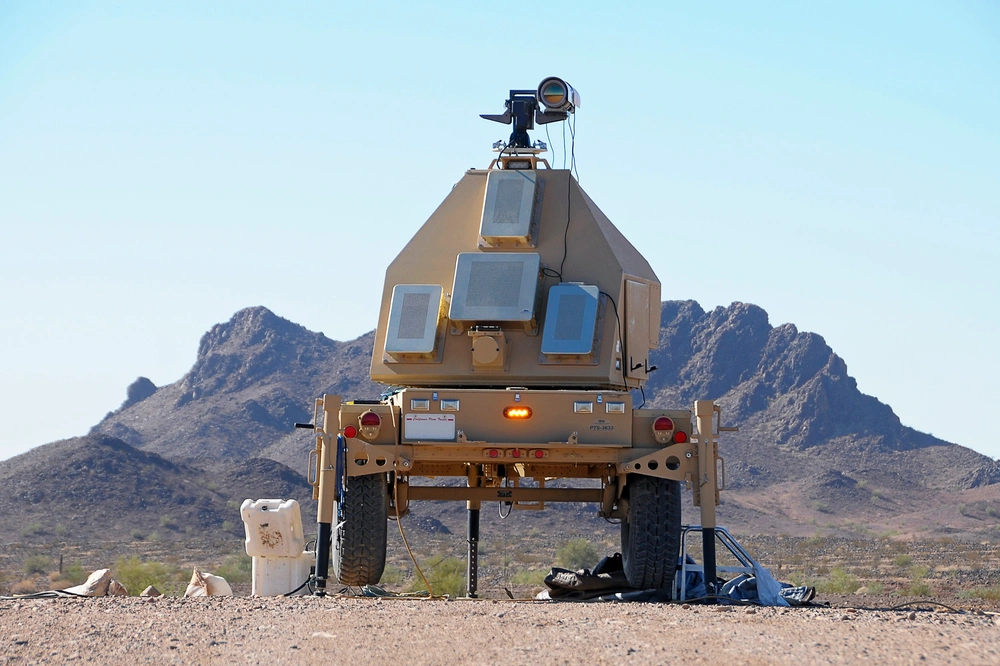
RF sensors. These are the workhorses of civilian C-UAS. They listen for drone communication signals — the radio link between the drone and its controller, the telemetry downlink, the video transmission. By triangulating signals across multiple sensors, the system can locate both the drone and its operator in three dimensions. Critically, RF sensors do not transmit — they only listen — so they create no interference with aviation systems.
Specialized radar. Conventional air traffic control radar is designed to track aircraft — large, fast, cooperative targets with transponders. It filters out small, slow objects as clutter. Drone detection radar is purpose-built for the opposite: high update rates to track small targets, Doppler processing tuned for multirotor propeller signatures, and software that distinguishes drones from birds based on flight behavior.
Electro-optical / infrared cameras. Once radar or RF sensors detect a possible drone, PTZ (pan-tilt-zoom) cameras slew to the bearing and provide visual confirmation. AI computer vision analyzes the image to classify the object — drone vs. bird vs. balloon vs. debris — reducing false alarm rates that would otherwise overwhelm operators.
Response Protocol
When a drone threat is confirmed, the response follows a carefully scripted procedure:
-
Alert ATC. The control tower is notified immediately. Depending on the drone location relative to approach and departure corridors, ATC may suspend operations on affected runways.
-
Deploy law enforcement. Airport police or local law enforcement move to the estimated operator location provided by RF triangulation. The goal is to find and detain the person controlling the drone — which also neutralizes the drone, since most consumer drones will return-to-home or auto-land when they lose control signal.
-
Suspend operations. If the drone is in or near flight paths, operations are suspended. This is the costly part — every minute an airport is closed costs tens of thousands of dollars in airline operational impacts and passenger disruption.
-
Investigate and prosecute. Post-incident, digital forensics on recovered drones can identify the operator. In the U.S., the FAA can impose civil penalties up to $37,000 per violation, and criminal charges under 18 U.S.C. 32 (aircraft sabotage) carry prison sentences up to 20 years.
Remote ID Integration
Remote ID — essentially a digital license plate broadcast by drones — is the long-term solution for distinguishing legitimate drone operations from threats. In the U.S., the FAA Remote ID rule requires most drones to broadcast identification and location information. Airports are beginning to integrate Remote ID receivers into their C-UAS systems, allowing them to instantly identify cooperative drones and focus attention on non-cooperative or suspicious flights.
The Economic Reality
Airport C-UAS is expensive, and the cost-benefit analysis is brutal:
Sensors. A full airport C-UAS sensor suite — multiple radars, RF sensors, and cameras with the integration backend — costs $3-8 million to install, with annual maintenance and operator costs in the six figures.
Shutdown costs. Every hour of airport closure costs airlines and passengers millions. Gatwick lost $60 million over 33 hours. A similar incident at a hub like Atlanta or Dubai would cost exponentially more.
The deterrence gap. The most expensive sensor suite in the world cannot stop a drone whose operator is never found. As long as the response is procedural rather than technical, a single determined individual with a $500 drone can close a multi-billion dollar airport.
The unsolved problem — and the reason airport C-UAS remains a growth market — is that passive detection is not enough. Until a safe, legal method of in-flight drone neutralization exists for civilian airspace, airports remain vulnerable to a threat that costs the attacker almost nothing and the defender everything.
Key Features
- Passive detection only — no jamming
- Procedural response rather than technical defeat
- Multi-agency coordination (ATC, law enforcement, airport ops)
- Remote ID integration for cooperative drone identification
Advantages
- No risk of disrupting aviation safety systems
- Legal framework exists for operator prosecution
- Integration with existing airport security infrastructure
- Passive sensors avoid spectrum licensing issues
Limitations
- Cannot actively neutralize a drone in flight
- Airport shutdowns cost millions per hour
- Locating a drone operator is slow and often fails
- Layered passive sensors are expensive to deploy and maintain
Real World Application
The December 2018 Gatwick Airport drone incident shut down the UK second-busiest airport for 33 hours, affecting 140,000 passengers and costing airlines over $60 million. No operator was ever identified. Since then, major airports worldwide have deployed dedicated C-UAS detection systems, but the fundamental tension between security and aviation safety remains unresolved.