All Articles
Latest articles and analysis on counter-UAS technology and drone warfare

Ukraine doubles interceptor drone deliveries since start of 2026 | RBC-Ukraine
Ukraine has doubled its deliveries of interceptor drones in the first four months of 2026 compared to all of 2025, significantly bolstering its short-range air defense capabilities. These drones have proven highly effective, destroying over 33,000 enemy UAVs in March alone, and are substantially cheaper than traditional missile-based systems. A dedicated short-range air defense command has been established within the Ukrainian Air Force to integrate these systems.
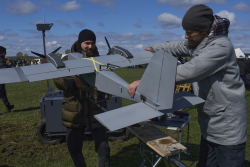
Drones Are the Biggest Military Revolution in a Century
Recent events in Ukraine demonstrate a significant shift in warfare, with drones playing a pivotal role in both direct combat operations (surrender to drones) and counter-drone engagements (maritime drone launching interceptors). This highlights the increasing sophistication and autonomy of drone systems on the battlefield.
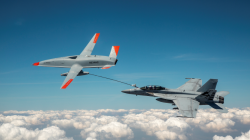
U.S. Navy's MQ-25 Stingray Completes First Flight
The U.S. Navy's first production-representative MQ-25 Stingray unmanned aerial vehicle successfully completed its first flight. This milestone signifies progress towards fielding a carrier-based refueling capability and extending the range of manned aircraft. The flight tested basic flight functions and data links.
How Ukraine’s drone war became Hezbollah’s new battlefield blueprint
Ukraine's innovative use of First-Person View (FPV) drones has significantly impacted battlefield tactics, forcing Russian forces to abandon conventional maneuvers. Hezbollah is now reportedly adopting similar drone tactics, leveraging lessons learned from the Ukrainian conflict due to attrition of existing weaponry and disrupted supply lines. The use of fiber-optic cables is increasing drone resilience against electronic warfare.
The Counter-Drone Problem Israel Can’t Solve…Yet. – The Defense Circuit
Israel is facing significant challenges in countering the increasing threat of small, low-cost drones, particularly along its northern border with Lebanon. Existing air defense systems are inefficient and costly to use against these smaller targets, and adversaries like Hezbollah are adapting by utilizing autonomous drones with hardened communication links. The incident involving Sgt. Idan Fooks highlights the vulnerability and evolving nature of this threat.
Transforming Military AI: Legal and Ethical Dimensions - Ronin's Grips
The DoD is rapidly accelerating the deployment of autonomous systems via programs like Replicator to counter advancements by competitors like the PLA. However, the report highlights a critical bottleneck: the difficulty of encoding legal and ethical constraints (LOAC, ROE) into AI algorithms. This poses risks of non-compliance with international law and potential escalation due to the speed of autonomous responses.
Netherlands Funds Two CCAs in New Partnership with USAF
The Netherlands will fund the purchase of two Collaborative Combat Aircraft (CCAs) in partnership with the USAF, marking a significant international collaboration on autonomous systems. These CCAs, potentially the General Atomics YFQ-42A or Anduril YFQ-44A, will be delivered to Nellis AFB for testing and development of operational tactics. The partnership aims to create 'affordable mass' capabilities and enhance interoperability between allied forces.
Halo_Shield™ - AeroVironment
AeroVironment has announced Halo_Shield™, a modular, distributed CUAS system designed to counter drone swarms, advanced UAS, and subsonic cruise missiles. The system utilizes a tile-based architecture with AI-driven command and control to automate threat detection, classification, and response across multiple domains. Halo_Shield is designed for both expeditionary forces and critical infrastructure protection, integrating with existing defense systems.
Hezbollah adopts advanced drone tactics from Ukraine war to counter Israel | The Jerusalem Post
Hezbollah is actively adapting drone warfare tactics observed in the Ukraine conflict, specifically employing fiber-optic guided drones to circumvent electronic warfare countermeasures. These drones, capable of carrying up to 6kg of explosives, are remotely controlled up to 15km away and represent a significant escalation in Hezbollah's capabilities. Initial deployments relied on Iranian-supplied one-way attack drones, but the shift towards fiber-optic control demonstrates a focus on overcoming existing Israeli defenses.
Slovakia receives BARAK MX air-defence system from IMOD
Slovakia has received the BARAK MX air-defence system from Israel under a €560m contract, ahead of schedule. The system is designed to counter a wide range of threats, including USAVs, and will be fully operational within weeks following ongoing training. This delivery builds on a prior $175m radar system deal between the two nations.