All Articles
Latest articles and analysis on counter-UAS technology and drone warfare

Preparing for major events: NUSTL field guidance for C-UAS planning
The National Urban Security Technology Laboratory (NUSTL) has released field guidance for optimal Counter-UAS (C-UAS) equipment placement, informed by assessments with eight FIFA World Cup host cities. The guidance focuses on site surveying best practices, considering mission requirements, line-of-sight, potential interference, and logistical factors. Proper documentation of candidate sites is emphasized for faster and safer future deployments.

True Anomaly raises $650M Series D at $2.2B valuation as Golden Dome space interceptor contracts reach $3.2B
True Anomaly, a space defense startup, secured $650M in Series D funding at a $2.2B valuation shortly after being selected for the Space Force's Golden Dome program. The company is uniquely focused on space-based interceptors, aiming to counter missile threats across multiple flight phases. This investment signals strong confidence in the future of space-based defense capabilities.
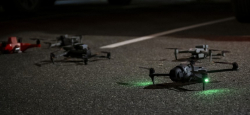
The Pentagon Replicated a Ukrainian-Style Drone Attack in Florida
The Pentagon recently conducted a realistic, Ukrainian-style drone attack simulation in Florida, focusing on coordinated, multi-domain attacks against critical infrastructure. This exercise differed from previous tests by involving a broader range of participants and technologies, aiming to replicate the complexities of real-world scenarios. The goal was to assess vulnerabilities and refine counter-UAS strategies.
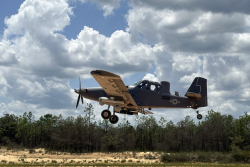
SOCOM Cuts Back on Skyraider, Wants Small Drones to Pair with MQ-9s
US Special Operations Command (SOCOM) is reducing its investment in the MQ-9 Skyraider program, opting instead to prioritize smaller, more numerous drones capable of operating in swarms. This shift aims to enhance situational awareness and provide complementary capabilities to existing MQ-9 assets. The move signals a preference for distributed, networked drone operations over reliance on fewer, larger platforms.
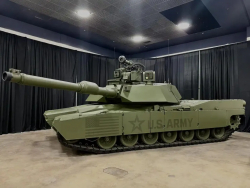
Army M1E3 "Fast" Tank Will Fire Lasers, EW, Launch and Destroy Drones
The US Army is developing the M1E3 "Fast" tank, a 60-ton vehicle designed to counter evolving threats including drones. Key capabilities include integration of directed energy weapons (lasers), electronic warfare (EW) systems, and dedicated drone defense systems – likely including launchable interceptors. This represents a significant shift towards equipping main battle tanks with robust counter-UAS capabilities.
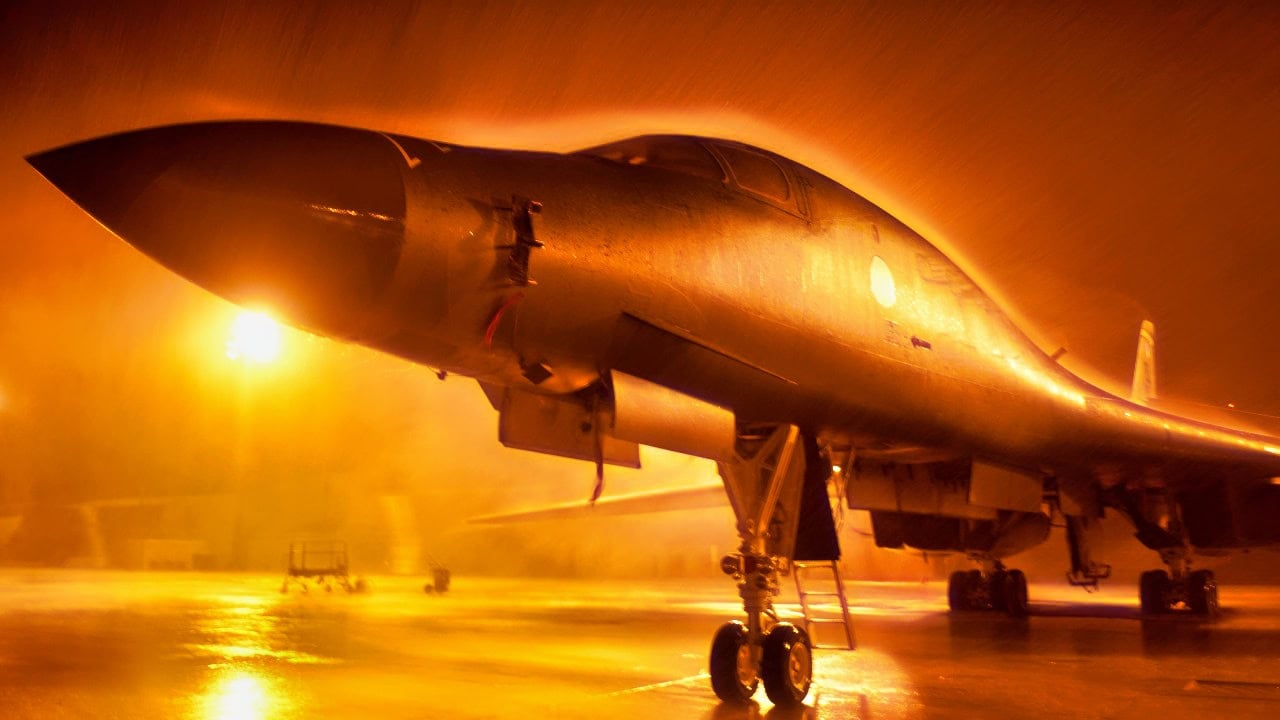
Air Force B-1B Lancer and B-2 Spirit Bombers Could Get Massive Upgrades to Fly Through Mid-2030s and Beyond
The US Air Force is considering significant upgrades to its B-1B Lancer and B-2 Spirit bomber fleets to extend their operational lifespan through at least the mid-2030s. The article highlights the continued importance of strategic bombing in high-intensity conflict, referencing a hypothetical 'Operation Epic Fury' against Iran. These upgrades aim to maintain capabilities for suppressing enemy air defenses and striking critical infrastructure.
Cheap drones, expensive lessons | Ctech
The proliferation of low-cost, commercially available drones – particularly FPV models – is fundamentally altering modern warfare, demonstrated by recent incidents in Israel and the ongoing conflict in Ukraine. This shift emphasizes the importance of rapid adaptation, mass production, and resilient supply chains over purely advanced technology. A key innovation is the adoption of fiber-optic control to mitigate jamming and detection.
The Defense Procurement Agency has contracted for more than 14,000 drones | UA.NEWS
The Ukrainian Defense Procurement Agency has contracted for 14,125 drones valued at 2.46 billion hryvnias, primarily DJI Matrice and Autel Evo series, to bolster reconnaissance and surveillance capabilities. Procurement utilized a framework agreement through the Prozorro system, achieving cost savings while maintaining operational security regarding suppliers and delivery timelines. The Ministry of Defense is also accelerating the delivery of ground robotic systems for logistical support.
Adapting to the Future of Drone Warfare - Ronin's Grips
This report highlights a critical vulnerability in the DoD's approach to drone warfare: the rapid adaptation of adversaries to US technological advantages. The traditional lengthy development cycle for military technology is being outpaced by the speed at which enemies can reverse-engineer and counter US systems, particularly with the proliferation of COTS drone technology. The DoD needs to shift towards a dynamic, continuous capability-evolution model to maintain dominance.
DoD outlines progress on Golden Dome missile defense architecture | Military Aerospace
The DoD is progressing rapidly on the Golden Dome architecture, a layered missile defense system designed to counter ballistic, hypersonic, and cruise missile threats. Key milestones include completing the initial architecture blueprint, establishing a Command-and-Control Consortium, and awarding contracts for system components. The program emphasizes integration of space-based sensors, interceptors, and AI-driven command networks.