All Articles
Latest articles and analysis on counter-UAS technology and drone warfare

India’s Drone Doctrine, Operation Sindoor and Unmanned Military Power
The article highlights India's need for a comprehensive National Military Drone Doctrine, spurred by the demonstrated effectiveness of drones in recent conflicts (Nagorno-Karabakh, Ukraine, Iran-Israel). It emphasizes a shift towards mass-producing intelligent, networked, and expendable unmanned systems, moving away from a state-dominated defense production model. The current Indian drone capability is fragmented, lacking full integration into military operations.

Today, Orqa U.S. is official.
Orqa U.S. has officially launched as a fully U.S.-owned and controlled UAS company, aiming to supply the U.S. military and government with American-made drone systems. The company leverages a decade of experience from its parent company, Orqa FPV, and is establishing a large-scale manufacturing facility in Florida. Orqa U.S. emphasizes full compliance with U.S. regulations and a commitment to avoiding Chinese components.
Counter-Drone Systems To Flood the Skies at Project Flytrap 5.0 - Arete
Project Flytrap 5.0, hosted by the U.S. Army in Lithuania, will focus on evaluating and integrating new Counter-UAS (C-UAS) technologies. The exercise is directly informed by observations from the Russia-Ukraine conflict, highlighting the increasing importance of both UAS and C-UAS capabilities in modern warfare. The Army recognizes a 'fundamental transformation' in operational warfare due to the proliferation of drones.
Pentagon counter-drone task force announces pilot program to get directed energy systems to 5 installations | DefenseScoop
The Pentagon's Joint Interagency Task Force 401 (JIATF-401) is initiating a six-month pilot program to deploy directed energy (DE) systems – high-energy lasers and microwave weapons – at five US military installations. This follows recent safety tests and a new safety agreement with the FAA addressing concerns about interference with commercial air traffic. The program aims to bolster defense against the increasing domestic drone threat.
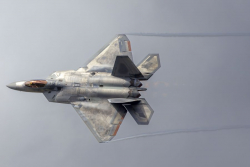
Air Force Arms F-22 With Anti-Jam Tech for GPS-Denied Combat
The US Air Force is equipping its F-22 Raptors with Northrop Grumman’s Embedded Global Positioning System/Inertial Navigation System – Modernized (EGI-M) to enhance resilience against GPS jamming and denial. This upgrade allows the F-22 to maintain accurate navigation and targeting even in contested electromagnetic environments. The EGI-M integrates inertial navigation with limited GPS data, providing a robust positioning capability.
Canadian Military Ramps Up Counter-UAS Defenses Amid Drone Threats
Canada is rapidly deploying counter-UAS (C-UAS) systems to protect key military infrastructure, spurred by lessons learned from the Ukraine conflict. Legal ambiguities regarding intercepting drones in domestic airspace remain a challenge, prompting amendments to the Aeronautics Act. The Canadian military is balancing security needs with the potential for civilian drone operations.

New rules will keep unmanned aircraft away from prisons and power plants
The FAA proposed new rules establishing Unmanned Aircraft Flight Restrictions (UAFRs) over critical infrastructure like prisons, power plants, and chemical facilities, following mandates from recent FAA reauthorization acts. These rules create two airspace designations – standard and special UAFRs – with varying levels of restriction and application processes. Importantly, UAFRs do *not* authorize the deployment of counter-UAS technologies.

Inside the Battle to Repair Chornobyl’s Damaged Confinement
A Russian drone strike damaged the New Safe Confinement (NSC) at Chornobyl, compromising its hermetic seal, ventilation, and cladding, leading to a fire and potential corrosion of the structure. Repair costs are estimated to exceed €500 million, with a deadline of 2030 to prevent long-term structural damage. The European Bank for Reconstruction and Development (EBRD) is leading the assessment and fundraising efforts.
Pentagon seeks AI target recognition for counter-drone weapons - IN Defence
The Pentagon is soliciting proposals for AI-enhanced target recognition (AiTR) for close-in counter-UAS systems, initially focusing on integrating the technology with existing Common Remotely Operated Weapon Stations (CROWS). The Defense Innovation Unit is managing the project, with prototypes required to detect, track, and engage small drones (Group 1 & 2) in both land and maritime environments. This initiative prioritizes field-ready solutions over lab demonstrations, emphasizing performance in realistic operational conditions.

9 May: Will Kyiv Attack the Parade in Moscow?
Russia has significantly scaled back its Victory Day parade in Moscow due to credible threats of Ukrainian drone attacks, signaling a perceived vulnerability. Debate exists within Ukraine and internationally regarding whether to exploit this vulnerability with an attack, weighing symbolic value against potential escalation. Russia is simultaneously increasing threats against Kyiv and bolstering air defenses around Moscow, potentially at the expense of regional coverage.