All Articles
Latest articles and analysis on counter-UAS technology and drone warfare

NATO fighter shoots down drone over Estonian airspace
A NATO fighter, a Romanian F-16 operating from Lithuania, shot down an unidentified drone over Estonian airspace on May 19, 2026, following a similar incident in Lithuania two days prior. Initial assessments suggest the drone was likely Ukrainian and diverted off course by Russian electronic warfare. The incident prompted air threat alerts across multiple Estonian counties and cell broadcast warnings in Latvia.
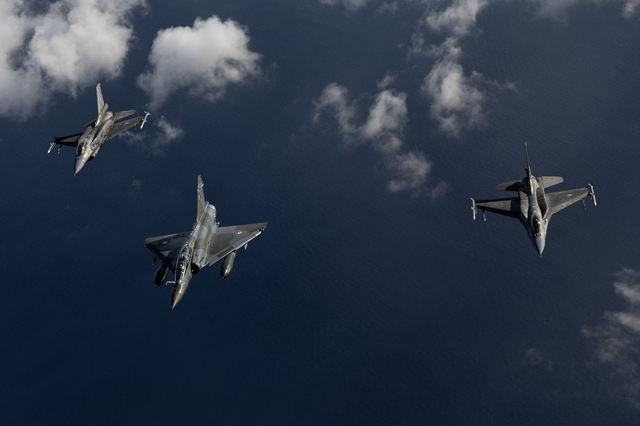
Romania Deploys F‑16s as Russian Drones Strike Near Ukrainian Port
Romania scrambled two F-16s in response to Russian drone strikes targeting Ukrainian infrastructure near the Romanian border. Romanian radar detected the drones approaching Izmail, Ukraine, but no airspace violations were detected. This incident highlights the increasing risk of escalation and the routine nature of Romanian responses to Russian drone activity.
India's Counter-drone Shield Must Add a Hard-kill Layer as Border Incursions Surge: BonV Aero
BonV Aero is advocating for a shift in India's counter-drone strategy, emphasizing the need for hard-kill systems alongside radio-frequency jamming due to increasing drone incursions from Pakistan and China. Recent events, including 'Operation Sindoor,' highlight the escalating threat, particularly from autonomous drones. India is responding with procurement of systems like the 2K22 Tunguska and development of indigenous solutions like DRDO's Bhargavastra.
“Drone and Counter-Drone Systems – Challenges for Poland’s Security” – Casimir Pulaski Foundation
A meeting convened by the Casimir Pulaski Foundation and the National Security Industrial Club in Poland focused on the growing challenges and opportunities surrounding drone and counter-drone systems. Discussions highlighted Ukraine’s rapid development as a drone manufacturer and the critical role of unmanned systems in the ongoing conflict, with drones accounting for over 80% of inflicted losses. Poland is actively seeking to bolster its drone capabilities and counter-drone defenses in response to escalating hybrid threats.
Tiami Networks Launches ARCHES Autonomous Counter-UAS Platform At SOF Week 2026
Tiami Networks launched ARCHES, an autonomous counter-UAS platform, at SOF Week 2026. The system provides detection, tracking, AI-driven intent evaluation, and kinetic/non-kinetic response options, including a high-speed interceptor and a fiber-optic tethered, RF-silent variant. Demonstrations and evaluation opportunities are immediately available for government stakeholders.
Perennial Autonomy Lands $500M JIATF 401 Counter-UAS Deal
Perennial Autonomy has been awarded a $500 million contract by JIATF 401 to expand the deployment of low-cost drone interceptors. The contract focuses on AI-enabled systems designed to create a layered defense against enemy drones, utilizing existing platforms already deployed within USCENTCOM. This is an indefinite-delivery/indefinite-quantity contract spanning three years.
Israeli gov't allocates NIS 2b. to combat Hezbollah drones | The Jerusalem Post
Israel has allocated NIS 2 billion (approximately $550 million USD) to counter the growing threat of Hezbollah's fiber-optic drones, which have already caused casualties. Current counter-UAS systems are largely ineffective against these drones due to their immunity to jamming and low cost. The IDF is pursuing a multi-faceted approach, including physical barriers (wire mesh) and testing numerous technological solutions, but admits no comprehensive defense currently exists.
All non-drone militaries are obsolete
The article asserts that drone warfare has fundamentally altered the battlefield, rendering traditional military forces increasingly obsolete. Ukraine's experience demonstrates the devastating effectiveness of drones, inflicting disproportionately high casualties on the Russian army. Advances in battery technology and AI are rapidly accelerating the development of autonomous drone swarms.
U.S. Army and NATO Tests Counter-Drone Shield During Flytrap 5.0 Against Swarm Attack Threats
U.S. Army and NATO successfully completed Project Flytrap 5.0, a large-scale counter-drone exercise testing over 50 technologies against coordinated drone swarm attacks. The exercise focused on integrating layered sensors, electronic warfare, and kinetic interceptors into a unified combat architecture. This initiative is part of a broader NATO effort to enhance air defense capabilities against low-cost drone threats.
Asia, Europe showing interest in Russia’s anti-drone nets — developer - Military & Defense - TASS
Russian company Mechanical Protection Systems (MPS) reports interest in its 'Darwin' anti-drone nets from several Asian and European countries. These nets are designed to physically intercept drones, reducing impact force and potential for detonation. MPS highlights the increasing global need for infrastructure protection against drone threats.