Modern war and the systemic learning deficit in Western military institutions | Lowy Institute
AI Analysis
This report highlights a critical learning deficit within Western military institutions, specifically regarding adaptation to modern warfare innovations observed in conflicts like Ukraine and Iran. Western forces are failing to rapidly institutionalize battlefield lessons into doctrine, procurement, and force structure, while adversaries like China, Russia, Iran, and North Korea are actively and quickly learning from these same conflicts. The analysis points to cultural, bureaucratic, and systemic issues hindering Western military adaptation, particularly in areas like drone warfare and counter-drone defenses.
Key Takeaways
- Western militaries demonstrate a 'single-loop' learning style, adapting tactics within existing doctrine but struggling to revise core assumptions.
- There's a significant gap in counter-drone capabilities and defenses for deployed forces and critical infrastructure in Australia.
- Adversaries have established an 'authoritarian knowledge market' for rapid dissemination of battlefield insights.
- Recent failures include a lack of preparedness for attacks on airbases (Russia/Belarus, US/Saudi Arabia) despite prior warning and observable trends.
- The report recommends cultural change, promotion reform, AI-enabled learning, rapid drone capability development, and acquisition reform to address the learning deficit.
Why It Matters
The inability of Western militaries to learn and adapt at the same pace as adversaries creates a significant strategic disadvantage, particularly in potential Indo-Pacific contingencies. This learning deficit could lead to unpreparedness for conflicts involving massed autonomous systems, drone-enabled combined arms tactics, and rapid indigenous production of military technology. Addressing this issue is crucial for maintaining a credible defense posture and avoiding catastrophic consequences.
Subscribe to The Informer for monthly expert analysis, and to Events for advance notice of visiting world leaders and distinguished guests.
You may unsubscribe from Lowy Institute newsletters at any time. For information on our privacy practices and how to unsubscribe, see our Privacy Policy.
Battlefield evidence is everywhere. The will to act on it is the missing Western capability.
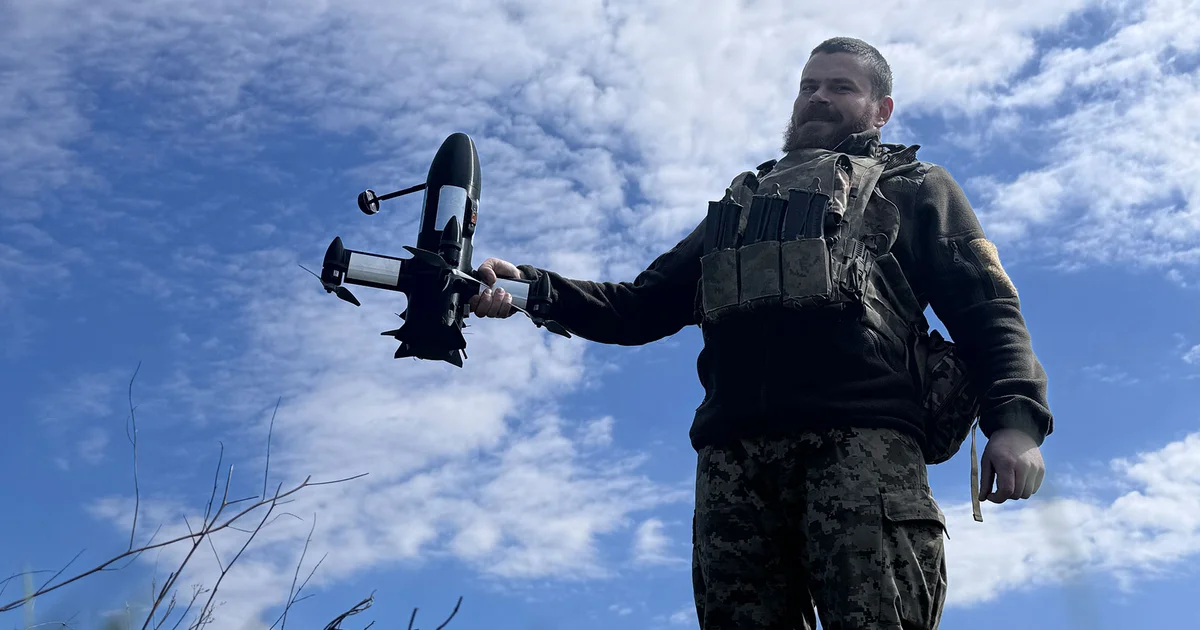
A Ukrainian soldier holds the P1-Sun interceptor drone on April 29, 2026 in Donetsk Oblast (Global Images Ukraine / Getty)
Modern war and the systemic learning deficit in Western military institutions
This paper identifies a critical strategic vulnerability: Western military institutions, including in Australia, are failing to energetically learn from modern wars. Despite four years of unprecedented visibility into Ukrainian battlefield innovations, and the recent war in Iran, Western forces have not institutionalised key lessons into doctrine, force structure, or procurement priorities.
This has implications for a range of strategic competitions. China, Russia, Iran, and North Korea have built an authoritarian knowledge market in which battlefield insights transfer rapidly. Western democracies, constrained by risk-averse bureaucracies, slow procurement cycles, and promotion systems rewarding managerial competence over innovative thinking, face a structural disadvantage in this competitive learning environment.
For Australia, the consequences are serious: minimal drone capabilities, almost no counter-drone defences for deployed forces or critical infrastructure, the opportunity costs of expensive systems, and slow mechanisms for translating foreign war lessons into force development.
The paper’s five recommendations address culture change, promotion reform, AI-enabled learning, rapid drone capability development, and acquisition reform. These are essential adaptations. The alternative is an Australian Defence Force structurally unprepared for Indo-Pacific contingencies where the lessons of the Ukraine war — massed autonomous systems, drone-enabled combined arms, and indigenous rapid production — are highly likely to be directly applicable. Ignoring visible evidence from modern wars when adversaries are absorbing those same lessons at speed constitutes a strategic choice with potentially catastrophic consequences for military organisations — and entire nations.
In 2023, a Russian A-50 airborne early warning aircraft was attacked on the ground at the Machulishchy airbase near Minsk. Located 200 kilometres from the Ukrainian frontline, the Russian Air Force had not imagined, nor prepared for, an attack on this location. In March 2026, a United States Air Force (USAF) E-3 Sentry airborne early warning aircraft, parked in the open at a Saudi Arabian airbase approximately 700 kilometres from Iran, was destroyed during Operation Epic Fury, the American–Israeli campaign against Iran.* There was one key difference between these attacks: the USAF had years of warning about the threat, which it did not heed. It demonstrated a lack of learning from other people’s wars.
At the strategic level, an even more recent glaring failure to learn is obvious. The Trump administration has failed to learn the central political lesson from the war in Ukraine: even supposedly much weaker nations in a war have agency. Such belligerents can demonstrate the will to resist foreign military aggression for years, if needs be. This has been the case for over four years in Ukraine and appears to be the case in the Iran war.*
The contrast between Western institutional learning inertia and the speed of adversarial learning is one of the defining strategic facts of this decade. Western governments and militaries have been slow to institutionalise the lessons of Ukraine and Iran. Their adversaries have not. China, Russia, Iran, and North Korea have built an authoritarian knowledge market in which battlefield insights — from drone employment to electronic warfare, from industrial mobilisation to strategic coercion — flow more rapidly than many Western institutions have acknowledged. When one member of this bloc learns, all of them can learn.*
Organisations can exhibit persistent failures to learn. The foundational work of theorists Chris Argyris and Donald Schön distinguished between “single-loop” learning — correcting errors within existing frameworks — and “double-loop” learning, which requires questioning the underlying assumptions themselves.* Military institutions are archetypal single-loop learners. They excel at tactical adaptation within doctrinal boundaries but can be structurally resistant to revising core doctrines. Organisations can fall into “competency traps” where they reinforce familiar routines even when those routines no longer serve the environment.*
While military units in the West have demonstrated an admirable vigour to learn the lessons of foreign wars, this same energy has not been apparent in their broader military and political institutions. Indeed, mainly because of the speed of change, much of the transformation in war of the past half-decade appears to have eluded defence bureaucracies. This deficit of learning is due to a combination of emphasis on pre-existing ideas, failure to accurately understand what occurs in foreign wars, application of disputed or misleading lessons, and failure to sustain the implementation of useful lessons.*
A learning deficit afflicts Western military institutions, including the Australian Defence Force (ADF).* This is not a resource problem nor a deficit of relevant information. It is a challenge of organisational culture, individual and institutional humility, leadership philosophies, and political inattention. In an era when war has never been more visible, choosing not to learn is a strategic decision with grave consequences.
This paper contains four sections. The first examines the nature of military learning and why it is so difficult to do well in peacetime. The second and third sections offer case studies in Western learning failure: the counter-drone war and the evolution of offensive operations.* The fourth section draws together the analysis into recommendations for the Australian Government and the Department of Defence. The paper concludes with a call for a different kind of institutional leadership, one prepared to nurture “responsible rebellion”.*
History offers a rich and often cautionary literature on how military institutions learn, how they fail, and how the consequences of those failures are measured. The core findings of this literature provide the analytical foundation for what follows.*
Cognitive science identifies schema rigidity — the tendency to interpret new information through pre-existing frameworks rather than updating those frameworks — as a core mechanism in both individual learning disabilities and organisational inertia. In military organisations, doctrine functions as a collective schema. Lessons from another country’s conflict that confirm existing doctrine are readily absorbed; those that challenge it are marginalised, reinterpreted, or ignored.*
Adaptation theory, drawing on Darwin’s foundational insights about evolutionary pressure and natural selection, provides a useful construct for identifying remedies to military learning disorders. A core insight from the literature on this topic is that institutions that can identify change in their environment, analyse its implications, and alter their behaviour accordingly will outcompete those that cannot, or do not. Military organisations exist in a permanently competitive learning environment, in peace and in war, even if they do not always fully appreciate the degree of change and competition they face. This drives the need to build and continuously evolve learning and adaptation cultures; cultures that incorporate both individual competence and institutional processes.*
Adaptation in military organisations does not occur at a single moment or in a single mode. Three distinct forms of adaptation are relevant to the contemporary challenge: adaptation before war, adaptation during the transition from peace to war, and adaptation in war. Each has different organisational and leadership imperatives, each proceeds at a different pace, and each requires a different institutional disposition.*