The US military wants to showcase battle-ready laser weapons by 2028
AI Analysis
The US Department of Defense aims to demonstrate scalable, battle-ready laser weapons by summer 2028, driven by the 'Golden Dome' missile defense initiative and perceived threats from Iran. Significant funding increases are allocated for directed energy weapon development, with a focus on transitioning prototypes to mass production. Past challenges with engineering, reliability, and operational deployment in harsh environments remain a concern.
Key Takeaways
- USD(R&E) Emil Michael states the science of laser weapons is 'largely done,' with focus now on engineering and scalability.
- The 'Golden Dome' initiative is accelerating laser weapon development, with $452M allocated in FY27 R&D spending specifically for directed energy within the program.
- The Army and Navy plan to spend $675.93M over five years on a containerized 150-300 kW Joint Laser Weapon System (JLWS).
- Operational testing of the 50kW Stryker-mounted DE M-SHORAD revealed issues with heat dissipation and reliability, hindering its program of record status.
- Concerns remain about maintaining laser weapon functionality in real-world combat environments, beyond controlled demonstrations.
Why It Matters
Successful fielding of directed energy weapons offers a potential asymmetric advantage in air defense, particularly against drones and low-cost threats. The focus on scalability and cost reduction is crucial for widespread deployment, but overcoming engineering hurdles is paramount. The increased urgency driven by Iranian activity suggests a perceived near-term threat requiring rapid capability development.
Editor’s note: This story originally appeared on Laser Wars, a newsletter about military laser weapons and other futuristic defense technology. Subscribe here.
The U.S. military is pushing to demonstrate high-energy laser weapons engineered for fielding at scale in the next two years, according to the U.S. Defense Department’s top science and technology official.
Testifying before the Senate Armed Services Committee’s Emerging Threats and Capabilities Subcommittee on May 19, Undersecretary of Defense for Research and Engineering (USD(R&E)) Emil Michael told lawmakers that the science of laser weapons “is largely done.”
The Pentagon, he added, is now focused on addressing the engineering challenges that come with transforming exquisite prototypes into mass-producible capabilities — the “scaled” element of the department’s “scaled directed energy” critical technology area.
“We now have a suite of directed energy products that go from low-end to high-end, and now we have to scale production of those,” Michael said.
When questioned by Sen. Gary Peters (D-Mich.) about the three-year timeline for fielding laser weapons at scale that defense officials previously publicized in March, Michael stated that President Donald Trump’s planned "Golden Dome for America" domestic missile shield would accelerate those research and development efforts due to the initiative’s “big reliance” on directed energy, adding that “our experience in Iran has also doubled our interest in these systems.”
“A lot of the money allocated to Golden Dome is going to go to the fundamental engineering of these systems so that we can make them cheaper, smaller and more proliferated,” Michael said. “And because the commitment was made to the president that we’re going to have a demonstration that includes directed energy in our Golden Dome architecture, there’s a lot of energy going into that.”
The directed energy demonstration is expected to occur during the summer of 2028, Michael said, part of a series of planned Golden Dome-related events.
“There’s never been more effort in the department on this particular capability,” Michael said. “There [are] several companies that are emerging that have developed it, and several companies that are taking what they’ve already built and making it cheaper and better.”
Michael comments effectively tie the future of U.S. military laser weapons to a presidential priority with serious money and a hard deadline behind it.
The Pentagon’s fiscal year 2027 budget request contains $452 million in proposed R&D spending for the “development, integration, and assessment” of directed energy weapons in support of Golden Dome alone, more than triple the $142 million enacted under the “One Big Beautiful Bill Act” reconciliation package Trump signed into law in July 2025.
In addition, the U.S. Army and U.S. Navy together have laid out plans to spend $675.93 million over the next five years on a containerized 150-300 kW Joint Laser Weapon System (JLWS) as part of the military’s broader Golden Dome architecture.
Michael’s mention of Iran as having “doubled” the Pentagon’s interest in directed energy, meanwhile, adds an operational urgency that budget numbers alone don’t capture.
But there’s a problem with Michael’s declaration that the science of laser weapons is “largely done” and the engineering is what remains: engineering is exactly what has sunk U.S. military programs in the past.
Building effective laser weapons means ensuring they can be operated and maintained across a range of tactical environments by soldiers who aren’t laser specialists.
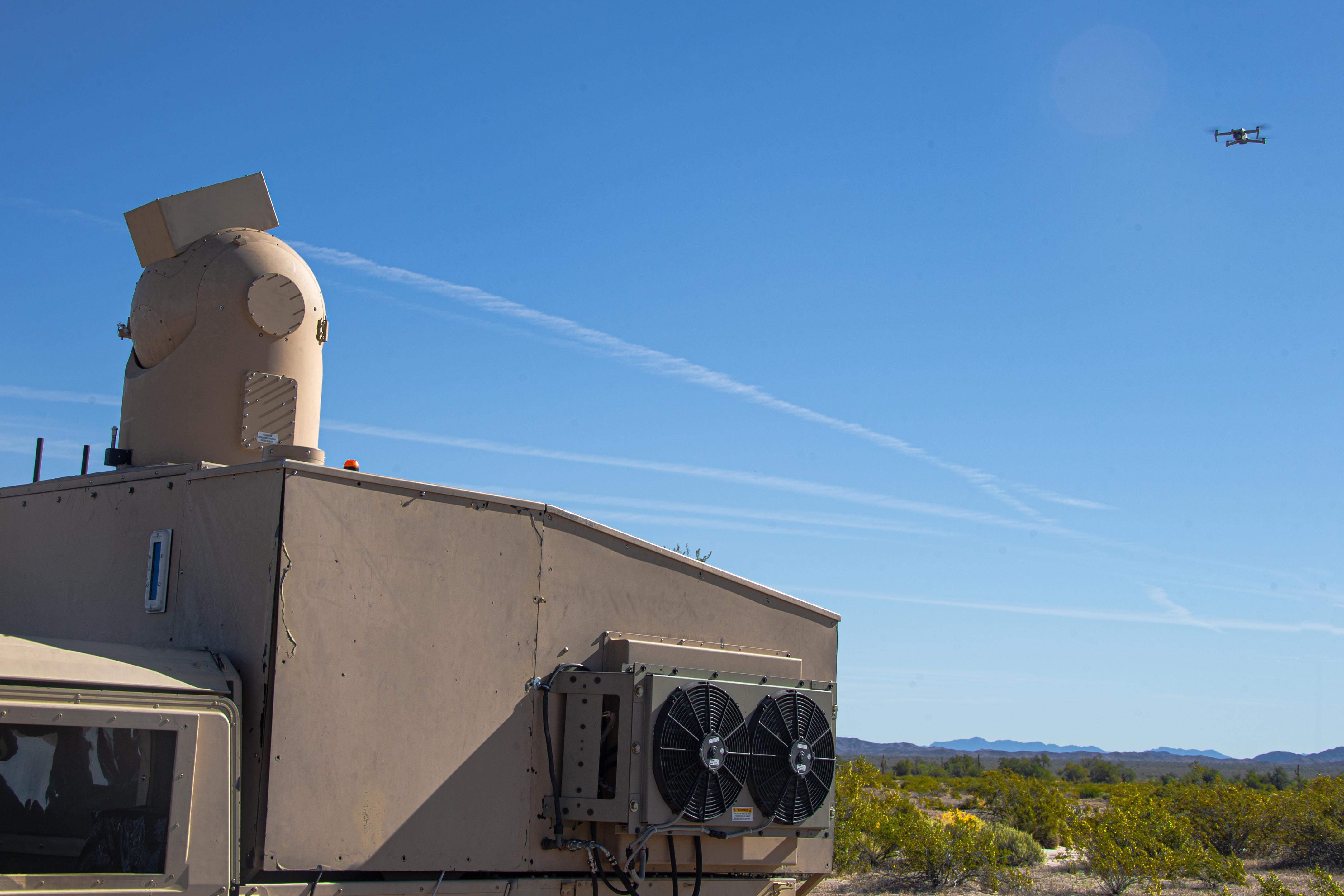
Consider the Army’s 50 kW Stryker-mounted Directed Energy Maneuver-Short Range Air Defense (DE M-SHORAD), which the service determined was “not mature enough” to become a program of record after rocky operational testing in the Middle East in 2024 exposed issues with the system’s heat dissipation and reliability in its vehicle-mounted configuration.
Retired Army Lt. Gen. Robert Rasch summed up the problem with real-world directed energy weapon deployments in August 2025.
“We can’t get by with the thought of having clean rooms out in combat,” he said.
The Pentagon has been burning drones out of the sky with lasers since 1973, but it has yet to consistently translate demonstrators into battle-ready weapons that American service members can actually rely on outside of a controlled environment.
Indeed, the last decade has proven a graveyard of promising laser weapon programs.