Romania Strike Exposes NATO’s Eastern Flank Risks
AI Analysis
A Russian drone impacted Romanian territory near Galați, marking the most serious security breach since the Ukraine invasion began. The incident highlighted vulnerabilities in Romania’s air defense capabilities, specifically against low-flying, inexpensive drones. It underscores the increasing risk of escalation and spillover from the Russo-Ukrainian war into NATO territory.
Key Takeaways
- Romanian air defenses failed to intercept the drone despite radar detection and F-16 interception attempts.
- Existing air defense systems (e.g., Patriot) are ineffective against low-cost, low-altitude drones.
- NATO requires enhanced air defense systems, surveillance networks, coordination mechanisms, and communication protocols.
- Romania needs to increase defense spending and integrate further into NATO's air defense architecture.
- The incident will likely increase pressure for Western states to accelerate arms deliveries to Ukraine, particularly air defense systems, and enhance Black Sea security.
Why It Matters
This incident demonstrates Russia's willingness to probe NATO's defenses and test the limits of the alliance's commitment. It highlights a critical gap in NATO's layered defense – the ability to counter inexpensive, mass-produced drones – and necessitates urgent investment in counter-UAS technologies and integrated air defense systems. Failure to address this vulnerability could lead to further escalatory incidents.
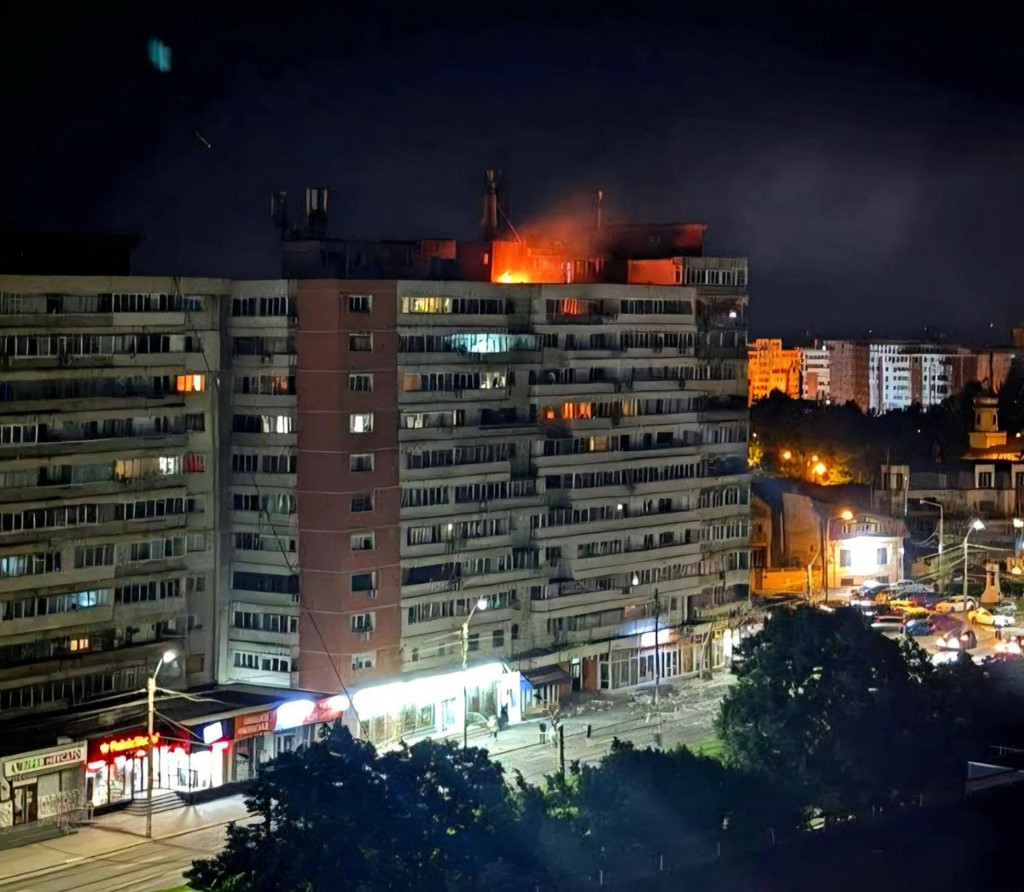
A Russian drone was shot down by an air defense system and crashed into an apartment building in Galați, Romania. A fragment of a Russian drone was found in the town of Siret last month. The attack with a drone that entered Romanian airspace is the most serious security breach since the start of the war between Russia and Ukraine, the Romanian Ministry of Defense said in a statement on Tuesday.
A Russian drone penetrated Romanian airspace and struck an apartment in Galați. The aircraft was detected by the Romanian radar and was chased by two F-16s. Although the drone was chased deep into Romanian territory, the pilot apparently did not have time to release a missile, and the drone hit an apartment building. The attack has caused significant implications. It is the most serious security breach of Romanian territory since the start of the Russian invasion in Ukraine, and it is a clear sign that the war is becoming a regional conflict.
Follow our coverage of the war on the @Kyivpost_official.
The incident exposed structural problems on both sides of the conflict. While NATO is operating in a new environment characterized by shrinking margins of error in deterring conflicts to avoid their escalation, Russia is increasingly employing low-cost, low-altitude and hard-to-track drones for its attacks on Ukrainian territory and in its hybrid operations against other neighbors. In other words, drones are becoming one of the many tools Russia uses to test the limits of NATO’s commitment to defend its member states.
Moreover, as has already been underlined, NATO has to ensure that it is deterring the conflict without allowing it to escalate, while at the same time it must prove its credibility by strongly defending the territories of its member states. For this purpose, NATO needs a more efficient air defense system, a larger network of surveillance systems and efficient mechanisms of coordination among its member states, as well as a more efficient system of communication in order to prevent any possible ambiguity that could be exploited by the opponent.
A further challenge, however, for Romania as a frontline state, is that its air defense cannot currently adequately counter the low-flying, short-range, and inexpensive drones. While an air defense system such as Patriot can shoot down ballistic and cruise missiles, it is unable to counter cheap drones that can be flown into areas where air defense systems are deployed. Therefore, such a country requires a more complex air defense system made up of a variety of different components, including effective radar coverage, rapid reaction forces, and counter-drone systems, all integrated into NATO’s Integrated Air and Missile Defense system.
The recent incident will put a lot of pressure on the country to increase defense spending and to integrate further into NATO. It will also once again highlight Romania’s growing importance in terms of Black Sea security.
The attack with a Russian drone also has bearings on the Russo-Ukrainian war. The fact that an operation with a drone entered Romania thus, in all likelihood, was unintended. However, the fact that the Russian campaign is now being conducted in increasing measure with the aid of inexpensive drones and, in addition, with long-range attacks against Ukrainian infrastructure aided by large numbers of missiles, could unintentionally draw NATO into a crisis in the future. The attack will also require the Alliance to further upgrade its air defenses and increase intelligence sharing with Ukraine. Moreover, there is increased pressure on the Western states to quickly deliver appropriate armaments, particularly in the Black Sea.
For Ukraine, the attack by a Russian drone serves to again point out the need for continued support from the Western states, in particular in air defense.
But addressing the problem of uncontrolled drones penetrating the airspace of member states will also require a longer-term perspective. NATO and the countries of Central and Eastern Europe must, first and foremost, strengthen the defenses of their airspace and enhance their respective capacities to detect and repel drone attacks.
At the same time, as a matter of priority, air defense systems, radar stations, and intelligence and surveillance assets and facilities, as well as mechanisms and centers for the planning and coordination of a joint defense effort, must be enhanced and integrated into NATO’s air defense system as a network. Several specific steps must be taken in order to create effective procedures for crisis management in the context of uncontrolled entries into the airspace of member states. These steps would enable the Alliance to evaluate situations of this kind and to communicate with member states involved in a crisis in a coordinated and measured fashion, to manage the crisis and contain its escalation promptly and appropriately.
In addition to these steps, the air defense capabilities of member states must be integrated into the air defense system of the Alliance as a whole, with the involvement of the aircraft and surveillance assets of NATO, including its AWACS (Airborne Warning and Control Systems), to strengthen the ability of member states to repel any attack and to provide a coordinated response.
Finally, diplomatic pressure on Russia must be sustained, in order to bring to bear the full weight of political consequences of any such violation of the airspace of member states of the Alliance.
Ultimately, the Russian drone attack on Romanian soil is a strategic warning to the Alliance of vulnerable eastern areas and of serious weaknesses in Romania’s air and defense systems, and of the dangers of spillover from the ongoing war in Ukraine and of accidents that could lead to a serious conflict between NATO and Russia.
The views expressed in this opinion article are the author’s and not necessarily those of Kyiv Post.