Kyiv Under Massive Russian Attack as Missiles and Drones Target Capital
AI Analysis
Kyiv and Ukraine experienced a sustained, multi-wave attack combining missiles and drones, indicating a Russian strategy of saturation to exhaust Ukrainian air defenses. The attacks occurred both during the day and overnight, targeting civilian infrastructure and aiming to maximize disruption and psychological impact. Ukrainian officials anticipate continued attacks, potentially timed to influence international diplomatic efforts.
Key Takeaways
- Russia employed a combined missile and drone attack strategy against Kyiv and Ukraine.
- The attacks were conducted in waves over an extended period (30+ hours) suggesting a saturation tactic.
- Damage was reported to residential buildings, roadways, and other infrastructure in multiple Kyiv districts.
- Ukrainian officials believe the attacks are intended to exhaust air defense resources and demoralize the population.
- The timing of the attacks may be linked to the Trump-Xi summit, with Russia attempting to project strength and influence negotiations.
Why It Matters
This sustained assault highlights Russia's continued reliance on air strikes despite setbacks and indicates a willingness to accept collateral damage. The saturation strategy poses a significant challenge to Ukraine's air defense capabilities and resource management. The potential political motivation – influencing the US-China dynamic – demonstrates the broader geopolitical implications of the conflict.
Kyiv came under a massive, multi-wave Russian aerial assault in the early hours of Thursday, as Russian forces launched a combined missile and drone attack at the Ukrainian capital.
The overnight attack followed a devastating daytime barrage on Wednesday, which Ukrainian officials described as one of the longest and largest coordinated bombardments of the war.
Follow our coverage of the war on the @Kyivpost_official.
Air raid sirens sounded across Kyiv and throughout Ukraine as Ukraine’s Air Force tracked multiple groups of Russian weapons moving toward the capital. Deafening explosions reverberated through the city as air defense units actively engaged and intercepted the incoming targets.
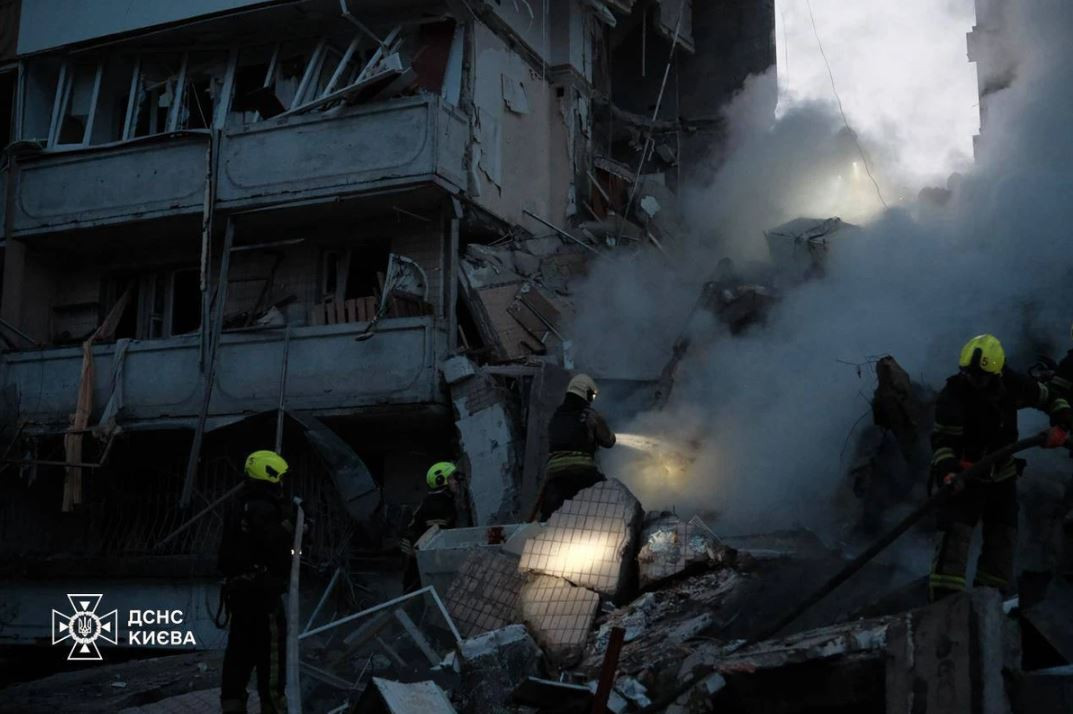
Kyiv City Military Administration chief Tymur Tkachenko said falling debris from intercepted drones and missiles struck several districts of the capital.
In Obolonskyi district, debris hit a residential building, sparking a fire. Damage was also reported in Dniprovskyi, Holosiivskyi and Solomianskyi districts, including residential buildings, roadways, a parked car and a non-residential building.
Klitschko urged residents to remain in shelters as Ukrainian air defense forces continued to repel successive waves of strikes.
Information about possible casualties was still being clarified.
President Volodymyr Zelensky had earlier warned of anticipated Russian attacks, citing Ukrainian intelligence reports that Moscow was preparing further missile and drone strikes.
The overnight escalation came after Russia launched a massive daytime drone barrage on Wednesday. Ukrainian officials said the scale of the attack suggested a calculated saturation strategy aimed at exhausting Ukraine’s air defense ammunition and overwhelming monitoring systems before heavier missile waves.
Speaking to Kyiv Post during the attack, Elkhan Nuriyev, a member of Ukraine’s Officers’ Union, said the pattern was consistent with Russia’s wider tactic of wearing down defenses before escalating overnight.
“Drones have been coming in waves for more than 30 hours,” Nuriyev said. “They usually launch missiles at night, when people are asleep, to cause maximum disruption and anxiety.”
According to Nuriyev, the assault aimed to hit Ukrainian cities while increasing psychological pressure on civilians.
“The goal is to make Ukrainians feel exhausted and pressure the president,” he said. “But Ukrainians will not do that.”
Nuriyev linked the timing of the maximum-scale bombardment to the highly anticipated Trump-Xi bilateral summit in Beijing, noting that Vladimir Putin calculated the violence to assert Russian leverage and force Ukraine to the absolute forefront of the superpower agenda.
“Putin wants them to say at the negotiating table in Beijing: ‘Look, Russia is finishing off Ukraine,’” Nuriyev said. “It is deliberately calculated to project an illusion of Russian dominance, ensuring Moscow forces its way into any global security architecture the US and China attempt to map out.”
The latest onslaught came days after Russia’s scaled-back May 9 Victory Day parade in Moscow, an event many viewed as a public embarrassment and a sign of the Kremlin’s growing vulnerability.
Air raid alerts remained active across parts of Ukraine as officials urged residents to follow safety instructions and remain in shelters until the all-clear.
Sevinj Osmanqizi is a journalist covering US foreign policy, security, and geopolitics, with a focus on the broader post-Soviet space. She reports on Washington’s decision-making and its implications for Ukraine and regional stability.