Ukraine’s Unmanned Systems Forces Strike Key Russian Assets Across Occupied Territories
AI Analysis
Ukrainian Unmanned Systems Forces (USF) conducted a series of long-range drone strikes targeting and destroying key Russian air defense assets (Pantsir, Tor) and radar installations across occupied territories. These strikes demonstrate a continued escalation in Ukraine’s drone warfare capabilities and a focus on degrading Russian logistical and defensive layers. The USF is pioneering novel tactics, including naval drone-launched aerial interceptors.
Key Takeaways
- USF destroyed a Pantsir-S1 system in Donetsk region.
- A Tor system was destroyed in Luhansk region.
- Two P-18 radar stations were destroyed in Luhansk and Zaporizhzhia regions.
- Targets also included Russian telecommunications, troop deployment points, and a repair base.
- Ukraine is emphasizing innovation and advanced control systems in its military strategy.
Why It Matters
The successful targeting of Russian air defense systems significantly weakens Russia’s ability to protect its forces and infrastructure in occupied Ukraine, creating opportunities for further Ukrainian offensives. Ukraine's demonstrated ability to strike deep behind enemy lines with drones highlights the evolving nature of modern warfare and the increasing importance of counter-UAS capabilities. This also signals a potential shift in tactical focus towards systematically degrading Russian military infrastructure.
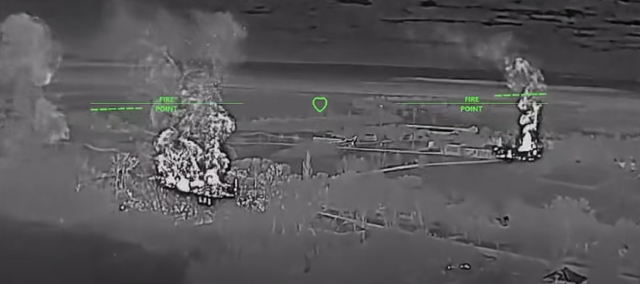
The Unmanned Systems Forces (USF) of the Armed Forces of Ukraine carried out a series of long-range strikes against multiple Russian military objectives in the occupied regions of Donetsk, Zaporizhzhia, and Luhansk during the first days of May.
Robert “Madyar” Brovdi, commander of the USF, released footage on Sunday confirming the destruction of several high-value assets.
Follow our coverage of the war on the @Kyivpost_official.
Among the targets successfully hit were:
A Pantsir-S1 surface-to-air missile and anti-aircraft artillery system in Novyi Svit, Donetsk region.
A Tor surface-to-air missile system in Markivka, Luhansk region.
Two P-18 radar stations located in Heraskivka, Luhansk region, and Sofiivka, Zaporizhzhia region.
The telecommunications center and temporary deployment point of the “Rubikon” unit in Mariupol.
A temporary deployment point for the “Storm” unit in Kamianuvate.
A Russian military personnel deployment point in Stepko, Zaporizhzhia region.
A repair base in Kadiivka and six separate airspace control systems across the occupied territories.
These operations follow a period of rapid technological escalation in drone warfare. Kyrylo Budanov, head of the Presidential Office, recently emphasized that success on the battlefield is increasingly dependent on innovation and the integration of advanced control systems.
The USF has been at the forefront of this shift, recently achieving a world-first by using a naval drone to launch an aerial interceptor.
The systemic nature of these strikes is intended to degrade Russian military logistics and air defense layers.
Previous operations led by Commander Brovdi in April targeted similar high-value assets, including Iskander missile systems in Crimea, and contributed to significant logistical bottlenecks for the Russian military.
Kyiv Post is Ukraine’s first and oldest English news organization since 1995. Its international market reach of 97% outside of Ukraine makes it truly Ukraine’s Global – and most reliable – Voice.