Ukraine Secures New Aid Pledges at Ramstein, Zelensky Urges Fast Delivery
AI Analysis
Ukraine secured new aid pledges at the Ramstein meeting, focusing on drones, air defense, and logistics, with significant contributions from Norway, the Netherlands, and other European nations. Delivery timelines remain critical as Ukraine seeks to bolster its battlefield resilience against Russian aggression.
Key Takeaways
- Norway pledges over $500 million for drones and $150 million for logistics.
- The Netherlands commits more than €200 million for drone procurement.
- Germany and the UK focus on air defense and long-range strike capabilities.
- Raytheon secures a $3.7 billion contract for PAC-2 GEM-T missiles for Ukraine.
- NATO's Prioritized Ukraine Requirements List (PURL) facilitates funding and coordination.
Why It Matters
The aid packages underscore the strategic importance of drones and air defense in Ukraine's military strategy, aiming to counter Russian advances effectively. Timely delivery of these systems is crucial for maintaining Ukraine's defensive capabilities and ensuring the protection of critical infrastructure, especially during winter months.
Ukraine will receive new military assistance packages following the Ramstein meeting, including funding for drones, air defense, and logistics, President Volodymyr Zelensky said.
In a Telegram post, Zelensky said five partner countries confirmed contributions to NATO’s Prioritized Ukraine Requirements List (PURL).
Follow our coverage of the war on the @Kyivpost_official.
Norway will allocate over $500 million for drones for Ukrainian brigades and an additional $150 million for logistics, while the Netherlands will provide more than €200 million ($236 million) for drone procurement.
Belgium will contribute funding for artillery shells and air defense, while the UK and Germany will continue efforts to supply drones and develop long-range strike capabilities.
Zelensky also thanked Spain for its readiness to work within the EU’s SAFE program, aimed at scaling joint defense production.
He noted that partners at Ramstein acknowledged the resilience of Ukrainian brigades on the battlefield.
“Partners at Ramstein noted Ukraine’s strong positions on the battlefield – I am grateful to each of our combat brigades for this,” Zelensky wrote.
“There is also a clear understanding of our needs in air defense and joint weapons production. The main thing is that every commitment announced is fully fulfilled and in a timely manner,” he added.
Zelensky stressed that with sufficient protection, Russia loses its ability “to achieve its occupation goals.”
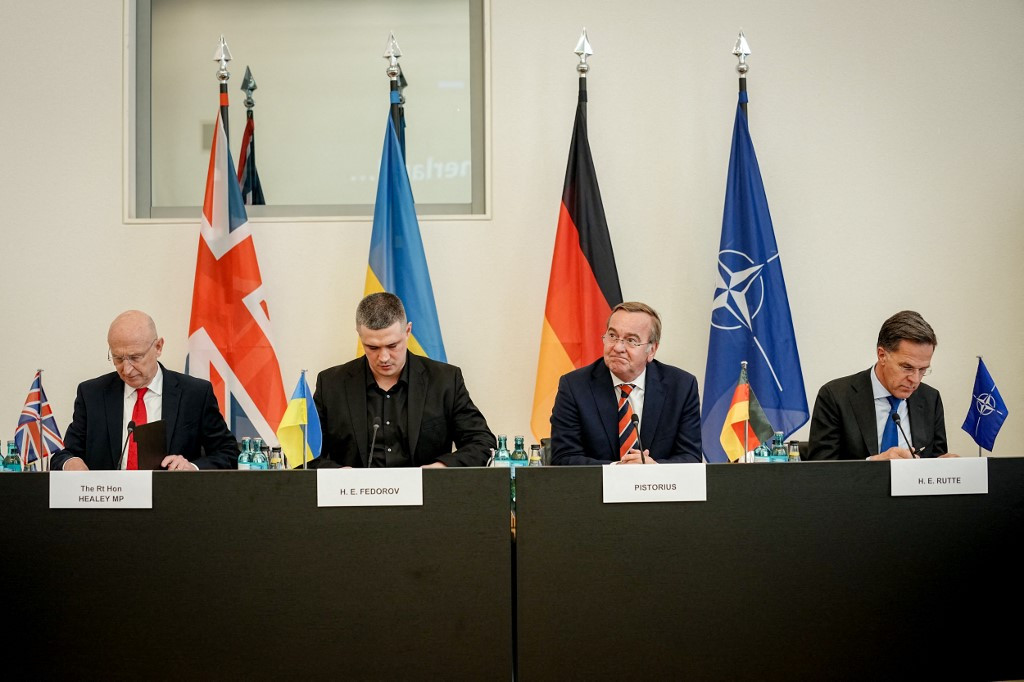
Multiple European countries announced new defense packages for Ukraine at the Ramstein meeting on April 15, though delivery timelines remain uncertain.
The Ukraine Defense Contact Group (UDCG) gathering focused on previously unveiled pledges, including Germany’s €4 billion ($4.7 billion) package with “hundreds” of Patriot missiles and IRIS-T systems, and the UK’s “biggest-ever” drone package of over 120,000 units alongside artillery rounds.
German Defense Minister Boris Pistorius said the systems – aimed at strengthening Ukraine’s top priority, air defense – will arrive in the coming years, while Ukraine’s Defense Minister Mykhailo Fedorov clarified that Patriot deliveries are expected between 2027 and 2029.
On the same day, Raytheon secured a $3.7 billion German-funded contract to produce PAC-2 GEM-T missiles for Ukraine.
Fedorov stressed Kyiv urgently needs both PAC-2 and PAC-3 interceptors, especially to protect critical infrastructure during winter, and thanked several countries for funding purchases via NATO’s PURL mechanism.
The meeting also highlighted continued reliance on drones and artillery, with additional contributions pledged by allies including the Netherlands and Norway. However, divisions emerged over burden-sharing within NATO.
While Pistorius downplayed comparisons, Fedorov acknowledged some imbalance but emphasized coordination.
NATO Secretary General Mark Rutte said allies “can do even better,” while offering cautious optimism on continued support – despite uncertainty over future US deliveries amid competing demands.
Julia is a Deputy Head of News and correspondent for Kyiv Post who has previously worked as a parliamentary editor, journalist, and news editor. She has specialized in covering the work of the Ukrainian parliament, government, and law enforcement agencies.