Ukraine, Germany Agree €4B Defense Package Including Patriot Missiles, Drone Production
AI Analysis
Ukraine and Germany have agreed on a €4 billion defense package that includes Patriot missiles, IRIS-T launchers, and joint drone production. The package aims to enhance Ukraine's air defense and long-range strike capabilities.
Key Takeaways
- The defense package includes several hundred Patriot missiles for Ukraine's air defense.
- 36 IRIS-T launchers will be supplied to enhance Ukraine's multi-layered air defense system.
- €300 million is allocated for Ukraine's long-range strike capabilities development.
- Joint production of 5,000 AI-enabled mid-range strike drones is planned under the 'Build with Ukraine' initiative.
- Germany is interested in Ukraine's battlefield experience and defense technologies, including drone systems.
Why It Matters
This agreement significantly boosts Ukraine's air defense and strike capabilities amid ongoing conflict with Russia, enhancing its ability to protect critical infrastructure. The collaboration also strengthens European defense ties and leverages Ukraine's battlefield innovations, potentially setting a precedent for future defense partnerships.
Ukraine and Germany have agreed on a €4 billion ($4.7 billion) defense cooperation package that includes Patriot air defense missiles, drone production and long-range weapons development.
Ukraine’s Defense Minister Mykhailo Fedorov said in a Telegram post on Tuesday, April 14, that the agreement was reached during talks with German Defense Minister Boris Pistorius.
Follow our coverage of the war on the @Kyivpost_official.
Fedorov described the cooperation as a “win-win cooperation” for Ukraine and Europe’s security.
Germany will finance a contract for several hundred Patriot missiles to help protect Ukrainian cities and critical infrastructure, Fedorov said.
Fedorov did not specify the number of missiles or a delivery timeline. Supplies of US-made Patriot missiles have been strained in recent years due to sustained demand from Ukraine to counter Russian attacks, a situation further exacerbated by the US / Israeli war in Iran.
The package also includes the delivery of 36 IRIS-T launchers to enhance Ukraine’s multi-layered air defense system, Fedorov said.
While Patriot systems are typically reserved for high-speed, high-value Russian missiles in Ukraine, IRIS-T launchers provide medium-range coverage against aerial threats at lower and medium altitudes as part of a layered air defense network.
The agreement also includes €300 million ($354 million) in investments into Ukraine’s long-range strike capabilities, allowing Kyiv to expand domestic weapons production.
German Chancellor Friedrich Merz hinted at plans to build long-range weapons inside Ukraine in November 2025, with a top German general hinting at ongoing work to fund Kyiv’s domestic long-range weapon production a few months prior.
It is unclear if the latest announcement is related to these earlier initiatives.
Under the “Build with Ukraine” initiative, Kyiv and Berlin will launch joint production of mid-range strike drones using artificial intelligence (AI).
At the initial stage, 5,000 drones are expected to be produced for the Ukrainian military, according to Fedorov.
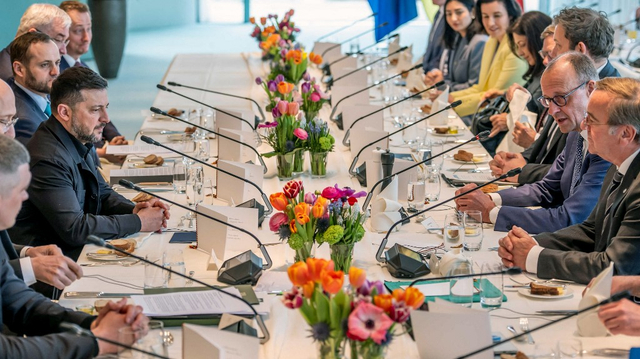
President Volodymyr Zelensky arrived in Berlin on Tuesday for talks with Merz as part of intergovernmental consultations aimed at deepening bilateral cooperation.
The meeting took place against the backdrop of stalled US-initiated peace talks between Ukraine and Russia, with Kyiv rejecting proposals that would involve ceding territory.
At the same time, Germany is increasingly interested in Ukraine’s battlefield experience and defense technologies, including drone systems developed during the war.
Alongside the leaders’ talks, broader consultations are underway involving senior officials from both countries. Ukraine’s Social Minister Denys Uliutin is expected to meet German Interior Minister Alexander Dobrindt at a “Unity Hub” in Berlin, a support center for Ukrainian refugees.
Merz also said Berlin would limit the number of Ukrainian men seeking asylum and facilitate their return home.
Speaking at a joint press conference alongside Zelensky, Merz said Berlin would work closely with Kyiv on the issue.
“We will work closely [with Ukraine] on issues related to Ukrainian citizens who have sought asylum in our country and facilitate their return home,” he said.
Yuliia Zavadska is a news writer at Kyiv Post. She has experience in breaking news coverage, fact-checking, and digital journalism, with a focus on fast, accurate reporting and clear storytelling. Before joining Kyiv Post, she worked as a news feed editor for several leading Ukrainian media outlets.