Japan’s EC-2 Electronic Warfare Jet, Arguably The World’s Ugliest Aircraft, Just Flew For The First Time
AI Analysis
Japan's EC-2 electronic warfare jet, derived from the C-2 transport aircraft, has completed its first flight. Designed to interfere with enemy electromagnetic operations, the EC-2 represents a significant upgrade in Japan's electronic warfare capabilities.
Key Takeaways
- The EC-2 is a standoff electronic warfare aircraft developed from the C-2 transport.
- It is designed to disrupt enemy sensors and communications from a distance.
- The EC-2 succeeds the retired Kawasaki EC-1 and features advanced jamming systems.
- Japan plans to procure four EC-2s, reflecting increased focus on electromagnetic spectrum operations.
- The EC-2 and RC-2 SIGINT platform are expected to operate in tandem for enhanced electronic warfare capabilities.
Why It Matters
The development of the EC-2 enhances Japan's ability to conduct electronic warfare, crucial for countering sophisticated air defense systems. This capability is strategically important given regional security challenges and the need for advanced electronic warfare platforms to maintain a technological edge.
The TWZ Newsletter
Weekly insights and analysis on the latest developments in military technology, strategy, and foreign policy.
Terms of Service and Privacy Policy
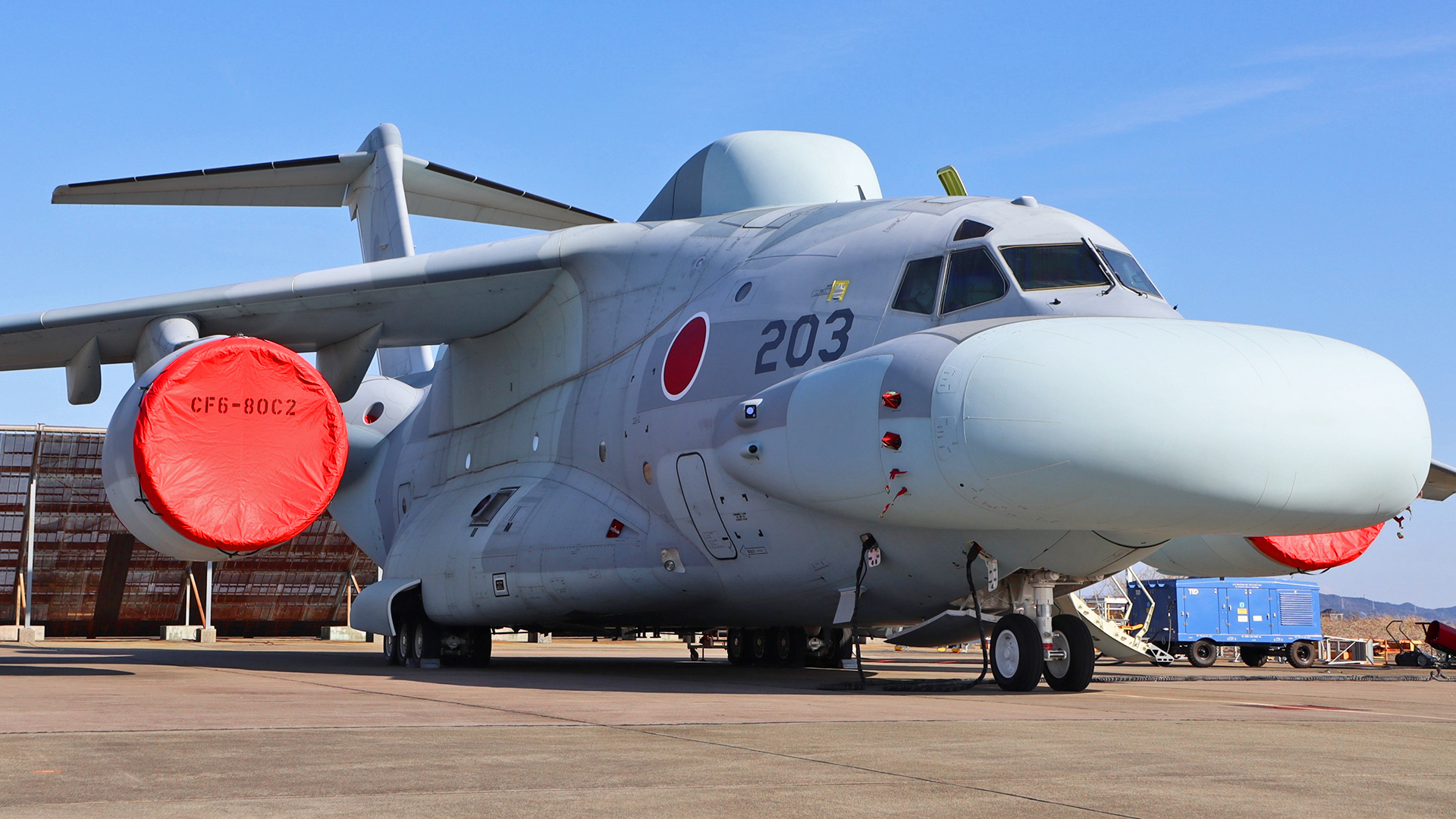
The latest addition to the Japan Air Self-Defense Force (JASDF) is, without question, one of the ugliest military aircraft to grace an apron today. With its enormous, bulged nose and other awkward protuberances, the Kawasaki EC-2 is, nevertheless, an important addition to the JASDF at a time when it faces increasing challenges from various sophisticated threats. The aircraft, which has generated much interest, took to the air for the first time today at Gifu Air Base, in the prefecture of the same name.
https://t.co/rBniYCTWQK pic.twitter.com/rqA8ZXSNqG
試験飛行を終えて🦆が戻ってきた#岐阜基地 pic.twitter.com/8Rv623THgu
うぐぐぐ。画面つるつるいっぱい。センター逃した…_(┐「ε:)_📸 pic.twitter.com/HslcQc10Yb
EC-2初フライトおめでとう🎉でっけぇ……。 pic.twitter.com/Yo3oZoFnPW
Derived from Japan’s indigenous C-2 twin-jet transport, the EC-2 is a standoff electronic warfare aircraft, the development of which began in 2021. Its primary role is to interfere with an opponent’s operations on the electromagnetic spectrum, from outside the range of air defense threats.
Specifically, the EC-2 is based on serial 68-1203, which was the third C-2 transport completed, before being modified for its specialist role.
As for the C-2, this military airlifter sits somewhere between a C-17 and a C-130 in terms of size and capabilities. In fact, it is probably closest in most regards to the four-turboprop Airbus A400M, but is powered by a pair of General Electric CF6 high-bypass turbofans — similar to those on many 747s and 767s, for instance.
Returning to the EC-2, this aircraft is the successor to the JASDF’s one-off and now-retired Kawasaki EC-1, which was converted from an existing C-1 transport airframe and was for many years operated by the Electronic Warfare Operations Group (Denshi Sakusengun) at Iruma Air Base, in Japan’s Saitama prefecture.
A series of photos shows the now-retired Kawasaki EC-1:
航空戦術教導団電子作戦群電子戦隊入間基地EC-1 021(3枚目のみ新規写真)カモノハシ・・・EC-1。見るのはいつも岐阜に帰省した時。この半年で入間、浜松で見慣れない場所で近くに感じることが出来た。それでも最後見られたのは岐阜だった。愛すべきEC-1、お疲れ様でした。 pic.twitter.com/DNppC5I0VB
未確認地上物体(先代)ちょうど昨年のこの時期に引退しましたね。一度見たら忘れないこの顔…!2代目も早く見てみたいですね pic.twitter.com/TxjZZXtvC6
The EC-2 was first noted by an aircraft spotter at Gifu last month.
岐阜基地です。2026/02/24「カモノハシ2世」EC-2というのですか??アンコリが入ったりランディングライトが点いたりしてました。早く進空して中国機を翻弄してください。 pic.twitter.com/FHLZuLfWxw
Gifu is home to the JASDF’s Aviation Development and Testing Group, which will put the EC-2 through its paces before it is approved for operational service.
未確認地上物体#岐阜基地#飛行開発実験団 pic.twitter.com/ZrwkmWeAUx
Before its first flight, the EC-2 became a peculiar object of interest for spotters and locals alike, with photographers taking numerous shots of the aircraft as it underwent taxi trials at Gifu.
登場しました㊗️スタンド・オフ電子戦機(68-1203)#岐阜基地 pic.twitter.com/EQq6tSz1oX
Prior to that, the EC-2’s appearance had only been publicly known thanks to a rendering released by the Japan Ministry of Defense.
Back in 2022, a spokesperson from the Japan Ministry of Defense’s Acquisition, Technology & Logistics Agency (ATLA) told Janes that the C-2 was selected as the platform due to its ability to carry a significant amount of equipment to enable it to conduct “effective jamming” from outside of the opponent’s threat envelope.
“[The] C-2 transport aircraft has been selected as the base platform after considering such factors as its flight performance, maximum payload, and cost,” the ATLA spokesperson said at the time.
“By choosing the C-2 as the base platform, we make use of the existing infrastructure of the C-2 and thus effectively and efficiently operate the new C-2-based standoff EW aircraft,” the spokesperson added.
カモノハシ2号 動く!!2026/3/16 岐阜基地 隣接川崎重工C-2 203号機 ハイスピードタクシー試験実施 pic.twitter.com/wF88vyrshT
Compared to the C-1, the C-2 has a significantly higher payload capacity. The new transport can carry a payload of nearly 80,000 pounds for a maximum takeoff weight of 310,000 pounds, as opposed to a payload of around 26,000 pounds and a maximum takeoff weight of 100,000 pounds for the older C-1. You can look at a very direct visual comparison of the C-1 and the C-2 here.
Reportedly, however, at least some of the equipment previously used in the EC-1 — including the J/ALQ-5 electronic countermeasures system — has been ported over to the new EC-2.
Like its predecessor, the EC-2 has a huge bulbous nose, but it also adds two large, bulged fairings in tandem on the top of the fuselage. Meanwhile, there are two other prominent fairings mounted on either side of the rear fuselage.
Detailed views of the Kawasaki EC-1:
2025.01.28浜松基地 RJNH入間基地配備EC-1 021カモノハシの転がり正面をたまらない光線で🙏これでEC-1の撮影最後かなー… pic.twitter.com/beL6pyGi8z
Very few details of other specific equipment have been released, but imagery of the aircraft confirms that missile approach warning sensors (MAWS) are installed around the fuselage as part of its self-defense suite.
In an operational context, the EC-2 would use its powerful jamming systems to disrupt enemy sensors — especially those belonging to air defense systems and communications — on the ground and in the air, from a long distance.
The details that have been released relating to the EC-2 refer to program costs. Namely, the FY2025 Budget Request notes that around $260 million was allocated to the development of the aircraft. This is part of a total of around $3.2 billion that is being spent to upgrade intelligence collection and analysis capabilities.
Reflecting the increased emphasis on electromagnetic spectrum operations, Japan plans to buy four EC-2s, compared to having just one EC-1 in the past.
The EC-2 is the second specialized variant of the C-2, after the RC-2 signals intelligence (SIGINT) platform, first flown in 2018 and now active with the Electronic Warfare Operations Group. This aircraft was converted from the second C-2, serial 18-1202, and was officially handed over to the JASDF in 2020.
#飛行機の転がりだけで100イイネ目指すRC-2 202 早朝の雛壇にて pic.twitter.com/I1pxrzFStc
203号機の雛壇前正面撮りてぇなRC-2でも迫力あったEC-1では撮れなかったな… pic.twitter.com/HqNzHA6L5v
The RC-2 also has fairings on top and on the sides of the fuselage, and atop the tail. The nose radome is enlarged, and there is an extensive under-fuselage antenna ‘farm.’
According to statements from the Japan Ministry of Defense, it seems the EC-2 and RC-2 will likely work in concert. Specifically, the RC-2 is part of a wider effort to “improve capabilities to gather electromagnetic information necessary for electronic jamming and electronic protection.” This suggests that the RC-2 will conduct regular peacetime missions to gather data on locations and types of threat emitters, as part of generating an electronic order of battle, with this information then being used to ensure the EC-2 is able to target specific emitters.
In the past, Japan has also looked at other specialized versions of the C-2, including arming the transports with air-launched standoff missiles, in a parallel to the U.S. military’s experiments with adding a standoff attack option to existing transport fleets.
As part of its fiscal 2023 budget, the Japan Ministry of Defense received a little over $25 million to explore the missile-toting C-2 concept, with a plan to continue technical research until fiscal 2024. If judged successful, full-scale development would then follow. The current status of that effort is unclear.
One factor that has stood in the way of additional procurement is the very high cost of the C-2, with around $2.3 billion plowed into the development effort and each airframe priced at approximately $176 million, as of 2017. This means Japan has been buying these aircraft at a slow rate, with the aim of fielding a frontline fleet of 16. The high cost has also contributed to a failure to win any export orders, which, if secured, would have helped to bring down the price.
The EC-2 seen on its first flight earlier today, accompanied by a Mitsubishi F-2B chase plane:
F-2引き連れて帰って来ました💦 pic.twitter.com/9NN6vdQRif
EC-2のチェイス機はF-2の105でした💦 pic.twitter.com/m5RpeY4a64
However, there is clearly a need for the EC-2, and it seems likely that the program will yield further examples of the standoff jammer.
In the past, Japanese defense officials have described the regional environment as “severe” and increasingly complex.
After all, Japan faces an increasingly challenging security environment, with the key threats provided by Chinese, North Korean, and Russian military activity. China has intensified its air and naval operations in the East China Sea and the wider Western Pacific, including deploying aircraft carriers and conducting frequent patrols near Japan’s southwestern islands. North Korea continues to test ballistic missiles capable of reaching Japan, while Russian aviation activity around Japanese airspace has also increased, including joint patrols with the Chinese military.
Outside of Japan, this type of platform is of growing interest, with a number of significant active procurement programs. In the past, we have looked in detail at the U.S. Air Force’s EA-37B Compass Call, as well as its derivative for Australia, the MC-55A Peregrine.
While its bizarre appearance might be the most obvious feature of Japan’s new EC-2, this ungainly machine will play an important role in the modernization of the Japan Air Self-Defense Force, as it increasingly looks at how to dominate the electromagnetic domain.
Contact the author: thomas@thewarzone.com
The Navy says it is confident in the CMV-22B to provide critical support to carriers at sea, but that its readiness and reliability need to be improved.
By Joseph Trevithick
Japan's interest in enabling its transport planes to launch advanced cruise missiles is likely the beginning of a new trend internationally.
By Thomas Newdick
Weekly insights and analysis on the latest developments in military technology, strategy, and foreign policy.
By signing up you agree to our Terms of Service and Privacy Policy.
By Joseph Trevithick
By Thomas Newdick
By Brian O'Rourke, Thomas Newdick, Tyler Rogoway
By Tyler Rogoway and Joseph Trevithick
By Joseph Trevithick
By Joseph Trevithick
By James Wallace and Tyler Rogoway
By Thomas Newdick
By Joseph Trevithick
By Howard Altman, Tyler Rogoway
By Joseph Trevithick
By Tyler Rogoway
By Thomas Newdick
By Thomas Newdick
By Howard Altman
By The War Zone staff
By Howard Altman
By Howard Altman, Thomas Newdick, Joseph Joseph Trevithick
By Thomas Newdick
By Joseph Trevithick, Howard Altman
By Tyler Rogoway
By Thomas Newdick
By Joseph Trevithick