After Ukraine, FPV drones could take on Arctic warfare
AI Analysis
Arctic nations, including Norway and the United States, are exploring the deployment of FPV drones for Arctic warfare, drawing lessons from their use in Ukraine. The Skydio X10D and experimental drones are being tested for intelligence-gathering and attack roles, with challenges noted in battery performance in cold environments.
Key Takeaways
- Norway is incorporating FPV drones like the Skydio X10D into Arctic military exercises.
- The Norwegian Ministry of Defense awarded a $9.4 million contract to Skydio.
- FPV drones face battery life challenges in Arctic conditions.
- The U.S. Marines are testing FPV drones with protective cages to enhance training durability.
- Both Norway and the U.S. are focusing on intelligence-gathering and attack capabilities with FPV drones.
Why It Matters
The adaptation of FPV drones for Arctic warfare signifies a strategic shift in military tactics, leveraging lessons from Ukraine to enhance intelligence and strike capabilities in challenging environments. This development could lead to increased procurement and innovation in drone technology tailored for extreme conditions, impacting future military engagements in the Arctic region.
Setermoen, Norway — Following their success in Ukraine, Arctic nations are assessing whether first-person-view drones could be deployed on Arctic battlefields.
Roughly 240 kilometers north of the Arctic Circle, two soldiers — part of the Norwegian Armed Forces’ long-range reconnaissance unit — were imperceptible from their position deep in the woods during NATO’s Cold Response 2026 exercise.
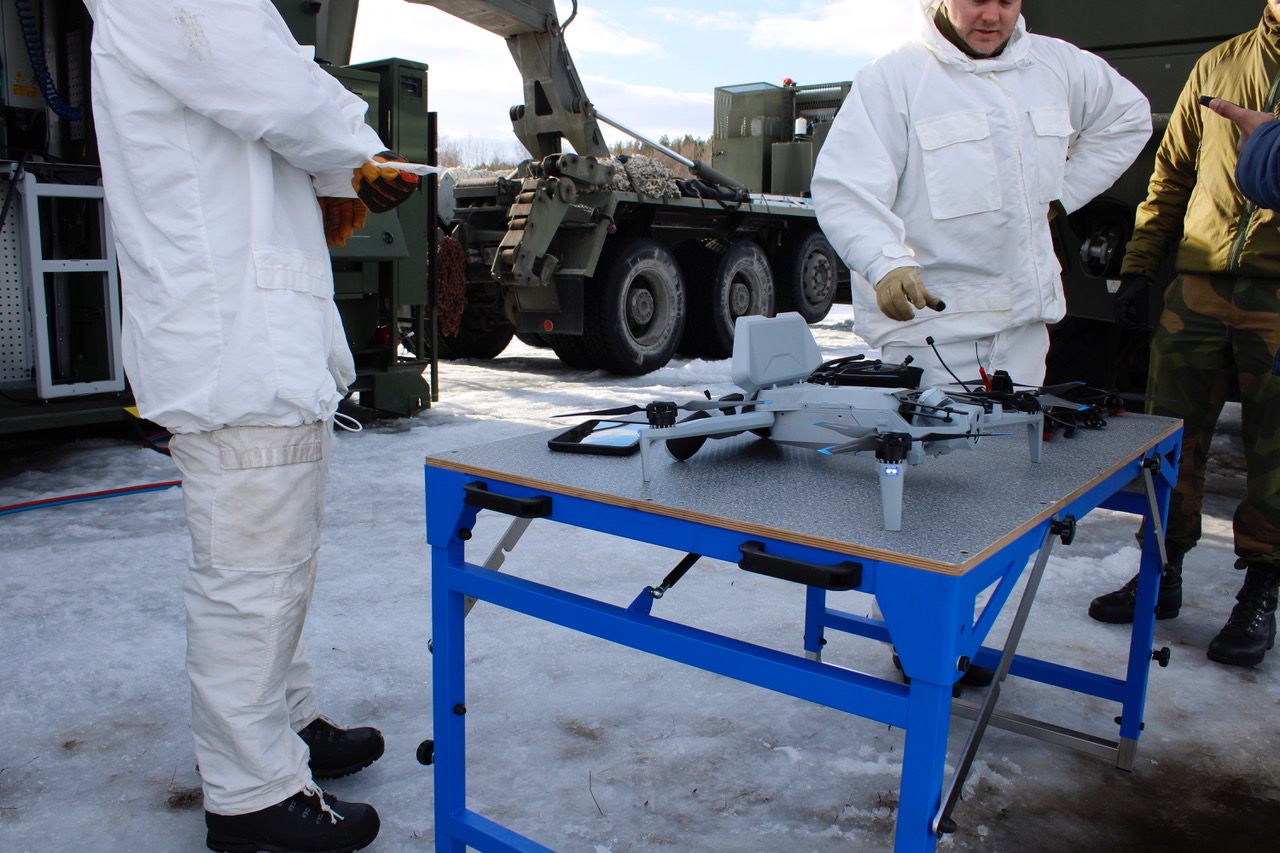
One of the only clues of their presence was a small, grey, first-person-view drone lying on the snow — a stark contrast to their all-white uniforms. The drone in question is an American system, the Skydio X10D, which is also used by Ukrainian forces.
The U.S. manufacturer was awarded a $9.4 million contract by the Norwegian Ministry of Defense in July.
“We are trying our best in Norway to implement lessons from Ukraine — for us, it’s all about increasingly using FPV and intelligence-gathering ones but adapting them to our environment,” said a Norwegian officer who spoke anonymously because of the sensitivity around the unit.
The Norwegian officer told Defense News during the NATO exercise, which lasts from March 9 to 19, that there is also an interest in incorporating FPVs into high-value target operations. While some operators have begun simulator training to fly them, this is a fairly recent development and has not yet been formally incorporated into their training.
Another drone model was displayed by the Norwegian Army Land Warfare Centre, which is responsible for training and developing weapon systems, including testing drones and sensors.
An officer with the Land Warfare Centre who flies the Skydio explained that, as part of Cold Response, almost every unit of the Norwegian Army was equipped with this capability to rehearse intelligence-gathering maneuvers. So far, it has performed relatively well, but it has experienced some difficulties, like most drones, in harsh conditions found in the Norwegian Arctic, he said.
One of the key challenges is battery life, which degrades significantly in cold environments.
An additional FPV used by the Norwegians during the exercise was a self-built one, with cheaply procured parts. It served as a one-way attack drone whose purpose was to carry explosives and see how far it could fly.
Another Arctic nation to have brought along an experimental drone was the United States.
The U.S. Marines tested a unique-looking FPV provided by Johns Hopkins University. The variant was equipped with a cage, the purpose of which is to prevent an excessive loss of the systems during training. The cage prevents it from crashing, and if repairs are needed, they can be carried out easily.
The U.S. troops used it in force-on-force scenarios, in which a friendly force engages a live adversary. This type of training allows their operators to enhance their piloting skills in a strike manner while also improving their counter-drone tactics, increasing pilots’ survivability.
Similar to the Norwegians, Master Sgt. Patrick Harrington, director of the unmanned systems center of excellence at the 2nd Marine Division, highlighted power as one of the biggest challenges to operating FPVs in Arctic conditions.
“We’ve been able to exchange with our allies here also, there’s interest in how each country [ourselves included] uses them, what they fly, how they fly it,” he said.
Elisabeth Gosselin-Malo is a Europe correspondent for Defense News. She covers a wide range of topics related to military procurement and international security, and specializes in reporting on the aviation sector. She is based in Milan, Italy.