First US casualties of Operation Epic Fury return as Trump vows escalation
AI Analysis
An Iranian drone successfully evaded U.S. air defenses, resulting in the first American casualties of Operation Epic Fury. President Trump has vowed to escalate the aerial campaign against Iran, while keeping all military options open.
Key Takeaways
- Iranian drone evaded U.S. air defenses, causing casualties in Kuwait.
- Operation Epic Fury involves a U.S.-Israel alliance against Iran.
- President Trump vows to escalate the campaign with potential new targets.
- White House denies imminent ground invasion but keeps options open.
- Iran claims readiness to confront U.S. forces if ground invasion occurs.
Why It Matters
The incident highlights vulnerabilities in U.S. air defense systems against drone threats, emphasizing the need for improved counter-UAS technologies. The escalation of military actions could lead to broader regional instability and necessitates strategic planning to mitigate further casualties and geopolitical tensions.
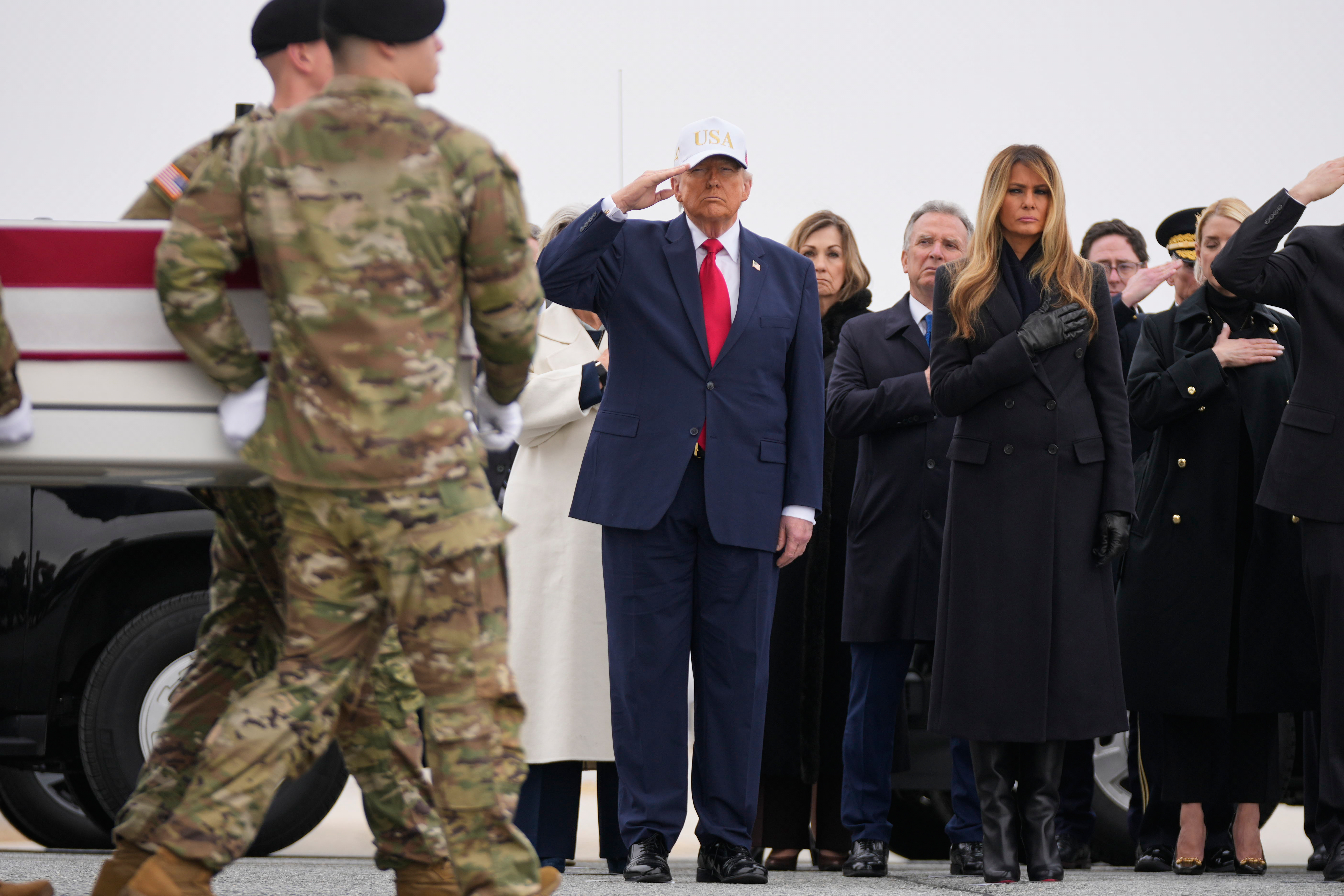
President Donald Trump, wearing a white USA baseball hat, rendered six salutes at Dover Air Force base on Saturday as six flag-draped cases of the fallen were returned to U.S. soil – the first American casualties of Operation Epic Fury.
First Lady Melania Trump, Vice President JD Vance, Second Lady Usha Vance, Defense Secretary Pete Hegseth, Army Secretary Dan Driscoll, Chairman of the Join Chiefs of Staff Gen. Dan Caine and other top officials assembled alongside the president as the troops’ remains were solemnly transferred from the C-17 transport plane to a waiting vehicle.
The service members were killed when an Iranian drone evaded American air defenses and struck a makeshift operations center in Port Shuabia, Kuwait. The attack was among the opening salvos of the war between a U.S.-Israel alliance and the Islamic Republic.
The slain soldiers were identified as Sgt. Declan Coady, 20, of West Des Moines, Iowa; Capt. Cody Khork, 35, of Winter Haven, Florida; Sgt. 1st Class Nicole Amor, 39, of White Bear Lake, Minnesota; Sgt. 1st Class Noah Tietjens, 42, of Bellevue, Nebraska; Maj. Jeffrey O’Brien, 45, of Indianola, Iowa; and Chief Warrant Officer 3 Robert Marzan, 54, of Sacramento, California.
Trump, speaking from his golf resort in Miami before the dignified transfer, vowed to keep American deaths in the campaign “at a minimum” — though he has previously acknowledged that more losses may be inevitable.
“Very sad situation to greet the families of the heroes coming home from Iran. Coming home in a different manner than they thought they’d be coming home,” he said, adding, “They are great heroes in our country.”
More than 6,000 miles away from Dover, American and Israeli forces continued their bombardment on Iran. Tehran has launched a series of retaliatory strikes directed at Israel and Gulf nations with U.S. military bases.
Trump on Saturday warned that the Islamic Regime would soon be “hit very hard,” signaling an expansion of the aerial campaign to include new “areas and groups of people.” The end goal, he says, is complete destruction.
The White House rebuffed reports that Trump is leaning toward a ground invasion of Iran, but emphasized that no military option has been ruled out.
“President Trump always, wisely keeps all options open,” White House Press Secretary Karoline Leavitt told Military Times. “But anyone trying to insinuate he is in favor of one option or another proves they have no real seat at the table.”
Iran’s foreign minister affirmed that the country is prepared to confront American forces should the U.S. expand its campaign by mounting a ground invasion.
“We are waiting for them,” Abbas Araghchi said. “Because we are confident that we can confront them, and that would be a big disaster for them.”
At this stage, Iranian ground forces do not stand a chance against the Americans, argued Sina Azodi, the director of Middle East Studies at George Washington University. But he noted that in the long-term, a full-scale ground invasion might work to Iran’s benefit.
“[The regime] thinks if they can impose more casualties on the United States and public opinion changes, then they will be able to force the U.S. to end the war sooner than later.”
“Iran is not Iraq,” he explained. “It is larger, it has a strategic depth, and it would take a lot more resources for the United States to invade.”
Trump, as he returned to Florida late Saturday afternoon, declined to commit on whether he was considering putting U.S. troops on the ground in Iran.
“I don’t think it’s an appropriate question,” the president told reporters on board Air Force One.
He added, however, that there “possibly” could be such a presence.
“If we ever did that, [Iran] would be so decimated that they wouldn’t be able to fight at the ground level.”
Tanya Noury is a reporter for Military Times and Defense News, with coverage focusing on the White House and Pentagon.