Gulf Defenses Unprepared for Iranian Drones, Analysts Say
AI Analysis
Iran is utilizing Shahed-136 drones to target Gulf countries, exploiting their inadequate defenses against low-cost threats. The Gulf states' current air defense systems are not equipped to efficiently counter these drones, leading to increased pressure on the US to intervene.
Key Takeaways
- Iran has launched over 1,000 drones at Gulf countries, primarily using Shahed-136s.
- Gulf defenses rely on expensive systems like NASAMS and Avenger, which are not cost-effective against low-cost drones.
- The US has deployed A-10 aircraft to the region to help counter drone threats.
- Iran's strategy aims to pressure Gulf states to influence US military actions.
- Ukraine offers to share its anti-drone experience with Gulf countries.
Why It Matters
The strategic use of low-cost drones by Iran highlights vulnerabilities in Gulf air defenses, potentially altering regional security dynamics. This situation could lead to increased US military involvement and collaboration with Ukraine to enhance counter-UAS capabilities in the Gulf region.
By stepping up long-range drone strikes against Gulf countries, Iran is exploiting the inadequacy of their defenses against the low-cost threat in a bid to pressure the United States to end the war, analysts said.
Since the operation began on Saturday, “Iran has primarily used ballistic missiles to attack Israel, but has relied on drones to attack Gulf countries,” according to the think tanks Institute for the Study of War and the American Enterprise Institute’s Critical Threats Project.
Follow our coverage of the war on the @Kyivpost_official.
Israel’s army said late Sunday that it was targeted by more than 50 drones “launched from Iran.” The Gulf countries, meanwhile, were on the receiving end of more than 1,000 – mainly Shahed-136s.
The United Arab Emirates says it has been targeted by more than 800 drones and nearly 200 missiles since the war erupted.
A luxury hotel and French base were among the sites targeted.
In Saudi Arabia, two drones hit the US embassy on Tuesday, while the massive Ras Tanura refinery on its Gulf coast went into partial shutdown after a strike.
Bahrain, Kuwait, Qatar, Oman and Jordan were also targeted.
For Steve Feldstein, senior fellow at the Carnegie Endowment for International Peace, the use of these drones – which cost tens of thousands of dollars – is “a meaningful way for the regime to impose costs against its adversaries.”
“As the conflict persists, this aspect could become more relevant,” he added.
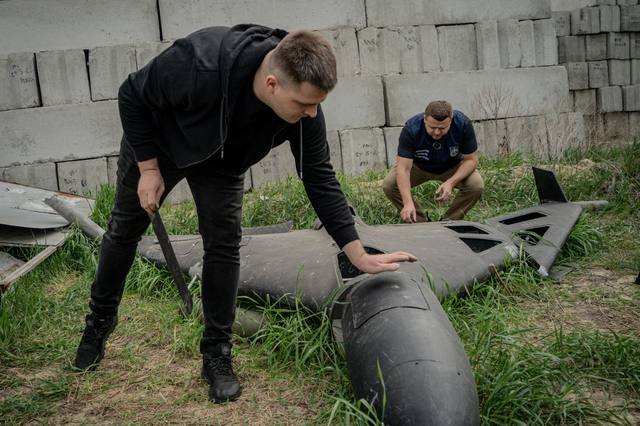
The Shahed-136, supplied by Iran to Russia and now produced by the thousands under the name Geran-2 for Moscow’s war against Ukraine, is incomparably cheaper than the missiles fired to intercept it, a European industry source specializing in these matters told AFP.
The source said it is a “tool for a war of attrition” aimed at exhausting the enemy’s resources.
The Gulf countries’ air defense systems are not designed to cope with that.
While they do not use the expensive Patriot missiles, as those are reserved for destroying complex targets such as missiles, they still resort to systems like NASAMS and Avenger, whose missiles cost several hundred thousand dollars, the source said.
The Emirates also has the “very expensive” Coyote anti-drone system.
The source added that while the Shaheds, guided by GPS, can be jammed, the jamming capabilities of countries in the region are “weak” and “would create many difficulties, including for the defense systems.”
“In Ukraine, the territory is dotted with acoustic detection systems and anti-drone drones that make it possible to shoot down Shaheds at low cost. There’s nothing at all like that in the Gulf countries,” the source said.
“The lessons observed in Ukraine have not been learnt, particularly by the Americans.”
In recent weeks, however, Washington has deployed A-10 attack aircraft to the region, whose cannon can be used against drones – just as the Israelis do with their Apache helicopters.
Ukraine has said it is ready to help and share its experience in the fight against drones.
During the 12-day war in June, Tehran confined itself to strikes against Israel.
This time, by attacking Gulf neighbors, “Iran’s calculation is to ramp up the pressure as quickly as possible so that these countries then put pressure on the US” to end its strikes, said Camille Lons, Gulf specialist at the European Council on Foreign Relations.
“Unlike Israel, these countries have very little resilience in the face of military pressure” and their societies are less prepared to cope with it, she added.
She said that Iran struck quickly out of fear that its offensive capabilities would be rapidly undermined by heavy blows from the US and Israel.
The Iranians had also learned the lesson last year “that by trying to limit escalation, they ended up appearing weak in the eyes of the United States,” Lons added.
Seth Jones, an expert at the US-based think tank CSIS, said that “if part of the Iranian strategy was to put pressure on Gulf states, so that they would push the US to try to curb this war... It could have the opposite effect.”
“It’s not entirely out of the question that we see some Gulf states get more involved in this, providing information, allowing their territory to be used for offensive strikes, not just defensive ones,” he added.