Anduril’s Fury Collaborative Combat Aircraft Is Now Flying With AIM-120 AMRAAM
AI Analysis
The U.S. Air Force's Collaborative Combat Aircraft (CCA) program has advanced to the weapons integration and captive carry testing phase with Anduril's YFQ-44 Fury drone carrying inert AIM-120 AMRAAM missiles. This marks a significant step in developing fighter drones capable of operating alongside crewed aircraft.
Key Takeaways
- Anduril's YFQ-44 Fury drone is undergoing weapons integration testing with AIM-120 AMRAAM.
- The CCA program aims to integrate drones into the Air Force's future force design.
- Testing focuses on safe systems integration and performance evaluation with inert munitions.
- The YFQ-44 is one of two designs in the CCA program, alongside General Atomics' YFQ-42A Dark Merlin.
- The program seeks to enhance combat mass and tactical possibilities against high-end threats like China.
Why It Matters
The integration of drones like the YFQ-44 Fury into the U.S. Air Force's arsenal represents a strategic shift towards unmanned systems that can augment traditional fighter capabilities. This development enhances the Air Force's ability to project power and maintain air superiority in contested environments, particularly against advanced adversaries.
USAF Courtesy Photo
The TWZ Newsletter
Weekly insights and analysis on the latest developments in military technology, strategy, and foreign policy.
Terms of Service and Privacy Policy
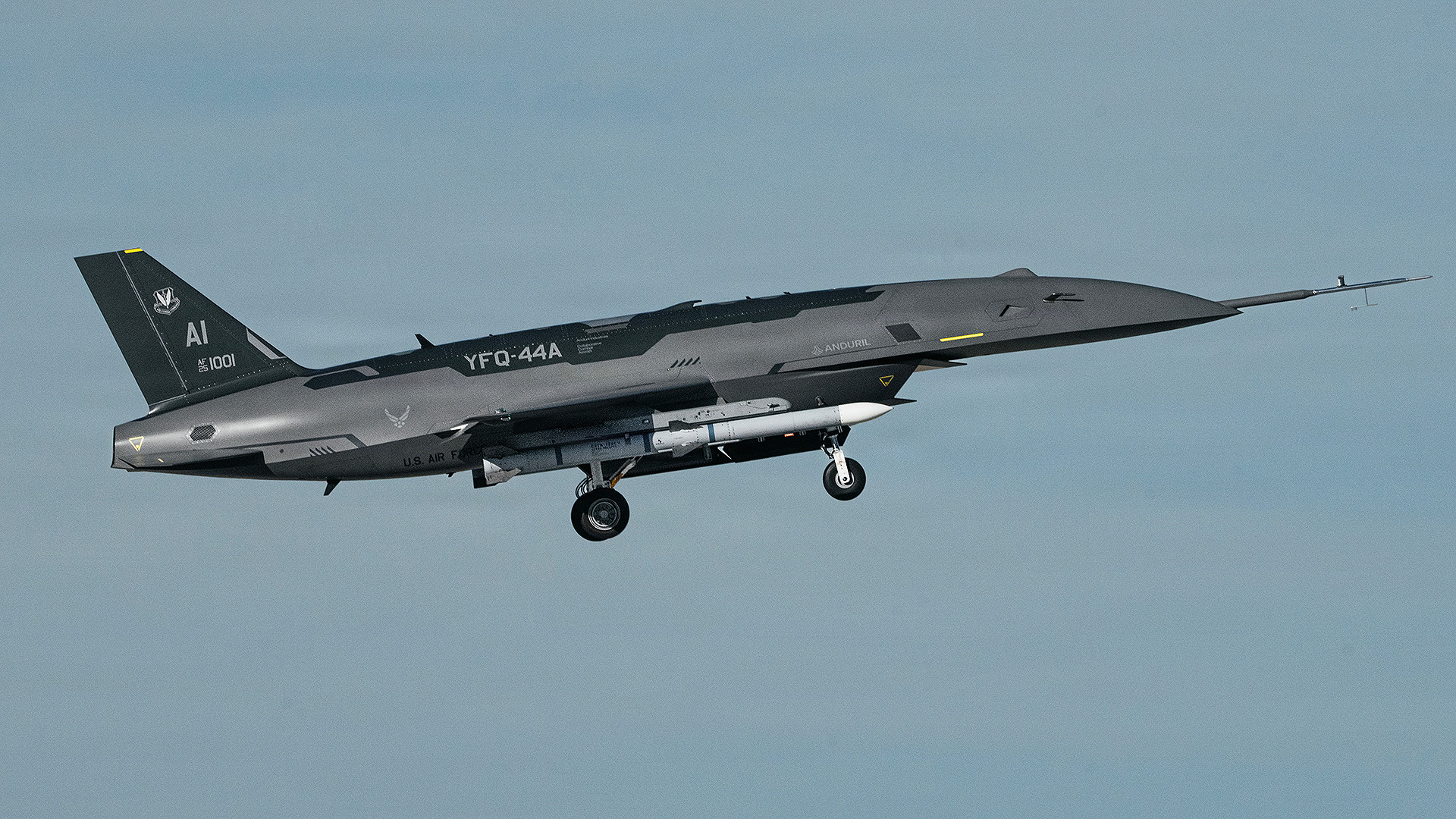
The U.S. Air Force has given us our first look at one of Anduril’s YFQ-44 Fury ‘fighter drone’ prototypes carrying an inert AIM-120 Advanced Medium Range Air-to-Air Missile (AMRAAM).
“The Air Force has entered the next phase of developmental testing for its Collaborative Combat Aircraft (CCA) program, initiating disciplined weapons integration and captive carry evaluations using inert test munitions to validate airworthiness, safety, and systems performance,” according to an Air Force press release put out this evening. “This milestone represents a deliberate step forward in integrating CCA into the Air Force’s future force design.”
“CCA program officials emphasized that this phase remains developmental and focused on safe systems integration — not operational employment,” the release also noted. “The use of inert test weapons allows engineers and test pilots to evaluate performance characteristics and separation safety in a controlled environment without live ordnance.”
“Throughout development and testing, a human retains authority over weapons release decisions,” the Air Force has also stressed. “CCA is designed to operate within established command structures and legal frameworks that govern all Air Force weapons systems.”
Air Force Chief of Staff Gen. Kenneth Wilsbach first announced this new development at the Air & Space Forces Association’s annual Warfare Symposium, at which TWZ is attendence. The YFQ-44 is one of two designs now under development as part of the first phase, or Increment 1, of the service’s CCA program. The other is General Atomics’ YFQ-42A Dark Merlin. No images have yet been released of the YFQ-42A carrying inert munitions.
Renderings have previously been shown of Fury carrying AIM-120s under its wings. The design, at least as it exists now, does not have an internal munitions bay. Anduril has also talked about weapons testing as part of its larger plans for the ongoing development of the YQ-44A in the past.
“We are following the same detailed approach used in every other aircraft developmental test program to validate structural performance, flight characteristics and safe separation,” Wilsbach said in a statement accompanying the release. “This ensures the CCA can safely integrate inert weapons before future employment.”
“CCA is a critical part of a larger, integrated system-of-systems that will give our warfighters the overwhelming advantage,” Wilsbach added. “This program is about delivering a network of effects that will sense, strike, and shield our forces in contested environments. We are empowering our teams to take smart risks and deliver this capability faster, ensuring we can deter, and if necessary, defeat any adversary.”
What other munitions beyond the AIM-120 may be included in the weapons integration and captive carry test plan remains to be seen. The Air Force has said in the past that future operational CCA drones are expected to be armed with AIM-260 Joint Advanced Tactical Missiles (JATM). JATM, which is still in development, is the planned successor to the AMRAAM.
The Air Force is not the first to fly a CCA-type drone with an AIM-120. Australian authorities, together with Boeing, announced the first live test shot of an AMRAAM from an MQ-28 Ghost Bat drone in December. You can read more about that milestone here.
In November, Turkish drone-maker Baykar had also announced a similar test involving its fighter-like Kizilelma. The drone fired a Turkish-made radar-guided Gökdoğan air-to-air missile in that instance.
The beginning of weapons integration and captive carry testing is still an important development for the U.S. Air Force CCA program, and Increment 1 more specifically. Both the YFQ-42A and YFQ-44A only made their first flights in the second half of last year.
Carrying air-to-air missiles is exactly what these drones were intended to do, at least to start. CCAs will also help increase the sensor reach of crewed fighters they’re teamed with. Overall, the Air Force sees CCAs as providing critical combat mass while helping to reduce risk and providing new tactical possibilities, especially potential high-end fights against opponents such as China.
The Air Force has yet to decide which Increment 1 CCA, or both, it wants to buy in larger numbers. Whatever the Air Force chooses will be set to become its first operational ‘fighter drones’ intended to carry live munitions into real combat alongside crewed companions.
Contact the author: joe@twz.com
Officials are looking into a report that the missile failed after being launched at a drone, slamming into a residence instead.
By Howard Altman
Manufacturer Raytheon continues to get longer reach out of its AIM-120 Advanced Medium-Range Air-to-Air Missile, while its AIM-260 successor waits in the wings.
By Thomas Newdick
Weekly insights and analysis on the latest developments in military technology, strategy, and foreign policy.
By signing up you agree to our Terms of Service and Privacy Policy.
By Thomas Newdick
By Thomas Newdick
By Joseph Trevithick
By Howard Altman, Tyler Rogoway
By Howard Altman
By Joseph Trevithick
By Joseph Trevithick
By Joseph Trevithick
By Joseph Trevithick
By Thomas Newdick, Tyler Rogoway
By Joseph Trevithick
By Thomas Newdick
By Thomas Newdick
By Joseph Trevithick
By Tyler Rogoway, Joseph Trevithick
By Joseph Trevithick
By Thomas Newdick
By Joseph Trevithick
By Joseph Trevithick
By Joseph Trevithick
By Thomas Newdick
By Joseph Trevithick
By Thomas Newdick
By Joseph Trevithick
By Joseph Trevithick
By Tyler Rogoway
By Tyler Rogoway
By Joseph Trevithick
By Joseph Trevithick
By Joseph Trevithick
By Joseph Trevithick
By Joseph Trevithick