Air Force’s drone wingmen have started flying with weapons
AI Analysis
The U.S. Air Force has commenced armed flight testing with Anduril's YFQ-44A drone wingman, marking a significant step in the Collaborative Combat Aircraft program. This testing involves carrying inert munitions, with live firing tests planned for 2026.
Key Takeaways
- Anduril's YFQ-44A drone wingman began armed flight testing with inert munitions.
- The Air Force emphasizes human control over weapons-release decisions.
- General Atomics and Northrop Grumman are also involved in the CCA program.
- The Air Force is integrating autonomy software from RTX Collins and Shield AI.
- A competitive production decision for the CCA program is expected in fiscal year 2026.
Why It Matters
This development signifies a major advancement in drone warfare capabilities, enhancing the U.S. Air Force's operational flexibility and combat effectiveness. The integration of autonomous technologies and collaborative combat aircraft is crucial for maintaining a strategic edge in contested environments.
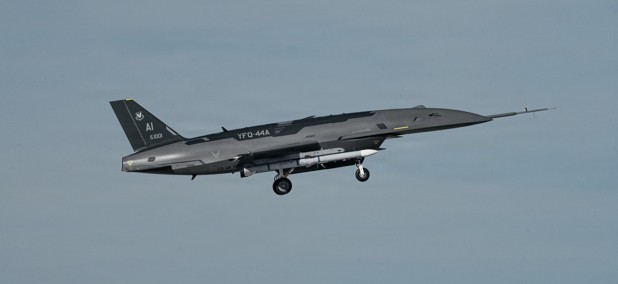
A YFQ-44A, part of the Air Force’s Collaborative Combat Aircraft program, undergoes an undated captive carry test at a California test location.
U.S. Air Force
Stay Connected
Thomas Novelly
AURORA, Colorado—Anduril’s drone wingman started armed flight testing this month, marking the next major milestone for the Air Force’s collaborative combat aircraft program.
The Air Force began captive carry evaluations in February, strapping inert munitions to Anduril’s prototype drone wingman. The weapons have not yet been fired, the service said in a statement, stressing that “a human retains authority over weapons-release decisions.”.
Gen. Kenneth Wilsbach, the Air Force chief of staff, showed an image during his keynote address at the Air and Space Forces Association’s conference Monday evening showing Anduril’s YFQ-44A carrying an AIM-120 advanced medium-range air-to-air missile.
“In close partnership with the U.S. Air Force, we have begun a planned series of flight tests with YFQ-44A involving the captive carriage of inert training munitions,” an Anduril spokesperson told Defense One. “This marks a deliberate, responsible, and necessary step in the aircraft’s development.”
Last fall, Anduril officials told reporters that the company had started integrated weapons testing and planned to start live firing testing in 2026. General Atomics, Anduril, and Northrop Grumman are all in the running to build the Air Force’s first collaborative combat aircraft.
“We are following the same detailed approach used in every other aircraft developmental test program to validate structural performance, flight characteristics, and safe separation,” Wilsbach said in a statement. “This ensures the CCA can safely integrate inert weapons before future employment.”
Both Anduril and General Atomics’ prototypes have notched their first flights. Northrop is planning a first flight for its drone wingman this year.
News of the weapons integration testing follows a service announcement this month that the Air Force had used the government-owned Autonomy Government Reference Architecture to integrate RTX Collins software aboard General Atomics’ YFQ-42 CCA aircraft and Shield AI’s technology on Anduril's YFQ-44 CCA.
General Atomics said earlier this month that it had logged another semi-autonomous flight on its YFQ-42 drone wingman with RTX Collins’ autonomy software onboard. Anduril has not flown a semi-automous flight with Shield AI, but plans to “very soon,” a company spokesman said.
C. Mark Brinkley, a General Atomics company spokesperson, declined to comment when asked if the company’s CCA had begun integrated weapons testing.
“General Atomics has been integrating weapons for decades,” Brinkley told Defense One. “We’ve fired air-to-ground missiles, air-to-air missiles, bombs of various sizes, loitering munitions, and air-launched effects. Weapons from the wings and weapons from the internal bay. No one wonders if we can put steel on target.”
A competitive Increment 1 production decision is expected in fiscal year 2026, the Air Force has previously said.
“CCA is a critical part of a larger, integrated system-of-systems that will give our warfighters the overwhelming advantage," Wilsbach said in a news release. "This program is about delivering a network of effects that will sense, strike, and shield our forces in contested environments. We are empowering our teams to take smart risks and deliver this capability faster, ensuring we can deter, and if necessary, defeat any adversary."
Editor's note: This story has been updated to clarify a General Atomics spokesperson’s comments.
NEXT STORY:
Air Force reaches deal with Northrop to expand B-21 production