Historic First: Ukrainian FPV Drones Destroy Russia’s $15M Solntsepyok on Russian Soil, Take Out Msta‑S Howitzer
AI Analysis
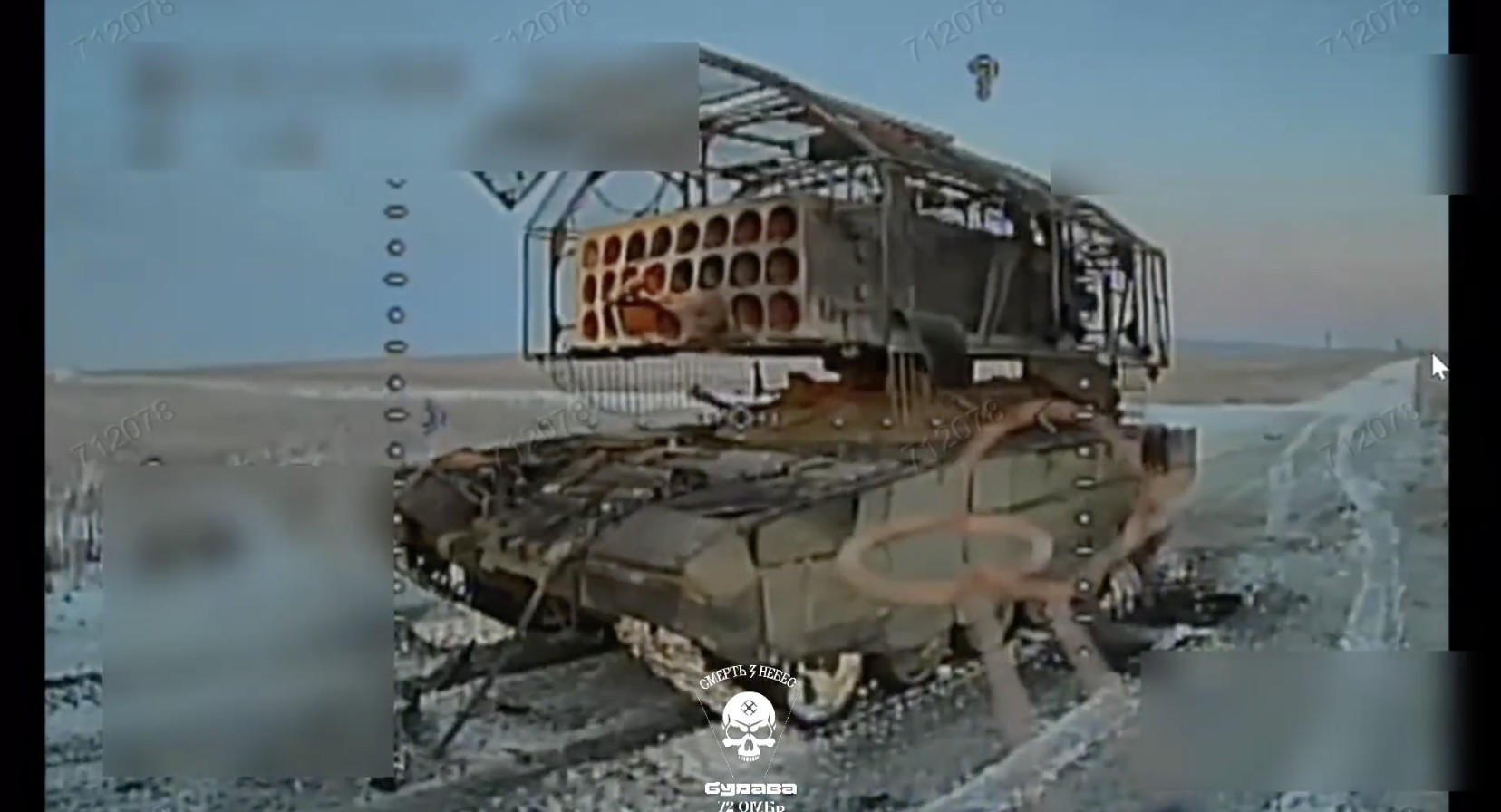
Ukrainian FPV drones from the 72nd Mechanized Brigade successfully destroyed a Russian TOС‑1A Solntsepyok thermobaric rocket launcher and a Msta‑S howitzer in Russia's Belgorod region. This marks the first confirmed destruction of a Solntsepyok on Russian soil, showcasing the effectiveness of Ukraine's drone warfare capabilities.
Key Takeaways
- Ukrainian FPV drones destroyed a Russian TOС‑1A Solntsepyok thermobaric rocket launcher on Russian territory for the first time.
- The attack occurred in the Belgorod region, just across the Ukrainian border.
- The Solntsepyok was hit four times, causing a massive detonation of its ammunition and complete destruction of the system.
- A follow-up strike targeted a nearby Russian Msta‑S self-propelled howitzer, igniting a fire and rendering it inoperable.
- The Solntsepyok, while powerful, is vulnerable due to its large size, light armor, and dangerous munitions, which can pose risks to nearby troops if damaged.
Why It Matters
This operation highlights the increasing role of FPV drones in modern warfare, particularly in targeting high-value assets deep within enemy territory. The destruction of the Solntsepyok on Russian soil not only demonstrates Ukraine's growing drone capabilities but also signals a shift in the conflict's dynamics, with potential implications for Russia's military strategy and morale.
Ukrainian forces have destroyed one of Russia’s most feared weapons – the TOС‑1A Solntsepyok thermobaric rocket launcher – for the first time ever on Russian territory.
The strike was carried out by FPV drone pilots of the “Bulava” unmanned systems battalion from Ukraine’s 72nd Mechanized Brigade, named after the Black Zaporozhians.
Follow our coverage of the war on the @Kyivpost_official.
The attack took place in Russia’s Belgorod region, just across the border from Ukraine.
Video released by the unit on Monday shows real‑time footage from first-person view (FPV) drones as they close in on the target.
In the video, the Solntsepyok is hit four times in succession, triggering a massive detonation of its onboard ammunition. The explosion destroys the launcher, estimated to be worth more $10-15 million.
The footage marks the first confirmed destruction of a TOС‑1A inside Russia, a weapon Moscow has long used to bombard Ukrainian military positions and civilian areas with thermobaric rockets.
Ukrainian drones also followed up on a nearby Russian Msta‑S self-propelled howitzer. Several FPV hits ignited a fire inside the 152mm artillery system, with thick smoke pouring from the vehicle.
Footage, posted Tuesday, suggests the crew fled after the initial strike, likely fearing an ammunition explosion. Ukrainian drones continued attacking to ensure the howitzer’s total destruction.
Often mislabeled a “flamethrower,” the TOС‑1A Solntsepyok is in fact a long‑range artillery system firing unguided rockets armed with thermobaric warheads.
These weapons are designed to maximize blast effects rather than fire, creating oxygen depletion and extreme pressure changes capable of rupturing internal organs and causing instant death.
Dubbed “legendary” by Russian propaganda, the system fires salvos of 24 rockets, each weighing more than 200 kilograms (441 pounds), saturating an area roughly 200 by 200 meters.
Russian forces have repeatedly used the weapon to level fortifications and devastate entire neighborhoods in Ukraine.Ukraine also operates several captured Solntsepyok systems, taken during earlier battles.
Since the start of Russia’s full‑scale invasion, Ukraine has destroyed at least 24 Solntsepyok systems, damaged six more, and captured three. More than 250 “Msta‑S” artillery systems have also been destroyed or damaged.
According to Russian officials, Solntsepyok has no direct equivalent anywhere in the world.
Despite its power, Solntsepyok has significant weaknesses. It is large and lightly armored, making it vulnerable to attacks from anti-tank missile systems and grenade launchers.
If the system is damaged, it can also pose a danger to nearby Russian troops due to the nature of its munitions.
For instance, as reported by Kyiv Post, in mid-June of 2024, ammunition from a Solntsepyok thermobaric warhead exploded in Shebekino, a town approximately 7 kilometers (4.3 miles) north of the Russian-Ukrainian border in Belgorod Oblast, killing three Russian soldiers.
Alisa is the Head of News and a correspondent at Kyiv Post, where she leads the newsroom’s coverage of breaking events and global developments. With over seven years of experience in TV journalism, Alisa has reported on international and Ukrainian politics, making complex stories easier to understand. Back in September 2022, Alisa joined the Kyiv Post team.