US base commanders to have more say in defeating drone intrusions
AI Analysis
The Pentagon has updated its counter-UAS policy, granting U.S. military base commanders greater authority to neutralize drone threats beyond traditional base perimeters. Commanders must submit counter-drone defense plans within 60 days and are now allowed to collaborate with federal agencies and contractors to enhance drone defense capabilities.
Key Takeaways
- U.S. military base commanders now have expanded authority to address drone threats beyond base perimeters.
- Unauthorized drone flights near bases are classified as surveillance threats under new Pentagon guidance.
- Commanders must submit counter-drone defense plans within 60 days and conduct regular drills to identify vulnerabilities.
- The policy enables collaboration with federal law enforcement and the use of contractors for counter-drone operations.
- JIATF-401 recently awarded a contract for DroneHunter 4700 systems, which use AI and nets to capture drones midair.
Why It Matters
This policy shift reflects the growing threat posed by drones to U.S. military installations, particularly in surveillance and potential attacks. By empowering base commanders with greater flexibility and resources, the Pentagon aims to enhance real-time response capabilities and strengthen overall base security against evolving drone threats.
All unauthorized drone flights in the vicinity of U.S. military installations have been classed as a surveillance threat in updated guidance released Monday by the Pentagon’s Joint Inter-Agency Task Force 401.
Signed by Defense Secretary Pete Hegseth in December, the guidance aims to create a clear framework for responding to unmanned aerial systems intruding near U.S. military bases.
The guidance allows military installation commanders to have greater authority and flexibility in neutralizing drones flying within sight of protected military areas, according to the release. The new policy also removes previous “fence-line” limitations around the bases, expanding the scope of what was previously considered base perimeters.
“Countering drones does not start and stop at the fence line,“ Brigadier General Matt Ross, director of JIATF-401, said in a release. ”With this new guidance installation commanders are empowered to address threats as they develop, and the guidance makes clear that unauthorized drone flights are a surveillance threat even before they breach an installation perimeter.”
Installation commanders are required to submit counter-drone defense plans for their bases within 60 days, with additional mandates for regular counter-drone drills and assessments of potential weak spots in base security that adversarial drone operators may exploit.
The guidance also allows installation commanders to share drone tracking information with federal law enforcement agencies. Additionally, it allows commanders to employ contractors to operate counter-drone systems.
The announcement comes amid rising surveillance concerns and drone intrusions near U.S. military bases, with a drone shot down near barracks housing American troops in Estonia last October.
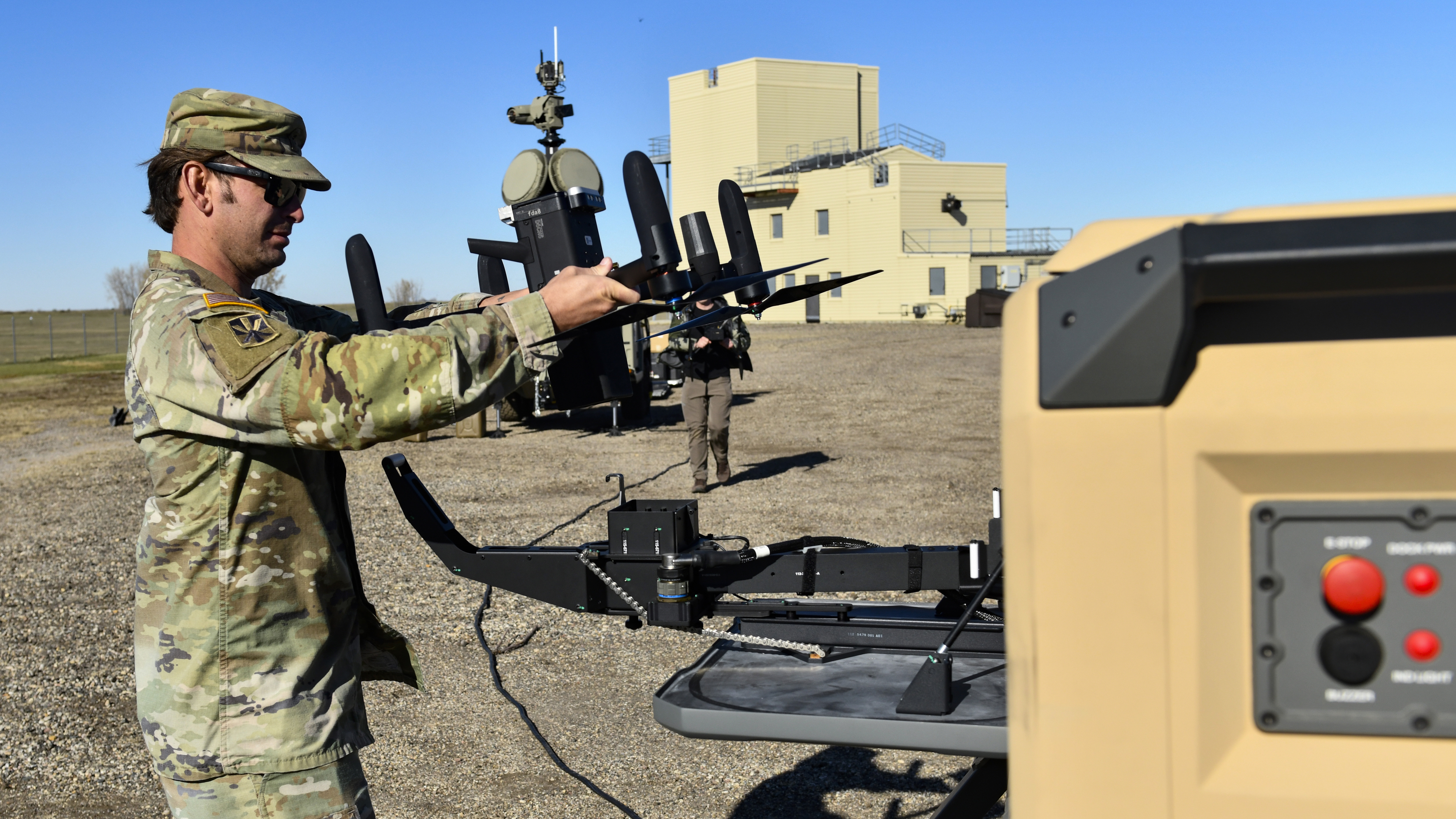
Earlier this month, JIATF-401 made a contract award for two of the DroneHunter 4700 system, which pursues and captures other drones in midair using artificial intelligence and nets.
Zita Ballinger Fletcher previously served as editor of Military History Quarterly and Vietnam magazines and as the historian of the U.S. Drug Enforcement Administration. She holds an M.A. with distinction in military history.