The Pentagon leans into drone swarms with a $100M challenge
AI Analysis
The Pentagon has launched the Orchestrator Prize Challenge, offering up to $100 million to develop technologies that enable commanders to control swarms of drones using plain language commands. This initiative aims to integrate autonomous drones from different manufacturers into cohesive, scalable, and human-supervised operations.
Key Takeaways
- The Defense Innovation Unit announced the Orchestrator Prize Challenge to improve drone swarm command capabilities.
- The challenge focuses on plain language control of autonomous drones rather than traditional programming or menu-based systems.
- The initiative is part of the Defense Autonomous Warfare Group (DAWG), a rebranding of the Replicator initiative.
- The Pentagon seeks to address the challenge of integrating drones from different manufacturers into a unified, vehicle-agnostic system.
- The effort reflects a shift toward scalable, autonomous swarm robotics for military applications, with a focus on human oversight.
Why It Matters
This initiative highlights the U.S. military's focus on advancing drone swarm capabilities, which are critical for maintaining technological superiority in modern warfare. By enabling seamless integration and command of autonomous systems, the Pentagon aims to enhance operational efficiency and address challenges posed by adversaries like Ukraine's extensive use of drones.
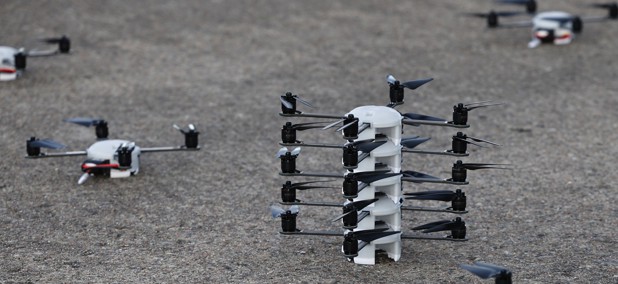
Target drones made by Michigan-based Swarm Defense Technologies were on display on November 21, 2025, during the Project Flytrap 4.5 counter-drone exercise at the military training center at Putlos, Germany.
Morris MacMatzen/Getty Images
Stay Connected
Patrick Tucker
The U.S. military wants to make it easy for troops to direct swarms of drones—on land, at sea, or in the air—and is offering vendors up to $100 million to do so.
On Tuesday, the Pentagon’s Defense Innovation Unit announced the Orchestrator Prize Challenge, the latest sign that the military is looking beyond simply buying warbots in bulk toward the larger challenge of giving commanders a way to command groups of different drones from different makers.
“We want orchestrator technologies that allow humans to work the way they already command–through plain language that expresses desired effects, constraints, timing, and priorities—not by clicking through menus or programming behaviors,” said Lt. Gen. Frank Donovan, who leads the Defense Autonomous Warfare Group. The DAWG, essentially a re-branding of the Replicator initiative, is running the challenge along with DIU and the Navy.
Replicator sought to procure thousands of small, highly autonomous drones quickly but missed a key August goal for delivery. (The bar is set by Ukraine, which last year sent more than a million drones to its frontline units.)
The Pentagon has been hacking away at bureaucratic obstacles that prevent the fast acquisition of drones, but the larger problem is how to make them actually useful to commanders who can’t spare troops to operate one drone at a time, as Ukrainian units do.
Hence the Ender’s Game-like “Orchestrator” challenge, to find a “robust, scalable and vehicle-agnostic capability for understanding, tasking and coordinating autonomous systems at the fleet level.”
The concept of swarm robotics goes back more than 30 years, to this 1995 paper. The Pentagon has been holding multiple-robot challenges, like the Navy’s SWARM and LOCUST events, for more than a decade. But SWARM used about a dozen autonomous boats in very simple naval maneuvers, while LOCUST employed choreographed maneuvers.
The challenge now is to integrate multiple drones capable of autonomous decision-making and to subordinate them to a human, or at least to human judgment (which is a closer reading of the actual Defense Department policy on lethal autonomous weapons).
The end result may be the real test of how well humans and robotic swarms really understand each other.
NEXT STORY:
Quantum cameras could remake space-based intelligence